
Your first night in an RV is something you’ll never forget. It’s exciting, but it can also feel a little overwhelming at the same time.
You’ve spent weeks, maybe even months, picking out the right RV. Comparing models, looking at floor plans, and trying to figure out what would actually work best for your trips. By the time you finally have it, you’re more than ready to start enjoying it.
Then the trip comes together. You’ve spent days, maybe even weeks, getting ready. Watching videos, reading guides, and making sure you didn’t forget anything important. Then you finally pull into your campsite, shut off the engine, and sit there for a second realizing this is actually happening.
What felt like a plan suddenly becomes real life, and that’s when the questions start creeping in. Did I level this right? Is everything hooked up correctly? Why does this feel harder than it looked online?
Even simple things can feel unfamiliar at first. Turning on lights, getting the water running, and figuring out how everything works together takes a little time. The dealer probably went over all of this when you picked up your RV, and at the time it made sense. But between the excitement, all the new information, and just wanting to get on the road, a lot of it doesn’t fully stick.
Most people drive away thinking they’ve got it figured out, only to realize that first night there are still a few things they have to work through. That’s part of the process, not a mistake.
It’s not difficult, it’s just new, and new always feels a bit uncomfortable in the beginning. Once you’ve gone through it once or twice, it starts to feel familiar, and those things that seemed confusing at first become second nature.
You might find yourself checking things more than once, walking around the RV making sure everything looks right, and listening for sounds you don’t recognize. That mix of excitement and uncertainty is completely normal, and every RV owner has been right where you are.
The truth is, your first night in an RV isn’t about getting everything perfect. It’s about learning as you go, slowing down, and figuring things out one step at a time.
Somewhere between setting up, sitting down, and finally relaxing, things start to click. You realize you don’t need to have everything mastered, you just need to get through that first night.
Because once you do, everything gets easier—and a whole lot more enjoyable.
Everything Feels Harder Than You Expected
The first thing most people notice is how long everything takes compared to what they expected. What looked quick and simple in videos suddenly feels slower when you’re the one doing it, and every step seems to take a little more thought than you planned for.
Leveling the RV might take a few tries before it feels right, and hooking up water and power can feel a little awkward the first time. You may find yourself stopping to look things over, stepping back, and double-checking connections just to be sure everything is set up correctly. Even though you understand the basic steps, it still takes time for it all to come together in a way that feels comfortable.
There’s a big difference between watching someone do something and actually doing it yourself. The dealer walkthrough probably made everything seem straightforward, but in the moment, with the excitement of being at the campsite and wanting to get settled in, it’s easy to forget small details. That doesn’t mean you’re doing anything wrong, it just means you’re learning.
You might reposition the RV once or twice to get it sitting right, or realize after you thought you were finished that it’s still slightly off level. Maybe the blocks need to be adjusted, or something just doesn’t feel quite right yet. These small corrections can feel frustrating at first, especially when all you want to do is relax and enjoy the evening.
What most people don’t realize is that this is exactly how the learning process works. No one gets everything perfect on their first try, and those small adjustments are what help everything start to make sense. Each step you go through, even the ones that don’t go smoothly, is building experience for the next time.
As you work through the setup, something starts to shift. The confusion begins to fade, and things that felt complicated at the beginning start to come together. By the time you’re finished, you already understand more than you did when you first pulled into the site.
That’s the turning point.
What felt difficult at the start begins to feel manageable, and the next time you set up, it won’t feel nearly as overwhelming. Each trip builds on the last, and before long, the process that once felt frustrating becomes something you can do with confidence.
You’ll Worry About Things That Don’t Matter
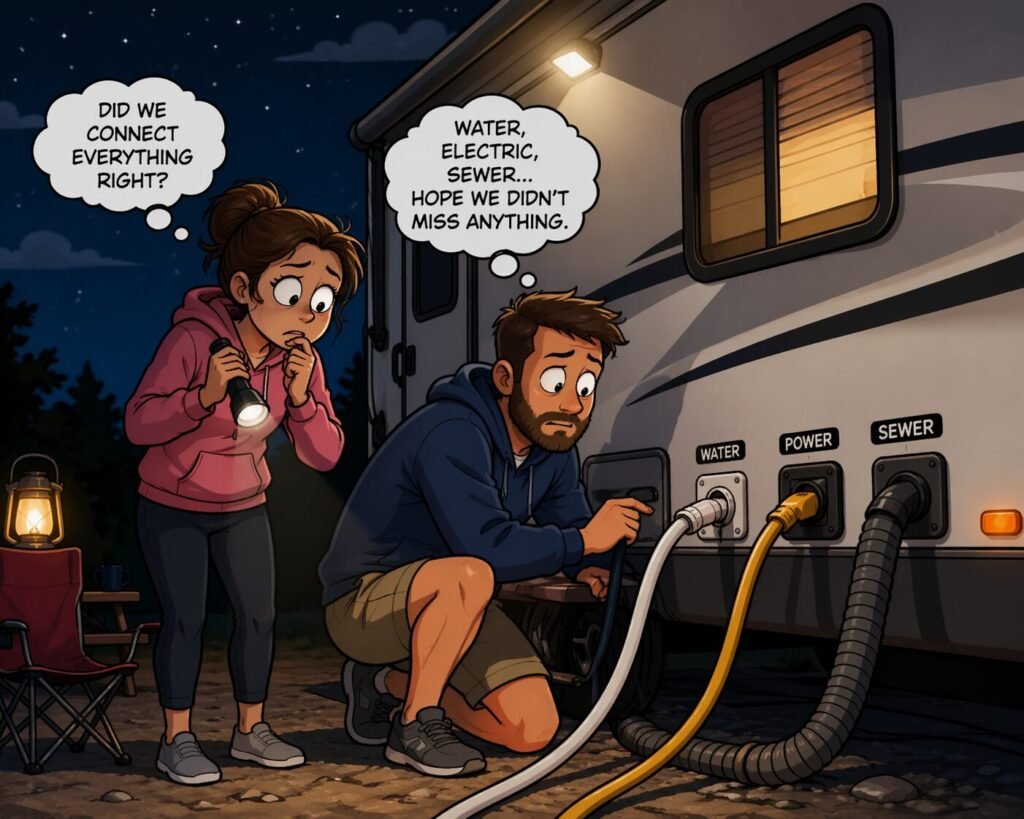
Once everything is set up, your mind doesn’t immediately relax the way you expect it to. Instead, it tends to go in the opposite direction, replaying every step and second-guessing whether everything was done correctly.
You might find yourself going back outside more than once just to check your connections. The power cord gets another look, the water hose gets tightened one more time, and you pause for a second listening for anything that doesn’t sound quite right. Even though everything is most likely fine, it doesn’t always feel that way in the moment. If you’re unsure about campground connections, it can help to review the basics ahead of time, like this guide from National Park Service on campsite setup and safety.
A lot of that comes from the fact that everything is still new. You don’t yet have the experience to confidently say, “this is normal,” so your mind fills in the gaps with doubt. Small things start to feel bigger than they really are, simply because you haven’t seen them enough times yet.
You might wonder if the water pressure is too high, if the electrical hookup is secure, or if something is going to stop working in the middle of the night. These thoughts are incredibly common, especially on that first trip, and they happen to just about everyone.
The reality is, most of the things you’re worrying about aren’t actually problems. They’re just unfamiliar. The systems in your RV are designed to work together, and as long as everything is connected properly, they tend to be far more reliable than they feel that first night.
As the evening goes on, you start to notice that nothing is going wrong. The lights stay on, the water keeps flowing, and everything continues to work the way it should. That’s when the tension starts to ease a little, and you begin to trust the setup more.
With each trip, that worry fades faster. What feels uncertain the first night becomes routine after a few setups, and the things that once made you second-guess yourself don’t even cross your mind anymore.
That’s part of the transition into RV life. The confidence doesn’t come all at once, it builds quietly through experience, one trip at a time.
Sleep Isn’t What You Expect
When you finally settle in for the night, you expect to relax and fall asleep quickly after a long day. Instead, it often takes a little time for your mind and body to adjust to a completely new environment.
Everything feels different.
The mattress isn’t quite the same as home, the space feels smaller, and every movement inside the RV is more noticeable. When someone walks around, you feel it. When a cabinet closes, you hear it. It’s not uncomfortable, it’s just unfamiliar. Then there are the sounds.
You might hear wind moving through the trees, footsteps from a neighboring campsite, or a vehicle pulling in late at night. Off in the distance, you may hear animals—crickets, owls, maybe even something rustling in the brush. Those sounds can feel louder than expected simply because you’re not used to them yet, and your mind is trying to figure out what’s normal.
Inside the RV, small sounds stand out more too. The hum of a fan, the click of a system turning on or off, or the slight creak of the structure settling can all catch your attention. None of it is a problem, but when it’s your first night, it can feel like a lot.
It’s easy to lay there thinking about everything you did that day, replaying the setup, or wondering if everything outside is still fine. That same mindset from earlier can carry into the night, making it harder to fully relax right away. But something starts to change as the night goes on.
The sounds begin to feel more familiar, your body settles in, and your mind starts to quiet down. What felt strange at first slowly becomes part of the experience. By the next night, you notice a difference. You fall asleep a little faster. The sounds don’t stand out as much. The movement doesn’t feel as noticeable. What once felt unfamiliar starts to feel normal.
That’s part of adjusting to RV life.
Sleep might not be perfect that first night, but it improves quickly. And before long, those same sounds and surroundings that once kept you awake become part of what makes the experience feel unique and even relaxing.
The Little Wins Feel Huge
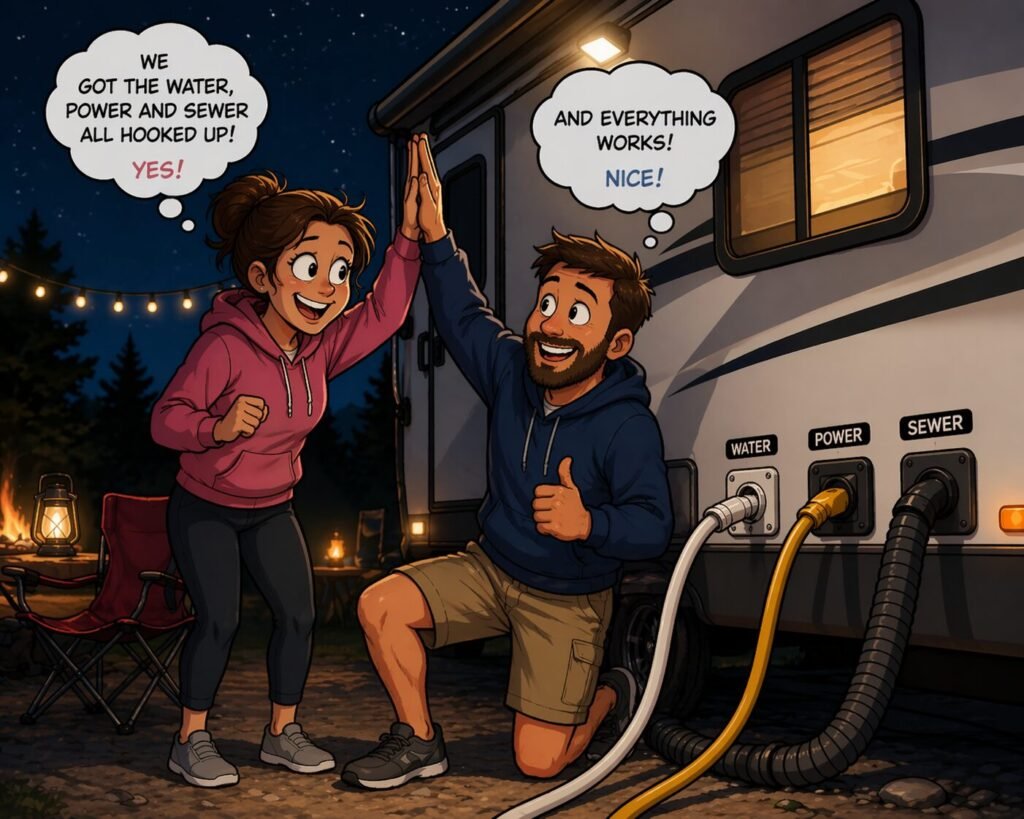
After everything that felt uncertain earlier in the day, something starts to shift once you’re set up and settled in. The stress doesn’t disappear all at once, but it starts to fade, and the small things you figured out along the way begin to feel like real accomplishments.
Getting the RV leveled, even if it took a few tries, feels like a bigger win than you expected. Hooking up the water and power correctly without any issues gives you a sense of confidence that wasn’t there when you first pulled in. Even something as simple as flipping a switch and seeing the lights come on feels different when you know you made it all work.
What seemed confusing just a short time ago starts to make sense. You begin to understand how the systems connect, how things respond, and what normal actually looks like. That understanding, even at a basic level, changes how you feel almost immediately.
Sitting down inside the RV after setup is one of those moments that sticks with you. The space starts to feel less like something unfamiliar and more like something you can settle into. You’re not just figuring it out anymore, you’re starting to get comfortable in it.
If you step outside for a few minutes, maybe to sit by the fire or just take in the quiet around you, it hits a little deeper. The RV is set up, everything is working, and you made it happen. That realization brings a sense of calm that wasn’t there earlier.
There’s also a mental shift that starts to happen. Earlier, you were focused on what might go wrong and whether you were doing everything correctly. Now, your attention shifts toward enjoying where you are and what you’re doing. The pressure eases, and the experience starts to feel more natural.
Those small wins build confidence faster than anything else. Each thing you figure out removes a little bit of uncertainty, and by the end of the night, you already feel more capable than you did when you arrived.
What most people don’t realize is how quickly this adds up. One successful setup leads to another, and before long, the process that once felt overwhelming becomes something you can handle without much thought.
That’s when RVing starts to feel enjoyable instead of stressful.
It’s not about everything going perfectly. It’s about realizing that you can adapt, figure things out, and keep moving forward even when things aren’t perfect. That confidence is what turns a first trip into the beginning of something you actually look forward to doing again.
Something Will Go Wrong (And That’s Okay)
No matter how much you prepare, something will not go exactly as planned on your first night. It might be small, it might be inconvenient, but it’s almost guaranteed to happen at some point.
Maybe the RV isn’t quite as level as you thought after you step inside. Maybe a connection needs to be tightened, or something simple doesn’t work the way you expected. It could be as minor as forgetting an item you thought you packed, or realizing dinner didn’t go quite the way you had in mind.
In the moment, it can feel frustrating.
After spending so much time preparing, it’s easy to expect everything to go smoothly. When something doesn’t, it can feel like you made a mistake or missed something important. That feeling is completely normal, especially when everything is still new.
The reality is, these small issues are part of the process. Every RV owner has had moments like this, especially in the beginning. What feels like a setback is usually just part of learning how everything works in a real-world situation.
Most of the time, the solution is simple. You adjust something, try it again, or figure out a quick workaround. It might take a few extra minutes, but you get through it, and in doing so, you learn something that will make the next trip easier.
That’s where the confidence starts to build.
Each small problem you solve removes a little bit of uncertainty. You begin to realize that even when something doesn’t go perfectly, it’s manageable. You don’t need everything to go right, you just need to be able to handle it when it doesn’t.
Over time, these moments stop feeling like problems at all. They become part of the routine, something you expect and deal with without much thought. What once felt frustrating turns into experience.
And that’s the key.
RVing isn’t about having everything go perfectly every time. It’s about learning how to adapt, adjust, and keep moving forward. The small things that go wrong early on are often the same things that teach you the most.
By the end of that first night, even with a few hiccups, you’ve already gained more experience than you realize. And that experience is what makes the next trip smoother, easier, and a lot more enjoyable.

The Moment It All Clicks
At some point during that first night, everything starts to settle down. The rush of setting up is over, the small worries have faded, and the constant second-guessing finally begins to quiet. The pressure you felt earlier in the day slowly gives way to something calmer.
You’re no longer focused on what might go wrong or whether you did everything perfectly. Instead, your attention shifts to where you are and what you’re experiencing. The checklist in your head disappears, and for the first time since you arrived, you’re not thinking about the next step.
Maybe you’re sitting outside in a chair, looking at the RV with the lights on and the campsite finally set up the way you pictured it. Maybe there’s a fire going, or maybe it’s just quiet with the sounds of the night around you. Either way, it’s a different feeling than anything earlier in the day.
You start to take it in.
All the time you spent researching, planning, and preparing begins to connect with what you’re actually doing in that moment. The RV is no longer just something you looked at, compared, or learned about. It becomes something you’re actively using, something that fits into your life in a real way.
That’s when it clicks.
The stress and uncertainty from earlier don’t disappear completely, but they lose their weight. The small mistakes don’t matter as much, and the things that felt confusing start to feel manageable. You begin to understand that you don’t need to have everything figured out to enjoy the experience.
There’s a shift in perspective that happens here. Instead of focusing on whether everything is perfect, you start to appreciate what you’ve already accomplished. You made it to the campsite, got set up, handled the small issues, and created a space where you can relax.
That realization carries a different kind of confidence. It’s not the confidence of knowing everything, but the confidence of knowing you can figure things out. You’ve already proven that to yourself, and that changes how you look at everything moving forward.
As the night goes on, that feeling settles in even more. The RV starts to feel comfortable, the surroundings feel less unfamiliar, and the experience begins to feel natural instead of forced.
This is the moment most people remember. Not because everything was perfect, but because it was real. It was the first time everything came together enough for you to stop thinking about the process and start enjoying the experience. That’s what makes RVing different.
It’s not about having everything go exactly as planned. It’s about creating moments like this, where things slow down, distractions fade, and you realize why you wanted to do this in the first place. Once that moment happens, something changes.
The next trip doesn’t feel as intimidating. The setup doesn’t feel as overwhelming. The unknown starts to feel familiar, and the experience becomes something you actually look forward to instead of something you’re trying to figure out.
That’s the turning point. It doesn’t happen all at once, and it doesn’t need to. But when it does, you know it—and it’s what keeps people coming back.
What Actually Matters Your First Night
By the time your first night starts to wind down, it becomes clear that a lot of the things you worried about earlier didn’t really matter as much as you thought they would.
You might have spent time trying to get everything perfect, adjusting and rechecking small details, or second-guessing whether you were doing things the right way. That’s a normal part of the experience, but it’s not what actually makes the night successful. What matters most is much simpler than that.
Being safely set up, having your basic hookups working, and creating a space where you can relax is really all you need. Once those essentials are in place, everything else becomes secondary.
It doesn’t matter if the RV isn’t perfectly level on the first try, or if something took longer than expected. It doesn’t matter if you forgot a small item or had to make a quick adjustment along the way. None of those things take away from the experience unless you let them.
What matters is that you made it there and followed through on something you planned. You took the time to choose the right RV, prepared for the trip, and worked through the setup even when it felt unfamiliar. That effort is what makes the experience meaningful, not whether everything went perfectly.
There’s also a shift in how you approach things after that first night. You start to realize that RVing isn’t about precision, it’s about flexibility. Being able to adjust, adapt, and keep moving forward matters far more than getting everything exactly right the first time.
As you relax and look around, the details that once felt important start to fade into the background. What stands out instead is the overall experience, the quiet, the change of environment, and the feeling of being somewhere different on your own terms. That’s what people come back for.
The first night isn’t about proving that you can do everything perfectly. It’s about learning that you don’t have to. Once that clicks, the entire experience becomes more enjoyable and a lot less stressful.
And that’s what actually matters.
Start Here: Make Your First RV Trip Easier