
When your RV breaker keeps tripping, it can quickly turn a relaxing day at the campsite into a frustrating problem. Everything might be working fine at first, then suddenly the power cuts out. The air conditioner shuts off, the microwave stops mid-use, or half your outlets go dead. Resetting the breaker might fix it for a few minutes, but when it keeps happening, it’s clear something isn’t right.
This is one of the most common electrical issues RV owners deal with, especially when using campground hookups. In most cases, the problem isn’t random. Your RV’s electrical system is designed to protect itself, and when a breaker trips, it’s usually because something is pulling more power than the circuit can safely handle. Other times, the issue can come from outside your RV, like unstable campground power, worn-out pedestals, or low voltage that puts extra strain on your system.
Understanding how safe electrical systems are supposed to work can help make sense of these problems, and organizations like the National Electrical Manufacturers Association set the standards that campground equipment is expected to follow.
What makes this confusing is that the cause is not always obvious. You might not be running anything unusual, or everything may have worked fine at the last campsite. Small changes, like plugging into a different power source, adding one extra appliance, or using an adapter, can be enough to push your system past its limit without you realizing it.
The good news is that once you understand how your RV handles power, this problem becomes much easier to diagnose and fix. Most breaker issues come down to a few common causes, and with a simple step-by-step approach, you can figure out what’s happening, fix it quickly, and avoid dealing with it again on your next trip.
Why Your RV Breaker Keeps Tripping
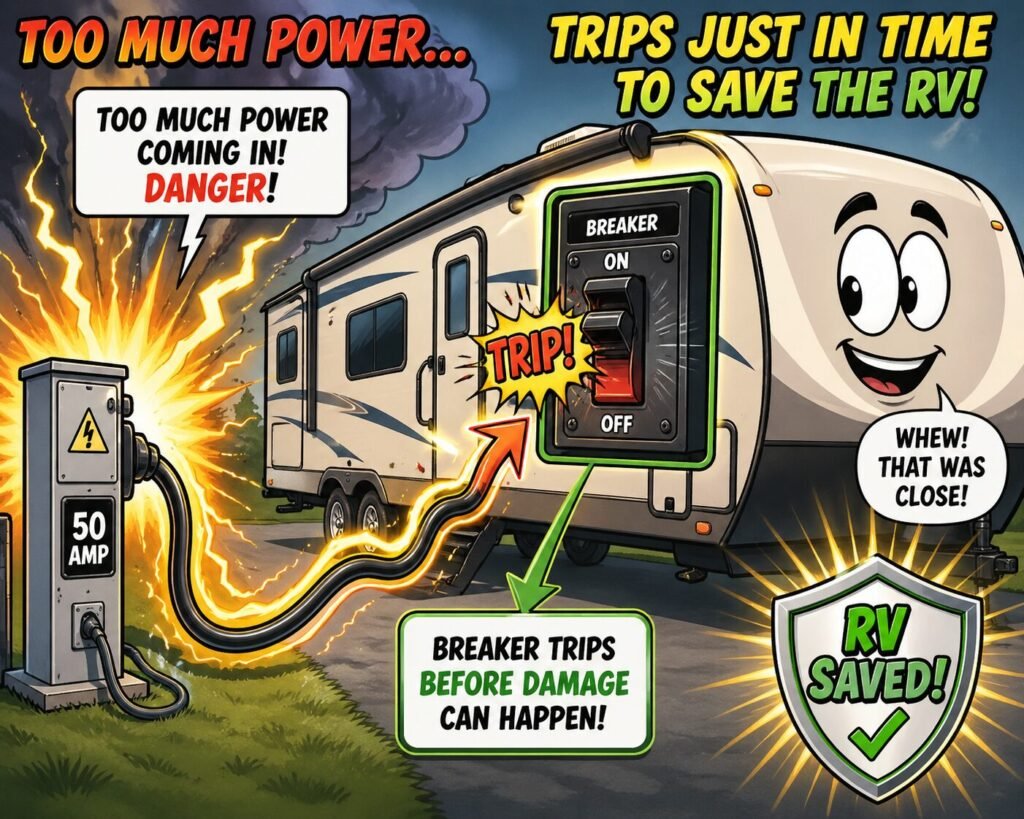
An RV breaker trips when the electrical system is trying to protect itself from damage. When too much power is being used on a circuit, or something isn’t working correctly, the breaker shuts everything off to prevent overheating, wiring damage, or appliance failure.
The most common cause is simply using more power than your RV is designed to handle. Every RV has a limit based on whether it runs on a 30 amp or 50 amp system. Once that limit is reached, even briefly, the breaker will trip to stop the flow of electricity.
This usually happens when multiple high-draw appliances are running at the same time. Air conditioners, microwaves, electric water heaters, coffee makers, hair dryers, and space heaters can all pull significant power. When a few of these are used together, it can quickly exceed what the circuit can safely handle.
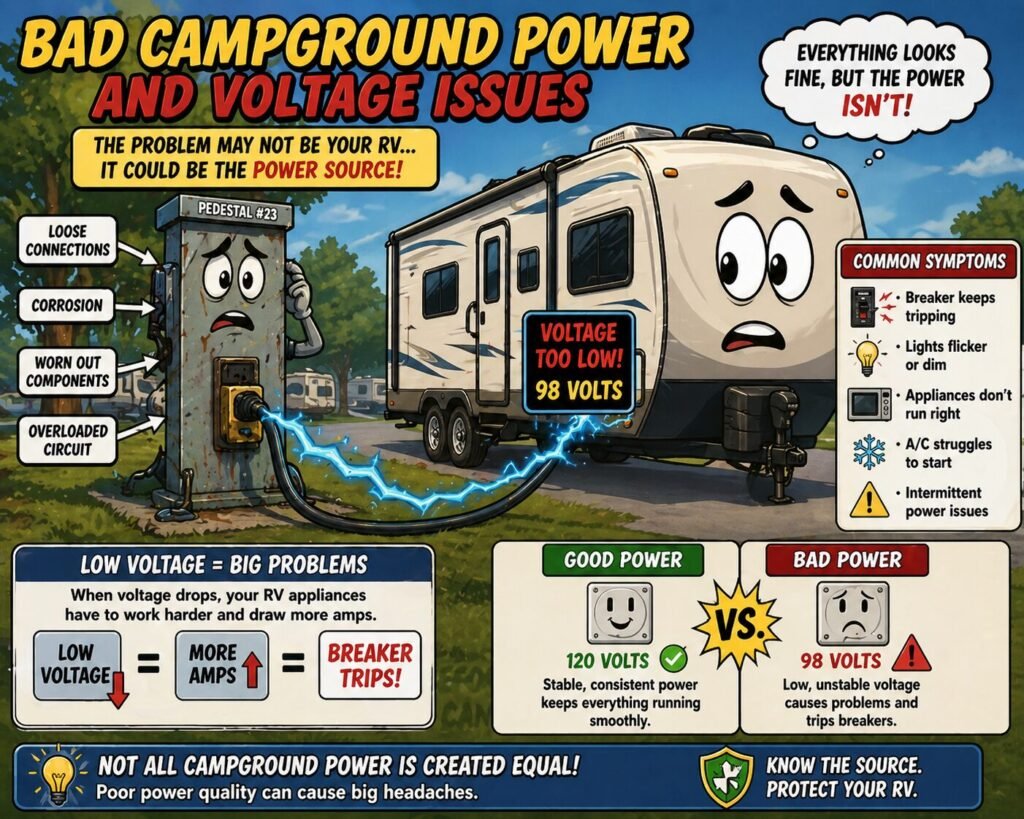
In some cases, the issue isn’t inside your RV at all. Campground power can vary from site to site, and worn or poorly maintained pedestals can deliver inconsistent voltage. When voltage drops, your RV may draw more amps to compensate, which can cause the breaker to trip even if your usage hasn’t changed.
There are also situations where the problem comes from the electrical connection itself. Loose plugs, worn outlets, damaged adapters, or aging breakers can all create resistance or heat, which leads to the breaker shutting things down.
The key to solving the problem is figuring out which of these situations you’re dealing with. Once you understand whether it’s an overload, a power supply issue, or a connection problem, the fix becomes much more straightforward.
30 Amp vs 50 Amp: Where Most Problems Start
One of the most common reasons an RV breaker keeps tripping comes down to how much power your RV actually has available at any given campsite. Not all electrical hookups provide the same capacity, and understanding the difference between 30 amp and 50 amp service is key to avoiding constant breaker issues.
A 30 amp RV system provides a limited amount of power that has to be shared across everything in your rig. That includes your air conditioner, microwave, water heater, outlets, and any other appliances you’re using. It doesn’t take much to reach that limit. Running an air conditioner on a hot day already uses a large portion of your available power. Add a microwave, coffee maker, or space heater, and you can easily push the system past its limit without realizing it.
A 50 amp RV system, on the other hand, is designed to handle much higher electrical demand. It allows multiple large appliances to run at the same time without overloading the system. This is why larger RVs with dual air conditioners and more residential-style appliances are typically built for 50 amp service.
Where things start to cause problems is when the power source doesn’t match what your RV is designed for. A 50 amp RV plugged into a 30 amp outlet using an adapter is one of the most common situations that leads to breakers tripping. Even though your RV is capable of handling more power, it is now restricted to the lower 30 amp supply. Everything may seem fine at first, but the margin for error becomes much smaller.
This becomes even more noticeable when appliances cycle on and off. Air conditioners, in particular, draw a surge of power when they start up. If your system is already close to its limit, that surge can be enough to trip the breaker instantly. This is why the problem often feels inconsistent. It may not trip right away, but it happens as soon as something kicks on at the wrong time.
Another factor many RV owners don’t consider is how small changes in usage can make a difference. Plugging in one extra appliance, switching your water heater to electric mode, or even using a hair dryer can push the system over the edge when you’re already near capacity.
Understanding what type of power you’re connected to and adjusting your usage accordingly is one of the simplest ways to prevent breaker issues. When you know you’re on 30 amp service, it becomes more about managing what runs at the same time rather than expecting everything to work like it would on full 50 amp power.
Running Too Many Appliances at Once
In everyday use, the most common reason an RV breaker keeps tripping is simply running too many appliances at the same time. This is where most RV owners run into trouble, especially if they are not thinking about how much power each item is using.
Large appliances like air conditioners, microwaves, and electric water heaters draw the most power. When one of these is running by itself, your system can usually handle it without a problem. The issue starts when multiple high-draw appliances are running together or cycling on at the same time.
What makes this confusing is that everything may seem to be working fine at first. You might have the air conditioner running, plug in a coffee maker, and nothing happens. Then a few minutes later, the breaker trips unexpectedly. This happens because your system was already close to its limit, and when another appliance turned on or cycled, it pushed the total demand just far enough to trigger the breaker.
Air conditioners are one of the biggest factors in this situation. They do not just draw power while running, they also require a surge of power each time the compressor starts. On a hot day, when the AC is cycling frequently, that repeated surge can easily overload a system that is already near its limit.
Smaller appliances can also add up faster than most people expect. Hair dryers, electric skillets, toasters, and space heaters all draw a surprising amount of power. Even though each one may seem minor on its own, combining them with larger appliances can quickly exceed what your RV is able to handle.
This is why breaker problems often feel inconsistent. It is not always about one single appliance causing the issue. It is usually the combination of everything running at the same time and the timing of when those appliances turn on.
Bad Campground Power and Voltage Issues
Sometimes your RV breaker keeps tripping even when you are not running that much. In those situations, the problem may not be inside your RV at all. It can come from the campground power source.
Not all campground pedestals deliver clean, stable power. Some are older, worn out, or have been used heavily over time. Loose connections, corrosion, or internal wear can all affect how electricity is delivered to your RV. Even if everything looks fine on the outside, the power supply may not be consistent.
One of the biggest issues is low voltage. When voltage drops, your RV appliances have to work harder to operate. To compensate, they draw more amps, which increases the load on your system. This extra demand can cause your breaker to trip, even though you have not changed what you are running inside the RV.
This is why you may notice that everything works perfectly at one campsite but causes problems at another. The difference is often the quality of the power being supplied, not your setup or your appliances.
Another factor is shared campground circuits. During busy times, especially in hot weather, multiple RVs may be pulling power from the same system. As demand increases, voltage can drop across the entire line, creating unstable conditions that lead to tripping breakers and inconsistent performance.
In some cases, the pedestal breaker itself may be weak or worn out. If it has been tripped repeatedly over time, it may become more sensitive and trip more easily than it should.
Understanding that campground power can vary helps explain why breaker problems are not always consistent. If the issue only happens at certain sites, there is a strong chance the power source is part of the problem.
Faulty Breakers, Connections, and Adapters
If your RV breaker keeps tripping even when you are not running much power, the issue may come down to the electrical components themselves. Over time, breakers, plugs, and connections can wear out or develop problems that cause them to trip more easily than they should.
Breakers are mechanical devices, and like anything else, they do not last forever. After repeated use, especially if they have tripped often, they can become weak and start shutting off power sooner than normal. This can make it seem like you have a power problem when the real issue is the breaker itself.
Loose or worn connections are another common cause. If your power cord is not fully seated, or if the campground outlet is worn out, it can create resistance where the connection is made. That resistance generates heat, and heat can trigger a breaker to trip even when the actual power draw is not excessive.
Adapters can also play a role, especially if they are lower quality or have been used heavily. A worn or poorly built adapter may not provide a solid connection, which can lead to inconsistent power flow, overheating, and breaker trips. This is more common when stepping down from 50 amp to 30 amp service, where the connection is already under more strain.
Extension cords add another layer of potential problems. If they are not rated for RV use or are too long, they can cause voltage drop and increase the load on your system. This can lead to overheating and make breakers more likely to trip under normal use.
These types of issues are often overlooked because they are not as obvious as running too many appliances. But if your breaker is tripping without a clear reason, it is worth checking every part of your electrical connection, from the pedestal to your RV, to make sure everything is in good condition and properly connected.
How to Fix It Fast
If your RV breaker keeps tripping, the key is to stop guessing and work through the problem step by step. Most issues can be narrowed down quickly once you understand what to look for.
Start by shutting everything down inside your RV. Turn off the air conditioner, microwave, electric water heater, space heaters, and any other high-draw appliances. This resets the demand on your system and gives you a clean starting point. Once everything is off, go ahead and reset the breaker at the pedestal or inside your RV.
After restoring power, begin turning appliances back on one at a time. Start with your largest load, usually the air conditioner, and give it a minute to run. Then slowly add other items like the refrigerator (if on electric), water heater, or small appliances. This process helps you identify whether the issue is caused by one specific appliance or simply too many things running at once.
Pay attention to timing while you do this. If the breaker trips the moment a specific appliance turns on, that appliance may be drawing too much power or having an issue. If everything runs fine until multiple items are on together, then you are dealing with a load management problem rather than a faulty component.
Next, confirm what type of power source you are connected to. If you are on 30 amp service, your available power is limited, and you will need to manage usage more carefully. If you are in a 50 amp RV but plugged into a 30 amp outlet using an adapter, your system is still limited to that lower capacity, even though everything inside your RV is designed for more.
Take a close look at your power connection at the pedestal. Make sure your plug is fully inserted and not loose. A loose connection can create resistance, which builds heat and can cause breakers to trip even when power usage is normal. Check for any signs of discoloration, melted plastic, or burning smells, which can indicate a bad connection or failing component.
If everything looks good but the breaker continues to trip, try switching to another pedestal if one is available. This is one of the fastest ways to determine whether the issue is coming from your RV or the campground power. If the problem disappears on a different hookup, you are likely dealing with poor or unstable power from the original pedestal.
Another useful step is to reduce your load temporarily and see how your system responds. Try running only one major appliance at a time for a short period. If your breaker holds steady under light use but trips as soon as you increase demand, that confirms the issue is related to power limits rather than a mechanical failure.
If none of these steps solve the problem, you may be dealing with a weak breaker, damaged adapter, or internal electrical issue. At that point, it is worth inspecting your equipment more closely or having the system checked to prevent further damage.
Taking a few minutes to go through this process methodically can save a lot of frustration. Instead of resetting the breaker over and over, you will actually understand what is causing the problem and how to prevent it from happening again.
How to Prevent Your RV Breaker From Tripping Again
Once you figure out what caused your RV breaker to trip, preventing it from happening again usually comes down to understanding how your RV uses power and making a few small adjustments at the campsite. Most of these problems are avoidable once you know your limits and what to watch for.
The first thing to focus on is managing what runs at the same time. If you are on 30 amp service, you cannot run everything like you would at home. High-draw appliances like the air conditioner, microwave, and electric water heater can quickly push your system past its limit when used together. Spreading out appliance use, even by a few minutes, helps keep your total power demand under control.
It also helps to understand which appliances draw the most power and when they cycle on. Air conditioners are a good example. They may run fine for a while, but when the compressor kicks on, it creates a sudden surge in demand. If your system is already near its limit, that surge can trip the breaker without warning.
Using quality electrical equipment plays a big role in preventing problems. A solid power cord, properly rated adapters, and tight connections all help maintain steady power flow. Worn or low-quality components can create resistance and heat, which increases the chances of breaker trips even when your usage seems normal.
This is also where using an electrical management system can make a difference. An EMS monitors the power coming into your RV and can detect issues like low voltage, wiring problems, or unsafe conditions at the pedestal. Instead of letting those problems damage your system or cause repeated breaker trips, it can shut power off before a bigger issue develops. This adds another layer of protection, especially at campgrounds where power quality is inconsistent.
Pay attention to the campground power source as well. Some pedestals simply deliver better power than others. If you notice that your breaker trips more often at certain sites, it may not be your RV at all. Adjusting your usage or moving to a different hookup can solve the problem quickly.
It is also worth checking your connections regularly. Making sure your plug is fully seated and in good condition helps prevent small issues from turning into bigger electrical problems over time.
Preventing breaker issues is less about avoiding electricity and more about understanding how your RV handles it. With a little awareness and the right equipment, you can keep your power stable and avoid dealing with the same problem every time you set up at a new campsite.
Start Here to Avoid RV Electrical Problems