
An RV power adapter, often called a dogbone, is one of those things most new RV owners don’t think about until they actually need it. When you get your first RV, there are a lot of systems to learn, and power hookups are one of the most confusing at the beginning. Everything seems simple when the dealer explains it, but once you’re at a campsite on your own, it can feel very different.
That first time you pull into a campsite, there’s a mix of excitement and hesitation. You get parked, step out, and start going through the setup process. Then you walk over to the power pedestal and realize something doesn’t match. The plug on your RV doesn’t fit the outlet in front of you. After everything you did to prepare, it’s a simple moment like this that can throw you off.
This is where an RV power adapter, often called a dogbone, comes in. It’s one of those small pieces of gear that doesn’t seem important until you actually need it. And when you do, it can be the difference between having power or sitting there trying to figure out your next move. Most beginners don’t even know they need one until they run into this exact situation.
The confusion usually comes from the different types of campground power. You’ll hear terms like 30 amp and 50 amp, and at first, it’s not always clear what that really means or how it affects your setup. It can feel like you’re missing something important, even though the solution is actually pretty simple once you understand it.
The good news is, this is one of the easiest parts of RVing to get comfortable with. Once you know what an RV power adapter does and when to use it, it becomes second nature. It’s just another step in the setup process, and one that gives you a lot more flexibility no matter where you travel.
What an RV Power Adapter (Dogbone) Actually Does
An RV power adapter, commonly called a dogbone because of its shape, is designed to solve one very specific problem: mismatched power connections. Your RV is built to plug into a certain type of outlet, but campgrounds don’t always match that exactly. Instead of being stuck without power, the adapter allows you to connect safely to what’s available.
At its core, the adapter doesn’t change how your RV operates. It simply acts as a bridge between two different plug types. If your RV has a 30 amp plug and the campsite only offers a 50 amp outlet, the dogbone makes that connection possible. The same goes the other way around, although that comes with a few limitations you’ll want to understand.
This is where a lot of confusion comes in for beginners. It’s easy to assume that plugging into a higher amp source means more power is being pushed into your RV, but that’s not how it works. Your RV only draws the amount of power it’s designed to use. The adapter doesn’t force extra electricity into your system, it just allows the connection so your RV can function normally.
Once you understand that, the whole concept becomes much simpler. The adapter isn’t something complicated or risky, it’s just a tool that gives you flexibility. Campgrounds vary, and having the ability to connect no matter what type of outlet is available makes your setup process smoother and a lot less stressful.
Most experienced RV owners keep at least one dogbone adapter on hand for this reason. It’s one of those small items that you may not use every time, but when you need it, you’re really glad you have it.
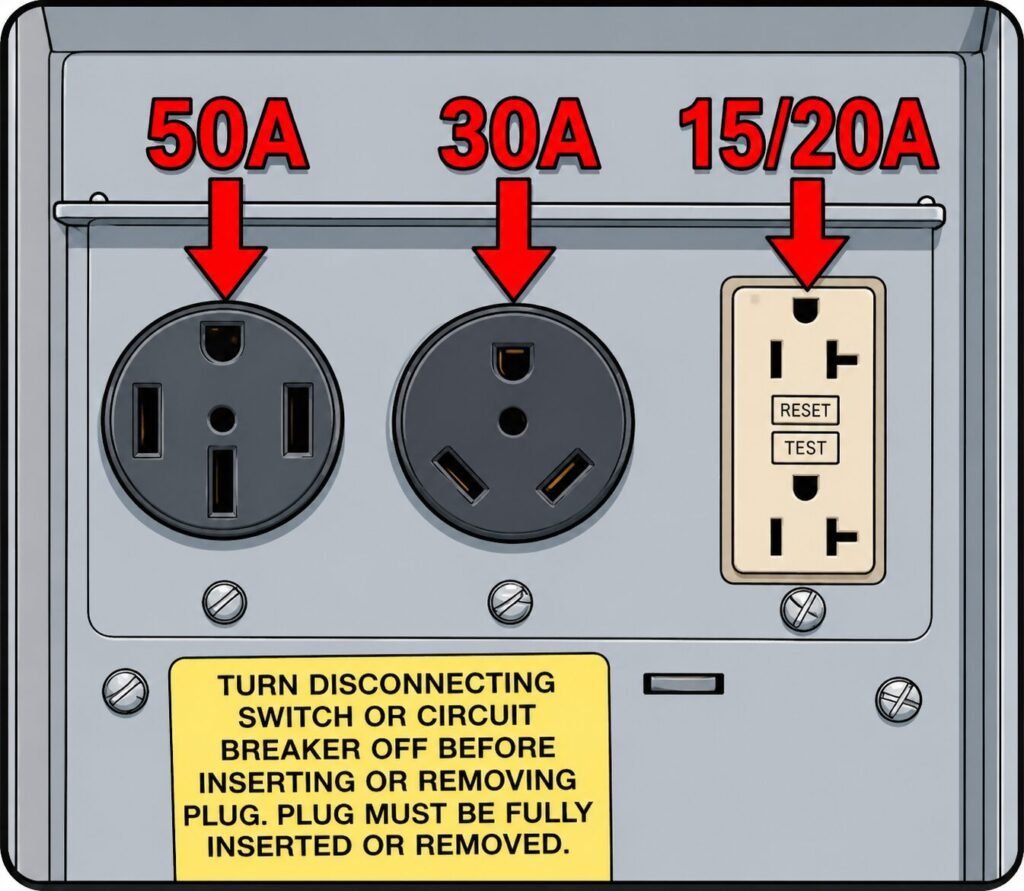
30 Amp vs 50 Amp RV Power Explained (Without the Confusion)
One of the biggest reasons RV power adapters confuse people is the difference between 30 amp and 50 amp service. On the surface, it sounds like one is just “more power” than the other, but the way they’re built and how they supply electricity is actually very different. That’s why understanding this makes everything else start to make sense.
A 30 amp RV uses a single power line and is designed to handle a limited electrical load. This is what you’ll find on many travel trailers and smaller RVs. It’s more than enough for basic use, but you do have to be mindful of how many things you run at the same time. Running the air conditioner, microwave, and a few other appliances together can quickly push it to its limit.
A 50 amp RV, on the other hand, is set up with a split system that provides significantly more available power. It’s not just a small increase, it’s a big jump in what your RV can handle. That’s why larger RVs can run multiple air conditioners, appliances, and electronics all at once without constantly worrying about tripping breakers.
Where this really matters is at the campground. You won’t always get the exact hookup your RV is designed for. Some sites only have 30 amp, others only have 50 amp, and sometimes the one you need is already in use or not available. That’s when your RV power adapter (dogbone) becomes important, because it lets you connect even when things don’t match.
The key thing to remember is that the adapter doesn’t change your RV’s limits. If you’re plugging into a lower power source, you’ll need to adjust how you use your appliances. Once you understand that, it becomes much easier to manage, and you won’t be caught off guard the next time you set up at a new campsite.
You may also come across standard 15 or 20 amp household outlets, especially when plugging in at home or in a driveway. These use the same type of outlet you’d find in a regular house and require a different adapter to connect your RV.
While it’s possible to run your RV this way, the available power is much lower than 30 amp or 50 amp service. This means you’ll be limited to basic functions like charging batteries, running lights, or using a few small appliances. High-demand items like air conditioners or microwaves usually won’t work without tripping a breaker.
It’s useful in certain situations, but it’s not a long-term replacement for proper campground hookups.
30 Amp vs 50 Amp vs 15/20 Amp RV Power (What You Really Need to Know)
This is where a lot of new RV owners get tripped up, because it’s usually explained quickly at the dealership and then forgotten in the excitement. You hear terms like 30 amp and 50 amp and assume it’s just a small difference in power. In reality, these are completely different setups, and understanding them is what makes using an RV power adapter actually make sense.
A 30 amp RV service is the most common for travel trailers and smaller RVs. It runs on a single 120-volt line and gives you about 3,600 watts of usable power. That’s enough for normal use, but you do have limits. You can run your lights, outlets, fridge, and usually one air conditioner, but if you start stacking things like the microwave, coffee maker, and AC all at once, you’ll quickly find those limits. This is why many RV owners learn early on to be mindful of what’s running at the same time.
A 50 amp RV is a completely different system. Instead of one power line, it uses two separate 120-volt lines, which gives you up to 12,000 watts of available power. That’s a huge jump, not just a small upgrade. This is why larger RVs can run multiple air conditioners, electric water heaters, and appliances all at once without constantly worrying about tripping breakers. It’s designed for higher demand and a more “home-like” experience when it comes to power usage.
You may also come across standard 15 or 20 amp household outlets, especially when plugging in at home or in a driveway. These are the same types of outlets used in houses, and you can learn more about how campground electrical hookups work from resources like The National Park Service, which explains what to expect at different campsites.
Where all of this ties together is when you arrive at a campsite and the hookup doesn’t match your RV. This happens more than most people expect. You might have a 30 amp RV and only a 50 amp outlet available, or the other way around. That’s when your RV power adapter (dogbone) becomes important. It allows you to connect to whatever power source is available, even when it doesn’t match your plug.
The key thing to understand is that the adapter does not change how much power your RV can use. It only allows the connection. If you’re plugged into a lower power source, like going from 50 amp down to 30 amp or even 20 amp, you’ll need to manage your usage. That means being more aware of what’s running so you don’t overload the system.
Once this clicks, everything else becomes easier. You stop guessing, you stop worrying about plugging in wrong, and you start to feel more confident setting up at any campground.
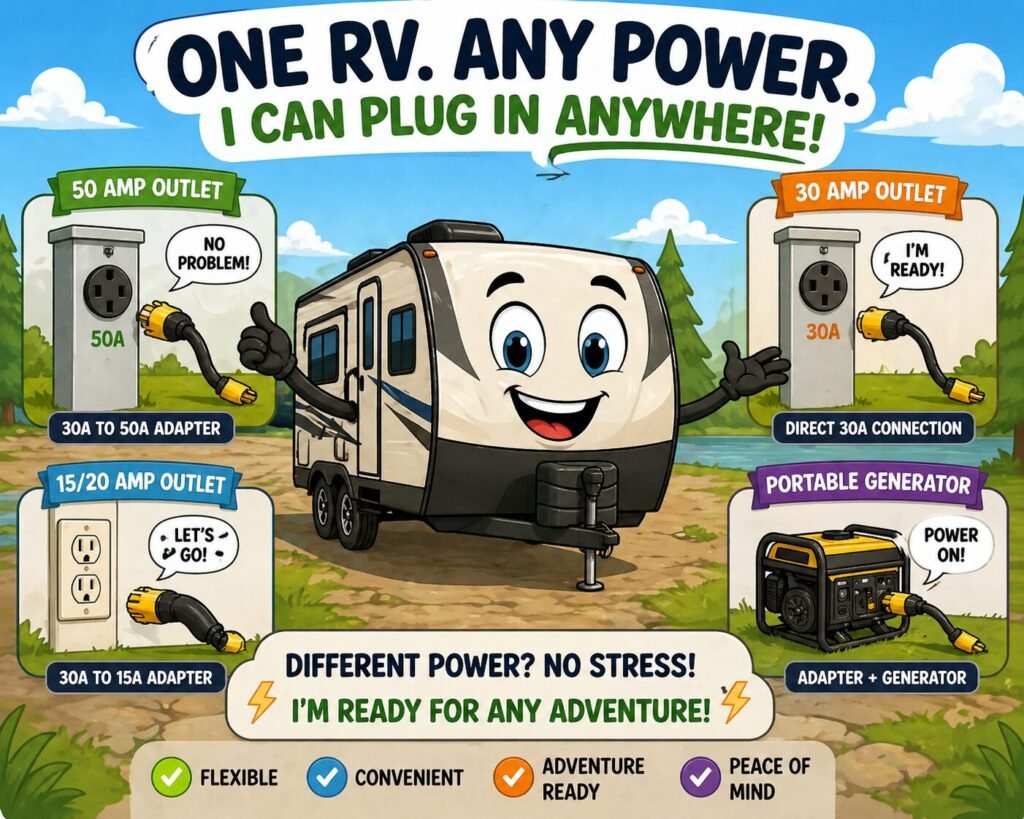
Can You Plug a 30 Amp RV Into 50 Amp? (And What About 15 Amp & Generators)
This is one of the most common questions new RV owners have, and it usually comes up the first time the plug doesn’t match the pedestal. The short answer is yes, you can plug a 30 amp RV into a 50 amp outlet, but you’ll need the right RV power adapter to do it.
A dogbone adapter designed for 30 amp to 50 amp connections allows your RV to safely plug into the larger outlet. Even though the pedestal is capable of supplying more power, your RV will still only draw the 30 amps it’s designed to use. The adapter doesn’t increase power, it simply makes the connection possible. Once you understand that, a lot of the fear around “too much power” goes away.
This setup is very common and generally not something to worry about. In fact, many experienced RV owners prefer using a 50 amp outlet when it’s available because those plugs are often newer and in better condition than heavily used 30 amp outlets. You’re still limited to what your RV can handle, but the connection itself is usually more reliable.
Where things start to change is when you go the other direction. Plugging a 50 amp RV into a 30 amp outlet means you’re now limited to that lower power supply. Everything will still work, but you’ll need to be more aware of what you’re running. High-demand appliances like air conditioners, microwaves, and electric water heaters can quickly push you past that limit and trip a breaker if you’re not careful.
You may also find yourself using a 15 or 20 amp adapter, especially at home or in a driveway. This is a standard household outlet, and it’s useful for basic things like charging your batteries, running lights, or keeping the fridge going before a trip. But it’s very limited. Most air conditioners and larger appliances won’t run on this setup without tripping the breaker, so it’s more of a temporary or maintenance solution than something you rely on for full camping use.
Generators are another place where adapters come into play. Many portable generators are designed with 30 amp RV outlets, but some only have standard household plugs. In those cases, you’ll use a 30 amp to 15 amp adapter to connect your RV. Just like with household power, you’ll be limited by what the generator can produce. Even if the connection works, the available power may only support a few appliances at a time.
Once all of this starts to make sense, your RV power setup becomes a lot less stressful. You’re not guessing anymore, and you’re not worried about plugging into the “wrong” outlet. You understand what each connection provides, what your RV can handle, and how to adjust depending on the situation.
Best RV Power Adapters (Dogbone) to Keep in Your Setup Kit
By now, it’s pretty clear that having the right RV power adapter isn’t just convenient, it’s something you’ll end up using sooner or later. Campgrounds aren’t always consistent, power setups vary, and even at home or on a generator, you’ll run into situations where your plug doesn’t match what’s available.
This is why most experienced RV owners don’t rely on just one adapter. They keep a small set on hand so they’re ready for anything. It takes the guesswork out of setup and saves you from that moment of standing at the pedestal realizing something doesn’t fit.
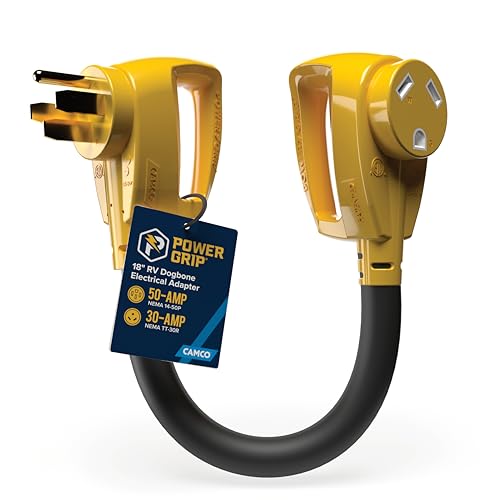
The three most useful adapters to carry cover almost every situation you’ll run into. A 30 amp to 50 amp adapter lets smaller RVs plug into larger campground hookups. A 50 amp to 30 amp adapter is just as important if you ever need to connect a larger RV to limited power. And a 30 amp to 15/20 amp adapter gives you the ability to plug in at home or connect to certain generators when needed.
You don’t need anything complicated, but you do want something reliable. These connections handle real power, and cheaper adapters don’t always hold up well over time. A solid, well-built dogbone adapter will last for years and give you a much more dependable connection at the campsite.
Here are the adapters most RV owners keep on hand

| 
| 
|
$15.49
| $17.58
| $21.99
|
What Actually Matters When It Comes to RV Power
By the time you’ve gone through your first few setups, something starts to shift. What felt confusing at the beginning starts to feel routine. The plugs make sense, the adapters aren’t intimidating anymore, and you stop second guessing every connection you make.
That’s really what all of this comes down to. RV power isn’t complicated once you understand the basics, but it can feel that way in the beginning when everything is new. You’re learning systems, trying to remember what goes where, and hoping you didn’t miss something important. That’s a normal part of the process, and it gets easier faster than most people expect.
What actually matters isn’t having the perfect setup or knowing everything right away. It’s understanding enough to be confident when you pull into a campsite. Knowing what your RV needs, having the right adapters with you, and being able to adjust depending on the situation is what makes the difference.
There will always be small things to figure out along the way. Maybe the pedestal is in rough shape, maybe the power is limited, or maybe you just forget something once in a while. It happens to everyone. The goal isn’t perfection, it’s being prepared enough that those moments don’t turn into problems.
Once you reach that point, something else happens. You stop focusing on the setup and start enjoying where you are. The campsite, the quiet, the routine of being outside—that’s why you got into RVing in the first place. And when your power setup just works without stress, everything else becomes a lot more enjoyable.
If you’re still learning the basics, these guides will help you get your full RV setup dialed in: