
RV fuel costs in 2026 are finally showing a break for RV owners. According to recent national averages from AAA, gas prices have dipped to some of the lowest national averages in years, and diesel — while still higher — has eased off the painful spikes we saw recently. That’s good news for anyone planning miles on the road this season.
But your real fuel cost isn’t just about what the sign says at the pump. It depends on the type of RV you drive, how much weight you’re hauling, your engine, your speed, and even the terrain under your tires. A Super C diesel, a gas Class C, a half-ton towing a travel trailer, and a full-time Class A all burn fuel — and money — in very different ways.
Instead of guessing or using outdated numbers, this guide breaks down real-world MPG ranges, diesel vs gas differences, and honest cost-per-trip math you can use to plan your 2026 travel budget with confidence.
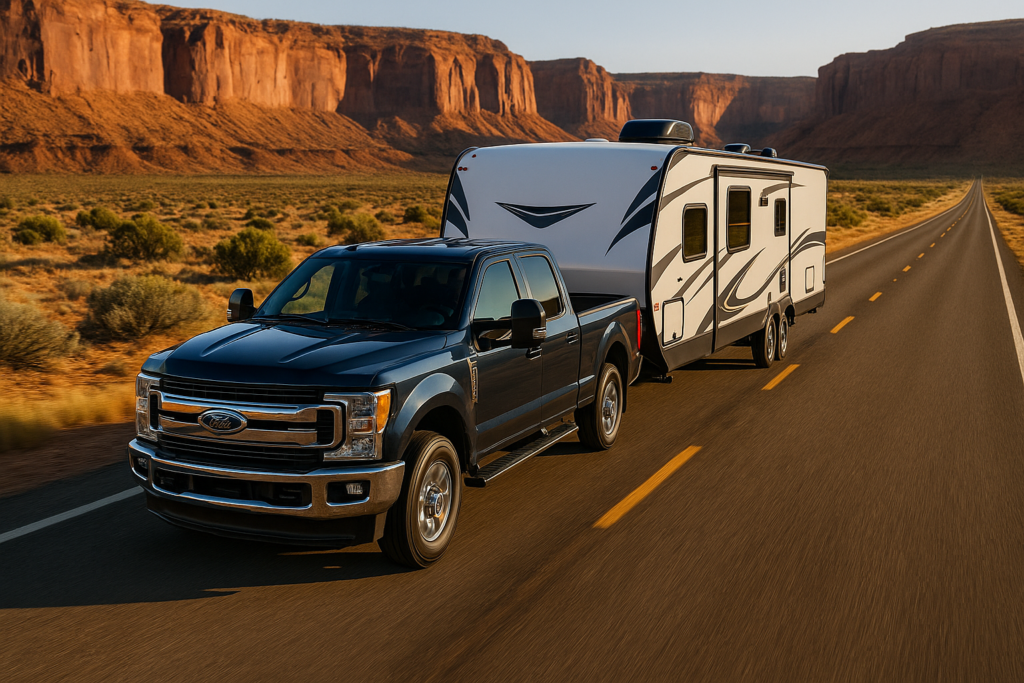
What Really Drives RV Fuel Costs in 2026
RV Fuel costs in 2026 may finally be easing up, but the actual cost of running your RV depends on far more than the number you see on the pump. In 2026, the biggest factors affecting how much you spend on fuel come down to engine type, rig size, weight, driving habits, and wind or terrain—things that matter a lot more than most owners realize.
The biggest variable is the type of RV you drive. A Class A diesel pusher, a gas Class C, a lightweight travel trailer towed by a half-ton pickup, and a Super C hauling a toad all burn fuel differently. Some rigs sip fuel. Some rigs swallow it. And some rigs—like truck campers—land right in the middle because the weight sits forward over the axle, giving better balance and aerodynamics than people expect.
Speed also plays a major role. Pushing a brick-shaped RV through the wind at 72 mph feels convenient, but it costs you real money. Dropping just 5–7 mph can swing your fuel bill dramatically over the course of a trip. The same goes for hills, mountains, and headwinds—your engine works harder, and your wallet feels it.
And finally, how often you move changes everything. A full-timer who travels weekly faces a very different fuel budget than a weekend camper who only makes a handful of trips each season. In other words: the road you choose matters just as much as the RV you choose.
Your RV’s Engine Type
Your engine choice is the single biggest factor in how much fuel you’ll burn on the road. Gas and diesel rigs deliver very different driving experiences, different torque curves, and different MPG ranges — and those differences show up fast in your fuel budget.
Gas engines make their power high in the RPM range, which means you’ll feel the engine working harder on hills, in headwinds, or while towing. They’re perfectly capable, but when a gas motorhome climbs a long grade, it’s drinking fuel at the same time it’s trying to stay in its powerband.
Diesel engines, on the other hand, make their torque low — that big push happens early — which is why diesel rigs pull smoother, hold speed easier on hills, and stay in their efficient RPM range even under load. That’s also why a diesel Class A or Super C usually beats a gas motorhome by 2–4 MPG in real-world driving.
Longevity is another difference that affects long-term costs. A gas engine may last 120,000–180,000 miles with good maintenance, while a diesel can run several hundred thousand miles if cared for properly. That doesn’t change your day-to-day MPG, but it absolutely matters if you plan to keep your rig for years.
The end result is simple:
Gas is cheaper at the pump, diesel gets better MPG, and each one wins in different scenarios.
Your RV fuel costs in 2026 depends heavily on which side of that equation your RV falls into.
How Your RV Weight and Aerodynamics Change Your Fuel Costs
Weight and wind resistance are two of the biggest factors that determine how far your fuel will actually take you. Even with fuel prices easing in 2026, a heavy or poorly aerodynamic setup can burn through your budget faster than you expect.
Lighter rigs — like Class B vans, small travel trailers, and truck campers — naturally sip fuel. They need less power to get moving, they stay planted in their lane without fighting crosswinds as much, and they accelerate without forcing the engine into higher RPM ranges.
On the other end of the spectrum, Class A motorhomes, fifth-wheels, toy haulers, and large travel trailers present a massive flat wall to the wind. That huge surface area increases drag, and every mile per hour over 60 exaggerates the penalty. Even a strong diesel will start gulping fuel when pushing a heavy, tall RV at highway speeds.
And then there’s weight. Every extra pound — gear, water, cargo, tools, even the side-by-side you’re hauling — increases the energy required to get the rig rolling and keep it there. That’s why two owners with the same trailer can see completely different MPG numbers.
If you understand the physics of the wind, and the load your engine is carrying, you understand 90% of what actually drives real-world MPG in 2026.
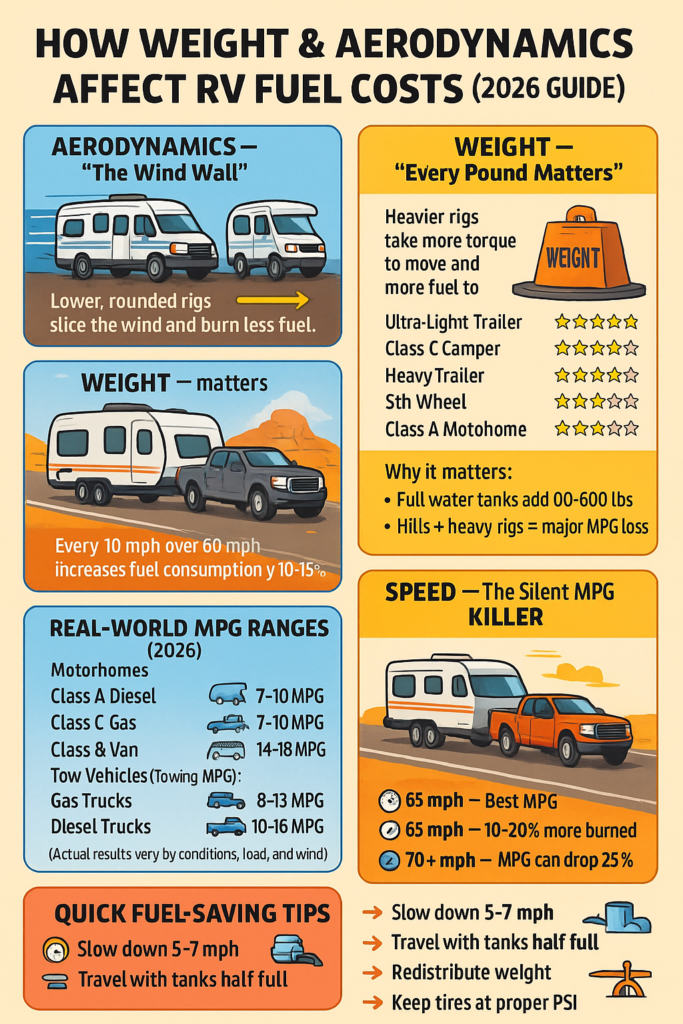
Speed — The Silent MPG Killer
Speed is the one fuel-cost factor every RVer thinks they understand… but most underestimate. Aerodynamic drag doesn’t increase in a straight line — it rises exponentially. Once you push past 60 mph, you’re no longer cruising; you’re punching a hole through the wind.
Even with fuel prices easing in 2026, speed still has a bigger impact on your fuel budget than almost any other variable.
At 55 mph, most rigs — towables and motorhomes — sit in their most efficient power band. But by 65 mph, that comfortable margin disappears. The engine works harder, transmission temps climb, and the RV’s large profile experiences significantly more wind resistance.
Slow down just 5–7 mph and you’ll see an immediate improvement in fuel range, stability, and overall driving comfort.
Real impacts at highway speeds:
- 55 mph → Best possible MPG for most RVs
- 65 mph → 10–20% more fuel burned
- 70+ mph → MPG can drop 25–40%
This is why two nearly identical RVs can have dramatically different fuel costs on the same trip — speed alone can swing fuel expenses by dozens of dollars per tank.
Bottom line: If you want predictable fuel costs in 2026, your right foot matters more than you think.
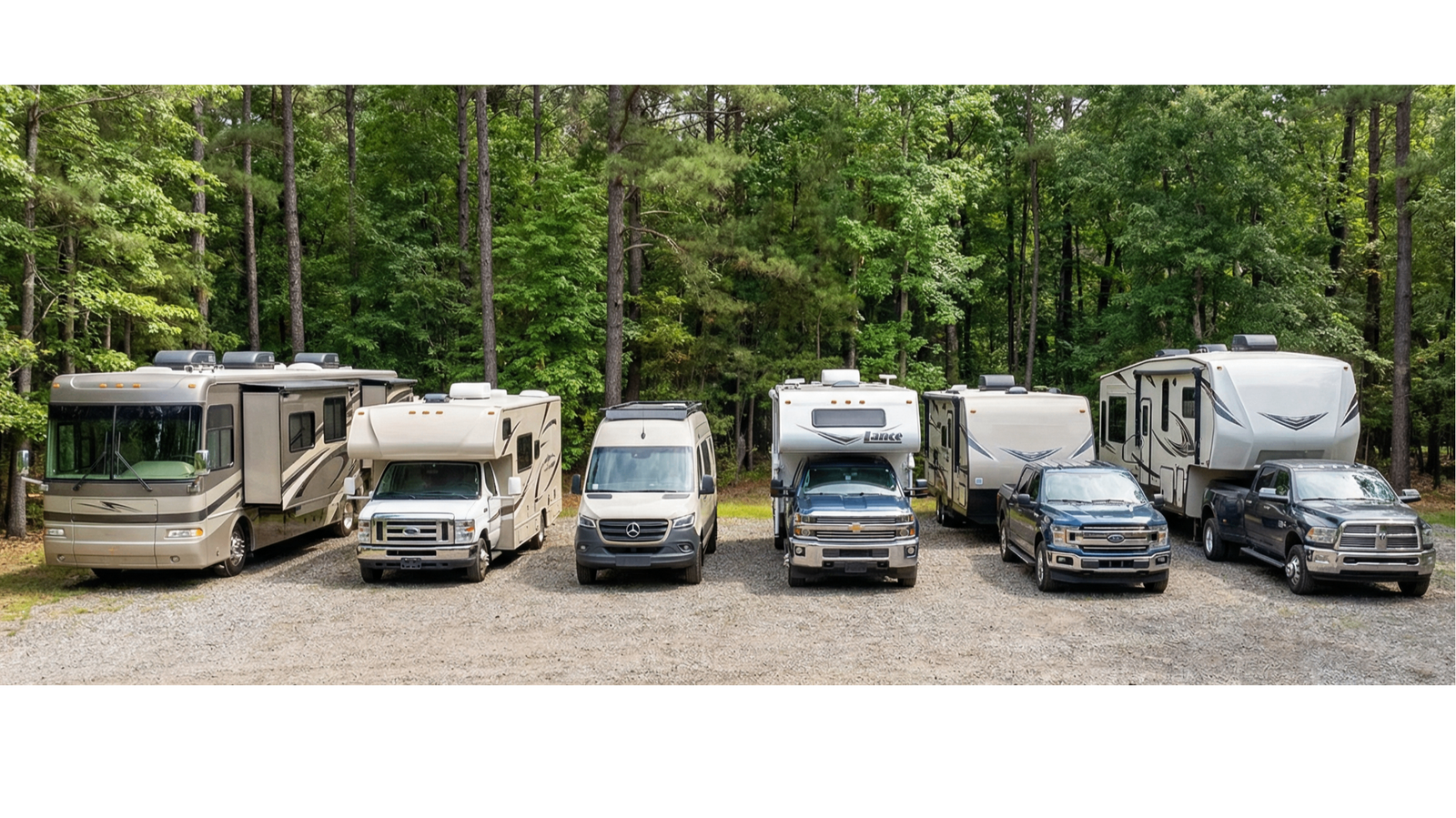
Real-World MPG by RV Type in 2026
After understanding what actually drives RV fuel costs in 2026, the next step is looking at how each RV type performs in the real world. Every class of RV behaves differently once it’s loaded, moving, and fighting wind. A diesel pusher doesn’t burn fuel like a gas Class C. A lightweight travel trailer won’t tow like a tall fifth wheel. And a truck camper — despite its compact footprint — changes a truck’s aerodynamics more than most people expect.
This is where real-world MPG matters more than any EPA estimate or dealer claim. These numbers come from actual RV owners, drivers who spend thousands of miles crossing interstates, mountain passes, deserts, and coastlines. They reflect what happens when the rig is fully packed, tanks fluctuate, winds shift, and terrain changes hour by hour.
The goal here isn’t to chase the perfect MPG number — it’s to understand the true fuel behavior of the RV you drive or plan to buy. When you know the realistic range for your class of RV, you can build a predictable 2026 fuel budget, plan smarter routes, and avoid surprises at the pump.
Below is the accurate, real-world MPG breakdown for every major RV style in 2026, including gas and diesel motorhomes, tow vehicles, truck campers, travel trailers, and fifth wheels.
Class A Motorhomes (Gas vs Diesel)
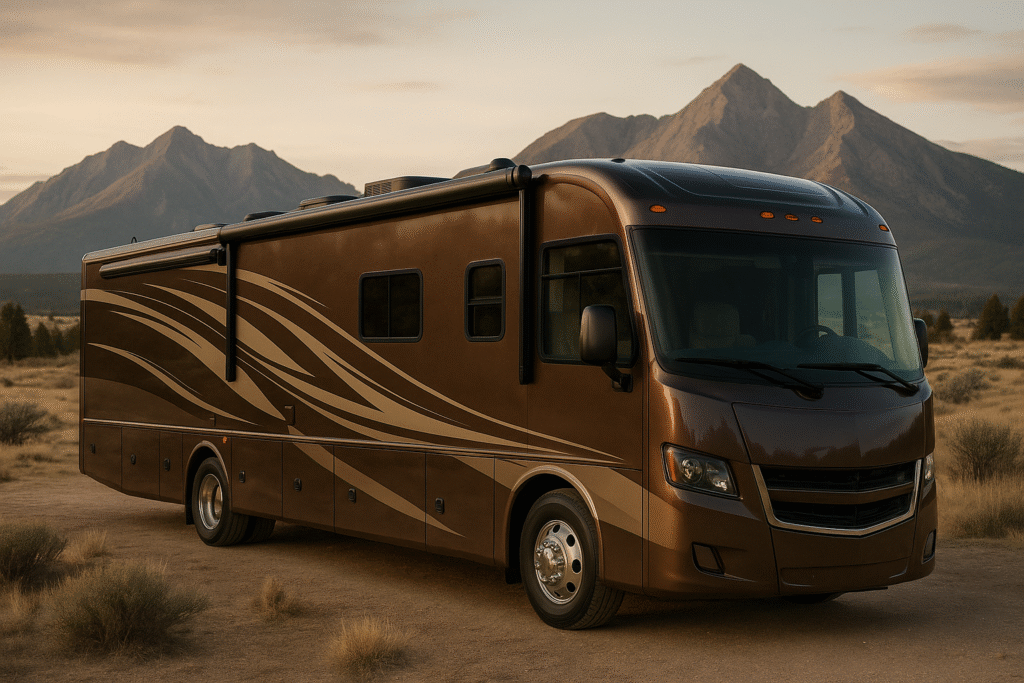
Class A motorhomes are the kings of the road—big, comfortable, quiet, and built for long miles. But all that size comes with a cost. These rigs push more wind than anything else on the highway, and their tall, flat front ends make them the least aerodynamic RVs on the market. That’s why understanding real-world fuel behavior is so important when estimating RV fuel costs in 2026.
Gas Class A MPG (Realistic 2026 Range)
Most gas-powered Class A motorhomes average 6–9 MPG once fully loaded for travel. Hills, headwinds, and heavy cargo can pull that down to 5–6 MPG, while steady cruising at 58–62 mph may let some owners touch 10 MPG on perfect days. These engines work high in the RPM range, and every grade or gust of wind forces them to downshift and burn more fuel.
Diesel Pusher MPG (Realistic 2026 Range)
Diesel pushers generally perform better, with most owners reporting 8–12 MPG. Some smaller or lighter models can reach 13 MPG, but that’s the exception. What diesel rigs offer is consistency—they hold speed better on hills, resist wind loads more efficiently, and stay in their ideal torque range even under heavy load.
This is why diesel pushers often feel smoother and more confident in mountain terrain. The engine isn’t fighting to stay in its powerband the way a gas motor does, and that translates directly into steadier fuel burn.
Fuel Tank Sizes & 2026 Fill-Up Costs
Most Class A motorhomes carry large fuel tanks to support long-distance travel.
- Gas tanks: 75–100 gallons
- Diesel tanks: 90–150 gallons
At 2026 national averages, a full fill-up can range anywhere from $250 to over $500, depending on tank size, fuel type, and regional pricing. This is where even a 1–2 MPG difference can save hundreds of dollars over the course of a long trip.
Why Diesel Usually Wins on Cost-per-Mile
Diesel may cost more per gallon, but diesel rigs often get 2–4 MPG better than gas Class As. Over a 1,200-mile trip, that gap adds up fast. Diesel engines also run cooler and produce power at lower RPMs, which helps maintain efficiency in tough driving conditions.
When comparing RV fuel costs in 2026, diesel pushers typically deliver the lowest cost per mile of any full-size motorhome.
Best Use Case for Class A Motorhomes
Class A motorhomes excel on long-distance highways where comfort and stability matter most. They’re built for travelers who want a smooth, quiet ride and a spacious interior that feels like a rolling apartment. These rigs perform best at steady speeds in the 55–65 mph range, where the engine can settle into a consistent rhythm and deliver predictable fuel behavior. While they’re not the cheapest RVs to operate, Class As offer unmatched luxury and highway confidence, making them the top choice for RVers who prioritize comfort over fuel economy.
Class C Motorhomes

Class C motorhomes strike a balance between size, comfort, and drivability. They’re built on a van or truck chassis, which gives them better aerodynamics and more efficient engines than a Class A, while still providing the living space many families want. Because of that, Class Cs offer some of the most predictable fuel behavior when calculating RV fuel costs in 2026.
Gas Class C MPG (Real-World 2026)
Gas-powered Class C motorhomes typically average 8–11 MPG once loaded with gear, water, and passengers. These rigs weigh less than Class As, but they still fight wind and elevation changes. Long grades or mountain travel can pull MPG down into the high 7s, while steady highway cruising at 58–62 mph may bring you back near the 10–11 MPG mark.
Diesel Class C MPG (Including Super C)
Diesel Class Cs — especially the Super C models built on heavy-duty truck chassis — generally return 11–14 MPG in mixed driving. Their low-end torque helps them stay in the efficient RPM range even on long climbs, and they handle heavy loads far better than gas models.
Some Super Cs towing a vehicle behind them still maintain 10–12 MPG, which is impressive for a rig this size.
How Towing a Toad Changes MPG
Adding a towed vehicle — often called a “toad” in the RV world — has a noticeable impact on fuel efficiency. Most Class C owners lose 1–2 MPG when towing a small SUV or compact car. Heavier or less aerodynamic toads can reduce MPG by 3–4 MPG, especially during mountain travel or in strong headwinds.
Why Class Cs Offer Stable Fuel Costs
Class C motorhomes usually provide more predictable MPG than Class A rigs because of:
- Smaller frontal area
- Lower overall weight
- More aerodynamic body design
- Engines designed for sustained highway travel
- Better efficiency under mixed driving conditions
For families, couples, and full-timers who want consistent cost-per-mile performance, Class Cs hit a sweet spot between power and fuel economy.
Best Use Case for Class C RVs
A Class C is ideal for RVers who want predictable fuel costs without giving up interior space. It offers better MPG stability than a Class A, more room than a Class B, and enough power to handle long trips across mixed terrain. And if you plan to tow a small car for exploring once you set up camp, a Class C handles that job with far less strain than other mid-size motorhomes.
Class Cs aren’t the absolute cheapest rigs to operate, but they deliver one of the best overall balances between comfort, drivability, and 2026 fuel costs.
Class B Motorhomes

Class B motorhomes consistently deliver the best fuel economy in the RV world because everything about their design works with the wind instead of against it. Their smaller surface area creates far less drag than Class A or C motorhomes, and their lightweight construction allows the engine to stay in its efficient power band even when fully loaded. The narrow body cuts down on crosswind resistance, and the absence of slide-outs means less weight and no awkward shapes sticking into the airflow. Combined with engine and transmission pairings engineered for steady highway travel, these factors make Class B vans incredibly fuel-efficient in conditions that can dramatically reduce MPG for larger rigs.
Gas Class B MPG (Realistic 2026 Range)
Gas-powered Class B camper vans typically return 14–18 MPG in mixed driving. Their smaller frontal area allows them to cut through wind far more efficiently than Class A or Class C motorhomes. Light cargo loads, low vehicle height, and highway-friendly transmissions all help keep fuel burn steady.
On flat highway travel at 58–62 mph, many owners regularly see MPG numbers in the upper end of the range.
Diesel Class B MPG (Best in the RV Industry)
Diesel Class B vans lead the entire motorhome category in real-world fuel efficiency. Most achieve 18–22 MPG, even when loaded for travel. Some lighter vans can touch 23–24 MPG under ideal conditions, though that’s on the high end.
These rigs benefit from:
- Strong low-end diesel torque
- Higher-efficiency gear ratios
- Turbocharging optimized for highway performance
- Lower vehicle weight compared to motorhomes with slide-outs
Because diesel engines maintain their efficiency on hills and in headwinds, they provide the most consistent cost-per-mile of any RV type in 2026.
Best Use Case for Class B RVs
A Class B is a great fit for RVers who want the lowest possible fuel costs without giving up mobility. Drivers who prefer a nimble, easy-to-handle RV appreciate how quickly these vans move through traffic, tight campgrounds, and narrow mountain roads. They don’t offer the same interior space as a Class A or C, but they excel at long-distance travel where MPG truly matters. For van lifers, digital nomads, solo travelers, or couples who rack up thousands of miles each season, a Class B provides one of the best overall values when calculating RV fuel costs in 2026.
Truck Campers (Slide-In Campers)
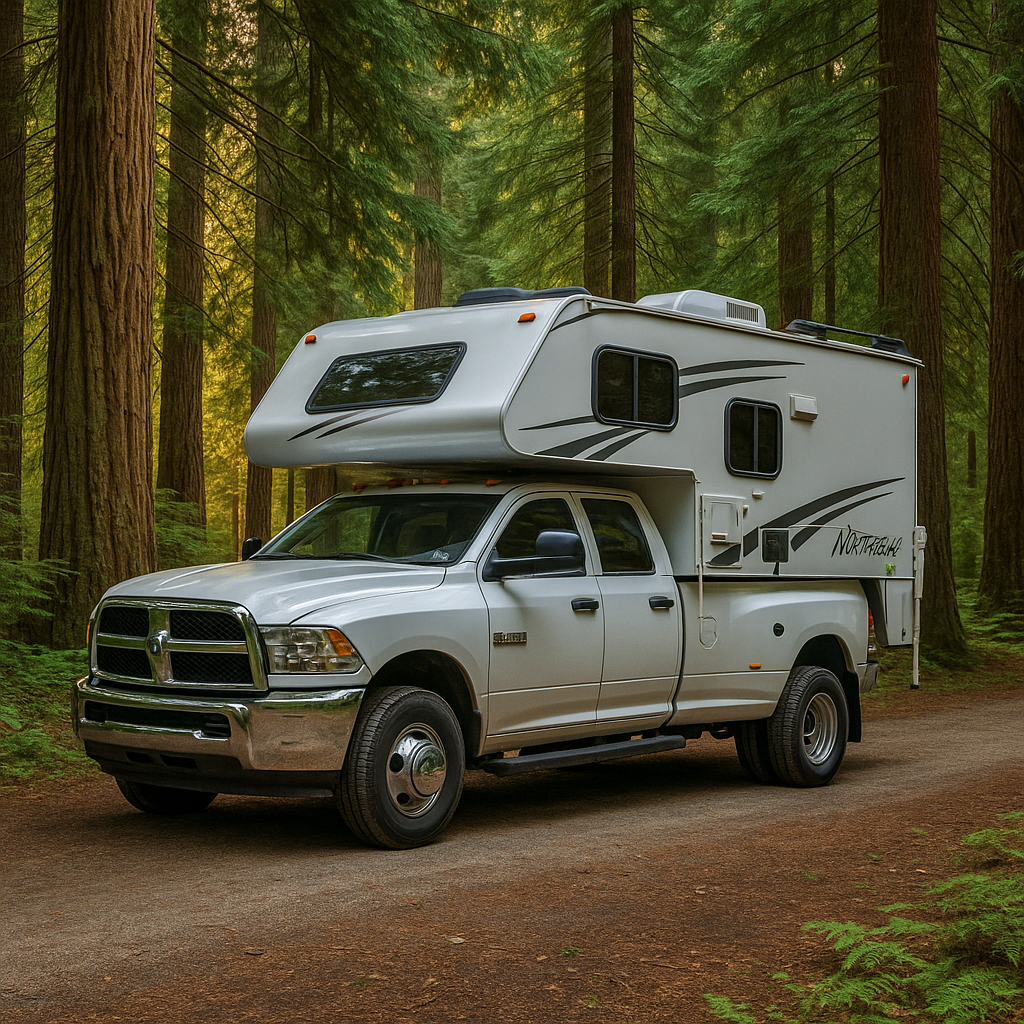
Truck campers are one of the most misunderstood RV setups when it comes to fuel economy. On paper, they appear lightweight compared to towables or motorhomes, and the footprint seems compact. But once the camper is sitting above the bed rails, the aerodynamics change dramatically. The flat leading edge acts like a wind brake at highway speeds, and even powerful gas or diesel trucks feel the extra drag.
Despite this, truck campers often return better MPG numbers than people expect, especially in city or mixed driving. Because the weight sits directly over the rear axle, the truck stays balanced and planted. This reduces the constant downshifting you see with travel trailers and fifth wheels, and it allows the truck to maintain traction on steep grades. Still, when it comes to RV fuel costs in 2026, aerodynamics—not weight—become the deciding factor.
Gas vs. Diesel in Real Truck Camper Use
Gas engines tend to average 8–12 MPG with a camper installed, depending on cab height, roof shape, and wind. Diesel trucks usually perform slightly better, coming in at 10–14 MPG, thanks to lower-RPM torque and more efficient highway gearing. Wind direction, speed, and elevation play a larger role in truck camper MPG than almost any other RV type because the camper sits directly in the airflow.
How a Truck Camper Really Behaves on the Road
Most owners notice that performance changes more with wind than weight. A strong headwind can drop MPG by several points, while a tailwind can suddenly make the truck feel stronger and quieter. On mountain grades, diesel trucks typically hold speed more smoothly, while gas trucks may run at higher RPMs, consuming more fuel. This is normal behavior and part of why truck camper MPG can vary widely between trips.
Who a Truck Camper Is Best For
Truck campers shine for RVers who want the freedom to go places other RVs simply can’t. If you camp deep in national forests, hunt, fish, boondock in rugged areas, or explore rough backroads, nothing matches a truck camper. They’re compact, capable, and easy to park. The trade-off is fuel efficiency at higher speeds, but for travelers who prioritize mobility and access over MPG, the compromise is well worth it.
When calculating RV fuel costs in 2026, truck campers land in the middle of the pack—more efficient than large towables and gas Class As, but less aerodynamic than Class B or C motorhomes. Their fuel behavior is unique, but once you know how they respond to speed and wind, the cost becomes easy to predict.

Camp Outdoor Seat with Lumbar Support and Portable Carry Bag - Lime/Grey
Tow Vehicles for Travel Trailers & Fifth Wheels
Towable RVs introduce more variables into fuel economy than any other RV category because you’re dealing with two completely different aerodynamic shapes traveling as one unit. The tow vehicle provides the power, cooling, braking, and stability, while the trailer contributes weight, wind resistance, and sway forces. When you combine those factors, towing MPG becomes a constantly shifting number influenced by terrain, wind speed, altitude, and trailer design.
Even two identical trucks can return dramatically different MPG depending on what they’re pulling. A long, low-profile travel trailer may slip through the air relatively easily, while a tall fifth wheel with a wide front cap catches the wind like a parachute. That’s why understanding how each tow vehicle category behaves under load is essential when estimating RV fuel costs in 2026.
SUVs — Efficient for Lightweight Travel Trailers
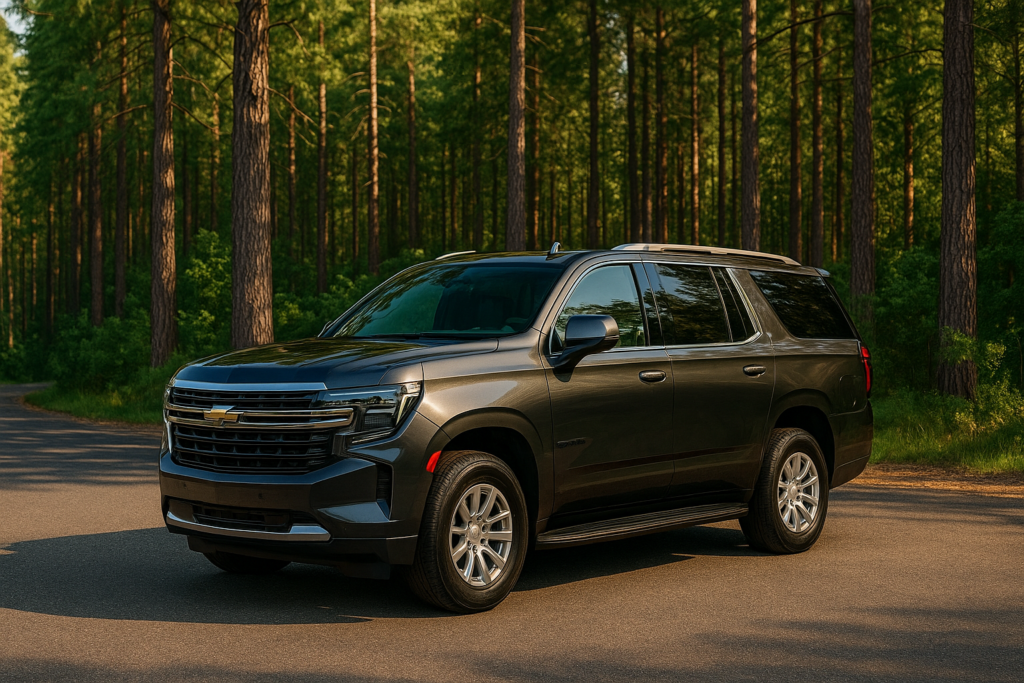
SUVs play a larger role in the towable RV market than many beginners realize. They’re especially popular with families and weekend travelers because they provide a comfortable ride, quiet cabins, and enough torque to handle light- to mid-weight travel trailers. The trade-off is that SUVs have shorter wheelbases and lighter frames than trucks, which means their fuel economy changes more quickly with wind, elevation, and trailer design.
Most mid-size and full-size SUVs towing trailers in the 3,000–5,500 pound range average between 10 and 14 MPG. The final number depends heavily on how the vehicle behaves in real conditions. Shorter SUVs tend to react more sharply to crosswinds, which forces the driver to make more throttle and steering corrections. Gear ratios also play a major role: highway-oriented gearing helps efficiency on flat ground but can make hill climbs more demanding. Cooling capacity matters too, because many SUVs downshift aggressively on long grades to protect the transmission, which increases fuel burn.
The most efficient SUV towing setups pair the vehicle with a trailer that has a rounded, aerodynamic front profile and a balanced interior load. Proper tongue weight—usually in the 10 to 15 percent range—keeps the rig stable and reduces sway, which helps the engine maintain steady speed without unnecessary corrections. When an SUV is matched to the right trailer and kept within its rated limits, it can deliver a surprisingly effective blend of comfort, control, and fuel efficiency for 2026 travel.
Half-Ton Trucks — The Backbone of the Travel Trailer Market
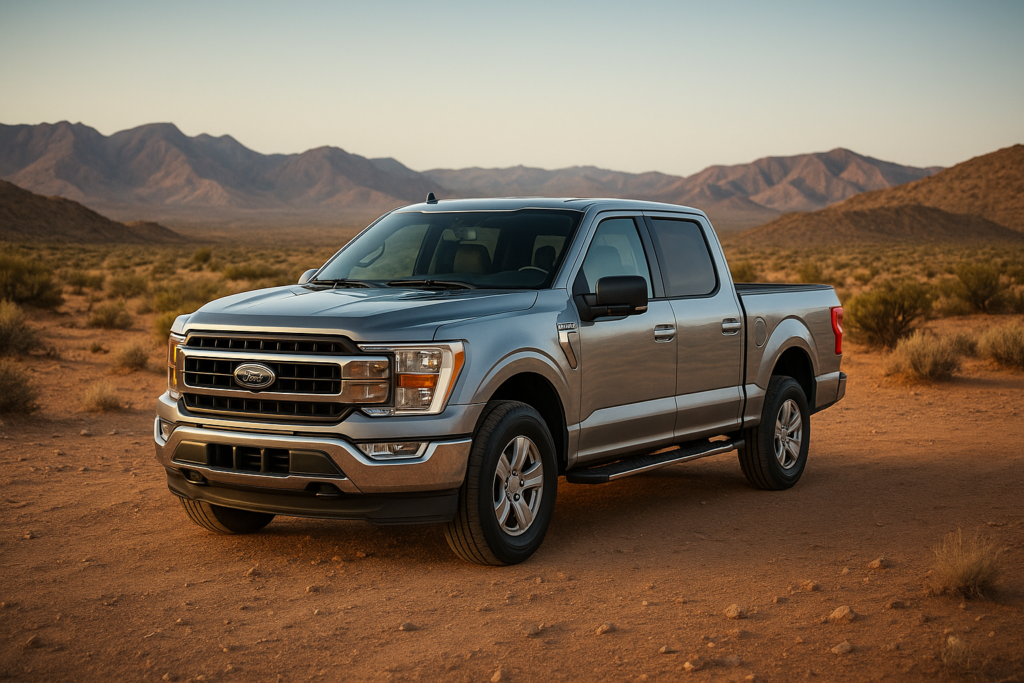
Half-ton trucks remain the most common tow vehicle in North America, largely because they strike a near-perfect balance between everyday drivability and towing capability. They provide more stability than SUVs thanks to longer wheelbases, stronger frames, and more robust powertrains. When paired with mid-size travel trailers, most half-ton trucks return 9 to 12 MPG in real-world towing, although that number shifts based on trailer shape, weight, and wind conditions.
Gas-powered half-tons often run at higher RPMs on long grades or in headwinds, which can pull MPG down quickly. Diesel half-tons, while less common, tend to hold gears longer and pull more efficiently at lower engine speeds, giving them a slight fuel economy advantage on extended highway runs. The overall efficiency of a half-ton setup depends heavily on how aerodynamic the trailer is. Tall, flat-front travel trailers can drag the truck backward at highway speeds, whereas sloped or curved trailer noses reduce turbulence and allow the engine to stay in a steadier power band.
Another factor that influences half-ton towing MPG is payload. When trucks approach or exceed their payload limits—especially with heavy tongue weight—they tend to squat, altering the angle at which air moves under and around the vehicle. That increased resistance forces the drivetrain to work harder and leads to more fuel burn. Accessories like tonneau covers or properly inflated LT tires can help the setup move more cleanly through the air and hold onto efficiency in mixed terrain.
Overall, half-tons perform best when towing trailers under 7,500 pounds, and they remain one of the most fuel-friendly options for travelers who want a comfortable, stable towing experience without stepping up into heavy-duty truck territory.
Three-Quarter-Ton Trucks — Power and Stability
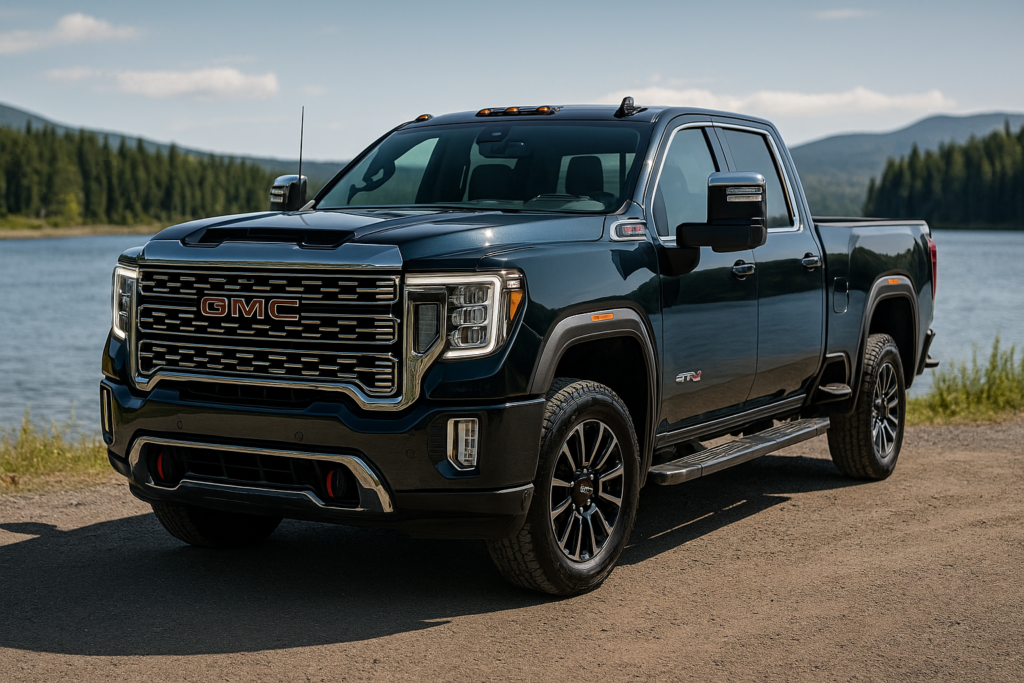
Three-quarter-ton trucks sit at a sweet spot in the towing world because they combine serious pulling power with the kind of stability that inspires confidence on long trips. Compared to half-ton pickups, they bring heavier frames, larger brakes, stiffer suspensions, and far more robust cooling systems. All of that matters when you’re towing heavier travel trailers or stepping up into smaller and mid-size fifth wheels. These trucks are built to stay composed under load, which makes a noticeable difference in both control and fuel economy.
In real-world towing, gas-powered 2500-series trucks usually return 7 to 10 MPG, depending on terrain, speed, and trailer aerodynamics. Diesel models tend to do better, often landing in the 10 to 13 MPG range, especially on flat or gently rolling highways where they can hold gears without frequent downshifts. The biggest advantage of a three-quarter-ton diesel is torque. These engines maintain power at lower RPMs, which allows them to pull steady without the gear hunting you often feel in lighter tow vehicles. The result is smoother towing and more consistent fuel burn.
Stability is another major factor. The weight and stiffness of a three-quarter-ton truck prevent the “push and pull” sensation that smaller tow vehicles experience when large trailers catch crosswinds or passing semis create turbulence. This stability helps the truck maintain a predictable throttle position, which translates directly into more stable MPG numbers. Even on steep climbs, these trucks tend to perform efficiently because their cooling systems are designed to handle prolonged strain without the abrupt downshifts that spike fuel consumption.
Three-quarter-ton trucks are particularly well suited for RVers who tow often, travel through mountain regions, or need a wider safety margin than a half-ton can provide. They’re not the most fuel-efficient option when towing lighter trailers, but when heavier loads or longer hauls are part of your lifestyle, their combination of strength, control, and dependable fuel economy makes them one of the most capable tow vehicles for 2026.
One-Ton Trucks and Duallys — Built for the Heaviest Fifth Wheels
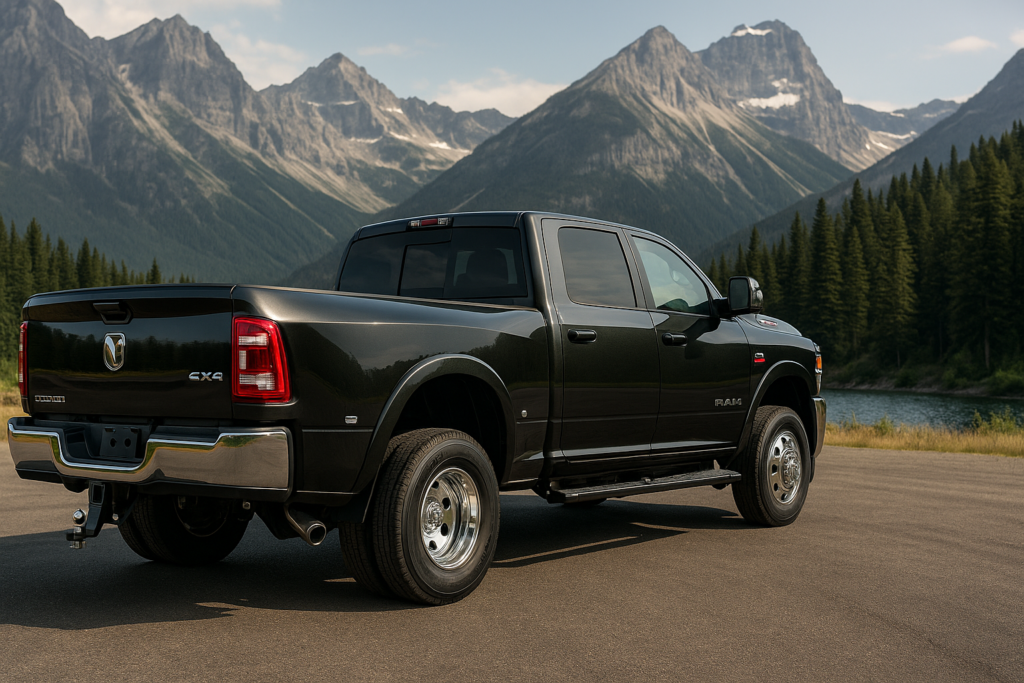
One-ton trucks are the workhorses of the towing world, and dually models take that capability to an entirely different level. These trucks are engineered specifically for heavy pin weights, long wheelbases, and the aerodynamic challenges that come with pulling tall, wide fifth wheels. Their rear axles, brakes, frames, and suspension components are designed to handle loads that would overwhelm lighter trucks, and that strength is exactly why they dominate the upper tiers of RV towing.
In real-world use, gas one-tons towing large fifth wheels often return 6 to 9 MPG, especially when climbing mountain grades or pushing into a strong headwind. Diesel one-tons, particularly dually models, generally achieve 9 to 12 MPG, with the best numbers coming from drivers who hold steady speeds on open highways. Diesel efficiency comes from torque—massive low-RPM pulling power that keeps the truck in higher gears longer and reduces the constant gear changes that eat into fuel economy.
The defining challenge for one-ton trucks isn’t weight alone but wind. Large fifth wheels present huge frontal surface areas, sometimes over 100 square feet of flat or slightly curved fiberglass facing directly into the airflow. At highway speeds, that acts like a moving billboard, and the truck must constantly push against that resistance. This is why tall fifth wheels can drop MPG so noticeably, even for powerful diesel engines. The aerodynamics simply work against you, and the truck compensates by burning more fuel.
Despite the higher consumption, one-ton trucks offer unmatched control. Their wider stance, especially on dually models, delivers stability that no other tow vehicle can match. Crosswinds, passing semis, and uneven road surfaces affect them far less, and that stability helps maintain consistent throttle input—one of the biggest contributors to predictable MPG over long distances. For RVers who tow heavy fifth wheels, travel full-time, or cross mountain regions frequently, the confidence and control these trucks provide often outweigh the added fuel cost.
One-ton trucks and duallys are purpose-built tools. They may not deliver the best MPG in the towing world, but they deliver the best performance under heavy loads. For anyone hauling a large fifth wheel in 2026, they remain the safest, most capable, and most predictable option on the road.
Trailer Aerodynamics and Why They Matter More Than Weight

Many new RV owners focus on weight when estimating towing MPG, but once you reach highway speeds, aerodynamics become the real deciding factor. Weight affects how much fuel the truck uses to get moving, but wind resistance determines how much fuel it burns mile after mile. The shape of the trailer controls how cleanly air flows around it, and even small design differences can create big changes in fuel economy.
A travel trailer with a rounded or sloped front cap moves through the air far more efficiently than a boxy, flat-front design. That flat wall acts like a wind brake at 65 mph, forcing the engine to push against constant resistance—even if the trailer itself weighs less. Fifth wheels follow the same rules. Their taller front caps create significant surface area for the wind to hit, and rounded modern designs tow noticeably better than older, square-front models. That’s why two trailers of the same weight can deliver completely different MPG: it’s the airflow, not the scale number.
Aerodynamics behind the trailer matter too. As air separates from the rear, it forms a vacuum that pulls backward on the rig, increasing drag. The faster you go, the stronger that vacuum becomes. This is also why a strong headwind can devastate fuel economy; a 20 mph headwind effectively turns a 60 mph tow into the aerodynamic equivalent of towing at 80.
Weight still plays a role, but aerodynamics dictate how hard the engine works for most of the trip. A well-shaped, wind-friendly trailer can save thousands in fuel over the course of a season. For RVers planning long routes in 2026, understanding trailer shape is just as important as understanding trailer weight.
Why Long Trips Get Better MPG Than Short Trips
Long towing days almost always produce better fuel economy than short, local trips, and the reason comes down to how engines and drivetrains operate over time. On a short run, the engine rarely settles into its most efficient rhythm. It spends more time warming up, downshifting for traffic, climbing small elevation changes, and responding to constant throttle adjustments. These conditions keep fuel consumption high and prevent the truck from reaching a steady, efficient state.
On longer drives, everything stabilizes. The engine reaches full operating temperature and stays there. The transmission finds a comfortable gear and holds it. Airflow around the truck and trailer becomes more consistent, reducing the small aerodynamic disruptions that happen in city or stop-and-go driving. Even the driver becomes smoother, maintaining steadier speeds and avoiding the frequent throttle pulses that kill MPG.
Terrain plays a role as well. Local trips often involve hills, intersections, and mixed-speed roads that force the truck to accelerate repeatedly—one of the most fuel-intensive actions in towing. Long highway stretches, by contrast, let the truck settle into a predictable load that the engine can manage efficiently for hours at a time.
Full-time RVers typically see more stable MPG numbers for this exact reason. Their rigs spend most of their travel time in optimal conditions rather than in short bursts of inefficient driving. For RV owners planning their 2026 travel budget, it’s helpful to remember that the length and consistency of the trip can affect fuel costs just as much as the weight or shape of the trailer.

What RV Owners Actually Spend on Fuel in 2026
Fuel is one of the biggest recurring costs in RV travel, but in 2026 it’s far more predictable than most new owners expect. Your actual spending comes down to three things: how many miles you drive, what MPG your RV realistically delivers, and the terrain or wind you travel through. Once you know those numbers, estimating fuel costs becomes straightforward.
Most RVers budget fuel by looking at the cost per 100 miles. A Class A diesel pusher that averages 7 MPG will burn around fourteen gallons in that distance, while a Class B van at 17 MPG may use only six. Towable setups fall in between based on the tow vehicle and trailer aerodynamics. This simple calculation is more accurate than guessing by tank size or fill-up frequency.
Long-distance trips reveal the biggest differences. A cross-country drive in a large diesel motorhome can easily cost several hundred dollars more than the same route in a Class C or a fuel-efficient Class B. Towable RVs vary widely depending on how aerodynamic the trailer is and how hard the truck works to maintain speed. Headwinds, mountain grades, and driving over 65 mph can raise fuel use quickly.
Travel style matters too. Weekend RVers often spend more per mile because short trips keep engines from reaching their most efficient state. Seasonal travelers see smoother averages, and full-timers—despite covering more miles—often report the most consistent fuel budgets because they drive long stretches at steady speeds.
In 2026, most RV owners fall into clear spending ranges: light-use travelers spend modestly, moderate-use RVers see more fluctuation, and full-timers experience the highest overall fuel costs but the most predictable averages. No matter which category you fall into, the pattern is the same—fuel spending becomes easy to estimate once you know your rig’s MPG and how you prefer to travel.
Monthly RV Fuel Budget — Realistic 2026 Ranges
Most RV owners think of fuel costs month to month, not yearly. In 2026, the amount you spend each month comes down to two things: how far you travel and what your RV actually gets for MPG. Once you know those numbers, your fuel budget becomes one of the easiest parts of RV planning.
Light-use RVers who only take a few trips often spend very little on fuel, even though short drives tend to return lower MPG. Seasonal travelers who mix weekend trips with the occasional long haul see more variation from month to month, especially when towing. Their fuel spending depends almost entirely on how many miles they cover and the shape of the RV they’re pulling.
Full-time RVers cover more ground but usually have the most predictable monthly fuel budgets. Longer travel days let engines stay in their most efficient range, which keeps MPG steady even when terrain or wind changes. Diesel rigs—both motorhomes and tow vehicles—tend to deliver the smoothest month-to-month averages.
Ultimately, your mileage determines everything. A month with only a few hundred miles is inexpensive. A month with a cross-state or cross-country haul can be one of your biggest expenses. With honest MPG numbers and a realistic idea of how often you move, estimating your monthly fuel budget in 2026 becomes simple and accurate, no matter what you travel in.
How to Save Money on RV Fuel in 2026
Saving fuel in 2026 isn’t about small tricks—it’s about understanding how your RV behaves and making a few smart adjustments that pay off every time you travel. The biggest gains come from how you drive, how well you maintain the rig, and the routes you choose. Even small improvements in MPG can save hundreds of dollars over a season.
Speed has the biggest impact. Once an RV pushes past the low-60 mph range, wind resistance increases rapidly and fuel efficiency drops. Slowing down even five miles per hour can noticeably improve range and reduce strain on the engine and transmission.
Tire pressure also matters. Underinflated tires add drag and force the engine to work harder, especially on hot days or when temperatures swing. Carrying excess weight, traveling with full tanks, or loading gear unevenly can also increase fuel burn. A lighter, well-balanced rig moves through the air more efficiently and stays easier to control.
Route choice plays a role as well. Flat or gently rolling highways are far more efficient than steep grades or winding mountain roads. Sometimes even adjusting your travel direction to avoid strong headwinds can make a difference. Many RVers reduce costs not by burning less fuel, but by paying less per gallon using discount programs and loyalty networks.
Planning tools help too. Apps that track fuel prices, wind forecasts, and elevation changes allow RVers to set realistic expectations and choose routes that support better MPG. When combined with steady driving, smoother throttle control, and consistent maintenance, these habits make fuel costs far more predictable—regardless of what you drive or tow.
In the end, saving fuel in 2026 comes down to consistency. A well-maintained, properly loaded RV driven at sensible speeds will always deliver better MPG than one pushed beyond its aerodynamic limits.
In the end, saving fuel in 2026 comes down to consistency. A well-maintained, properly loaded RV driven at sensible speeds will always deliver better MPG than one pushed beyond its aerodynamic limits.
Motorhome vs Tow Vehicle — Which Costs More to Run in 2026?
Comparing fuel costs between motorhomes and towable setups isn’t as simple as looking at MPG alone. Each configuration has its own strengths, weaknesses, and real-world behaviors that determine how much fuel you’ll burn over a season. In 2026, the gap between them is clearer than ever: motorhomes tend to use more fuel per mile, while tow vehicles often deliver better MPG but may travel more total miles depending on how you camp.
Motorhomes have one major advantage—they’re a single unit designed to move as one aerodynamic shape. Even though they may be large, their bodies are engineered to reduce drag as much as possible. Class A diesels, for example, hold steady on long grades and often maintain a predictable fuel burn. But because they’re heavy and tall, their MPG usually remains lower than tow vehicles, especially when pushing through crosswinds or climbing mountain passes. Gas Class As see the biggest penalty here, while Class Cs and Class Bs perform more efficiently but still remain less fuel-friendly than a modern pickup.
Towable RVs flip the equation. A half-ton or diesel pickup pulling an aerodynamic travel trailer often delivers better overall MPG than a gas Class A or C, but the trailer’s shape becomes the deciding factor. A rounded, lower trailer can tow surprisingly efficiently, while a tall fifth wheel with a large front cap can push MPG down close to motorhome levels. The truck’s efficiency also changes the moment it’s unhitched. You may burn more fuel on travel days, but once you’re set up at camp, your tow vehicle returns to normal driving MPG—something motorhome owners don’t benefit from when sightseeing or running errands.
For travelers who move frequently, the difference can add up. A diesel pickup towing a well-designed travel trailer may stretch fuel farther than a motorhome on the same route. But a dually towing a large fifth wheel may burn fuel at nearly the same rate as a diesel pusher, depending on terrain and wind. Travel style matters here as well. Motorhome owners often tow a small car behind them and use that for local travel, which offsets some of the fuel used by the coach. Tow-vehicle owners, by contrast, are driving their least efficient vehicle for every grocery run or scenic drive.
The bottom line: neither setup universally costs more to run. Motorhomes tend to use more fuel on travel days but save fuel once parked. Tow vehicles can be more efficient on the highway but may cost more in local driving. The winner in 2026 ultimately depends on how you travel, how often you move, and what type of RV you haul or drive. Understanding these patterns helps you choose the setup that matches your travel style—and your fuel budget.

Conclusion — Fuel Is a Big Cost, But It Doesn’t Have to Break the Budget
Fuel will always be one of the major costs of RV travel, but in 2026 it’s far more manageable than many new RV owners expect. Once you understand how your specific rig behaves—how it handles wind, elevation, speed, and weight—fuel stops become predictable instead of stressful. Every RV has its own rhythm, and learning that rhythm is what turns fuel budgeting into a simple part of trip planning rather than a guessing game.
Motorhomes, tow vehicles, vans, and fifth wheels all burn fuel differently, yet the same rule applies to all of them: consistency wins. Smooth throttle control, sensible speeds, proper tire pressure, and a well-balanced load do more to control fuel costs than anything else. Even a small improvement in MPG can stretch your range significantly over a season of travel. And when you pair those habits with smart route choices and a realistic travel pace, your fuel budget becomes something you can rely on—not something you worry about.
What matters most is matching your RV style to the way you actually travel. Some RVers chase miles and need the stability of a diesel coach or a heavy-duty tow rig. Others travel light and find freedom in vans or small trailers that sip fuel instead of gulping it. There’s no right or wrong answer—only what fits your pace, your destinations, and your comfort.
Fuel may be a big cost, but it doesn’t have to limit your adventures. With a little preparation and a clear understanding of your RV’s real-world behavior, you can plan confidently, travel smarter, and enjoy the road ahead without letting fuel prices dictate where you go. And when you’re ready to dive deeper into long-term RV budgeting, maintenance, or buying decisions, the rest of our guides are here to help you make the most out of every mile.
Related Reading