RV starter essentials are the part of buying your first RV that most new owners underestimate. Sewer hoses. Water pressure regulators. Power adapters. Leveling blocks. Suddenly you are standing in the camping aisle staring at shelves full of gear wondering what you actually need.
Most people assume the RV itself is the hard part. In reality, learning how to set up your campsite properly is where many new owners get caught off guard.
I remember our first campground setup clearly. We arrived excited to hook everything up and relax for the evening. Within minutes we realized we were missing a few things that experienced RV owners consider basic gear. Something as simple as a water pressure regulator was not on our list. That small piece of equipment protects your RV plumbing from high campground water pressure. Without it, you can damage hoses, fittings, or even your internal plumbing system.
Situations like this happen to a lot of new RV owners. Dealerships usually focus on the RV itself during the walkthrough. They show you how the refrigerator works, how to extend the slides, and how to operate the water heater. What they rarely explain is the equipment you actually need when you pull into a campsite for the first time.
Sewer connections require the right hoses and fittings. Water hookups need pressure protection and clean drinking water hoses. Electrical pedestals at campgrounds vary widely, which means adapters and surge protection are often necessary. Without the proper gear, something as simple as setting up for the night can quickly turn into a frustrating experience.
Another surprise for many new RV owners is how quickly the small items add up. A sewer hose here. A water filter there. Electrical adapters. Leveling blocks. Before long you have a small pile of equipment that suddenly becomes part of every camping trip.
In our guide to the real cost of owning an RV, we explained how first-month setup expenses often catch new owners by surprise. This guide is the practical follow-up. A simple breakdown of the RV starter essentials you truly need to camp safely and comfortably.
Some items protect important RV systems like plumbing and electrical components. Other pieces of gear simply make campsite setup easier and faster. And there are also a few accessories that RV stores promote heavily but most campers honestly do not need.
This first-time RV setup checklist focuses on the equipment that actually matters. The gear experienced RV owners rely on every time they pull into a campsite.
RV Starter Essentials Every First-Time RV Owner Needs
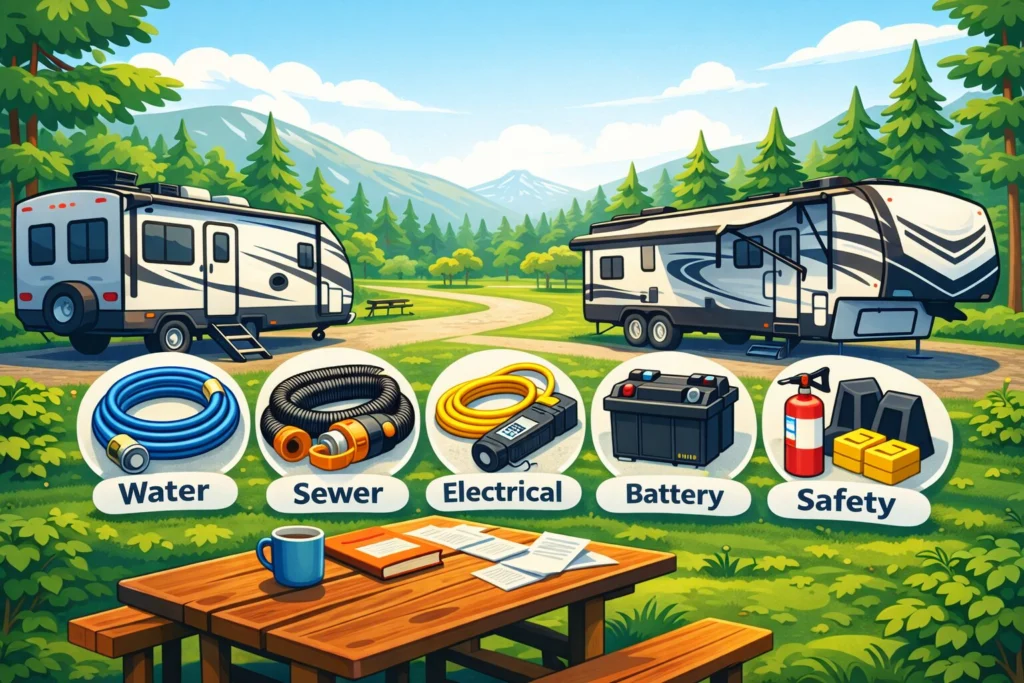
For first-time RV owners, RV starter essentials fall into a few core systems rather than a long list of random accessories. When you focus on what it actually takes to safely connect your RV to water, sewer, and power, plus a handful of basic safety items, you can avoid buying a lot of unnecessary gear and still be fully prepared for your first camping trip.
Most dealerships send new owners home with very little beyond the RV itself. During the walkthrough they explain how the appliances work and how the RV systems operate. What they rarely provide is the equipment needed to actually connect to a campsite.
That means your first trip often depends on having the right basics on hand before you ever leave the driveway. Missing a single hose, adapter, or safety item can quickly turn an otherwise relaxing weekend into a frustrating search for the nearest RV store.
The easiest way to understand RV starter essentials is to think in terms of systems rather than shopping lists.
Every RV, whether it is a compact travel trailer or a large fifth wheel, relies on the same basic connections in order to function properly at a campground. Your RV needs a reliable fresh water connection to supply sinks, showers, and toilets. It needs a safe way to connect to the campground sewer system so gray and black tanks can be emptied.
Your RV also needs electrical power from the campground pedestal to run appliances and recharge batteries. In addition to those connections, a few simple safety items help protect both the RV and the people inside it. Once these core systems are covered, most other RV accessories become optional and depend on how you like to camp.
Someone who travels on occasional weekend trips will likely carry different gear than a full-time RVer. Campers who stay in developed campgrounds will also use different equipment than those who prefer boondocking or off-grid travel. Even so, the core RV starter essentials needed to set up safely at a campsite remain largely the same for nearly every RV owner.
In the sections below, we’ll walk through each of these systems step by step. We’ll explain what equipment is truly necessary to get your RV connected and ready to camp. We’ll also show which items are helpful upgrades you may want later, and which accessories many first-time RV owners can confidently skip.
Water Connection RV Starter Essentials
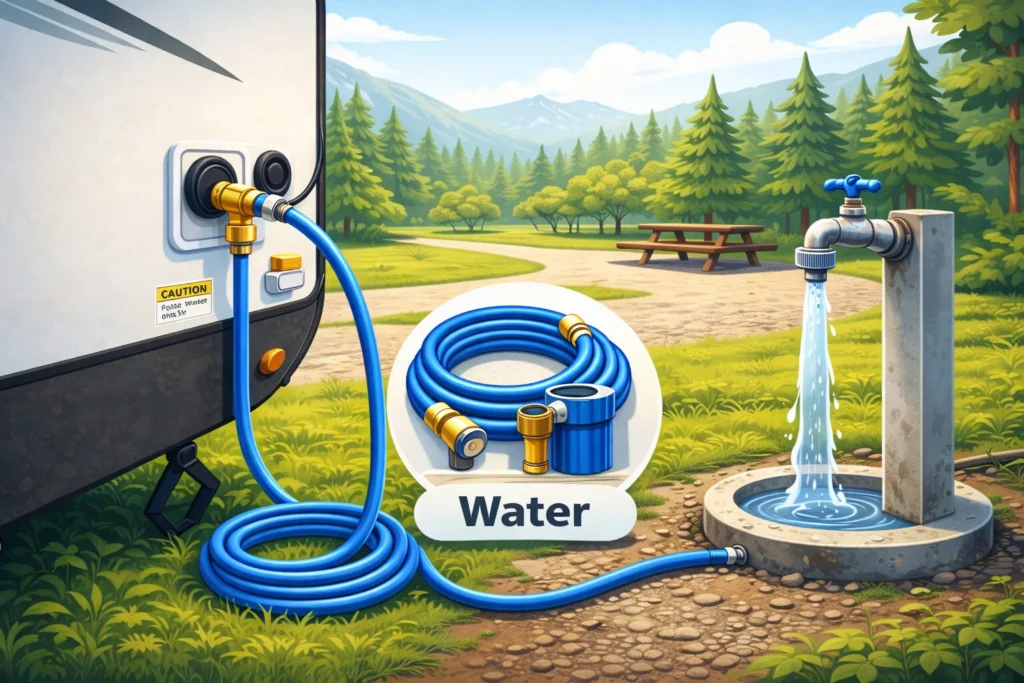
For first-time RV owners, the water system is one of the most misunderstood RV starter essentials—and one of the easiest places to overspend. At a minimum, your RV needs a safe, reliable way to connect to campground water without damaging plumbing or contaminating your drinking supply.
What you actually need to get started is simple. A dedicated RV drinking-water hose is essential. These hoses are designed for potable water and are clearly labeled as safe for drinking. Using a regular garden hose can introduce unwanted taste, odors, or contaminants into your RV’s water system.
A water pressure regulator is just as important. Campground water pressure varies widely, and excessive pressure can damage RV plumbing, fittings, and appliances. A regulator protects your system automatically and prevents leaks that often show up only after damage is done.
Many RVers also use a basic inline water filter, which helps improve taste and reduces sediment. While a filter isn’t strictly required for your first trip, it’s a common upgrade once you’ve camped a few times and know how sensitive you are to water quality.
Before your first trip, make sure you understand how your RV water system operates under pressure.

Advanced 6-Step Filtration Technology
Sewer Hookup RV Starter Essentials
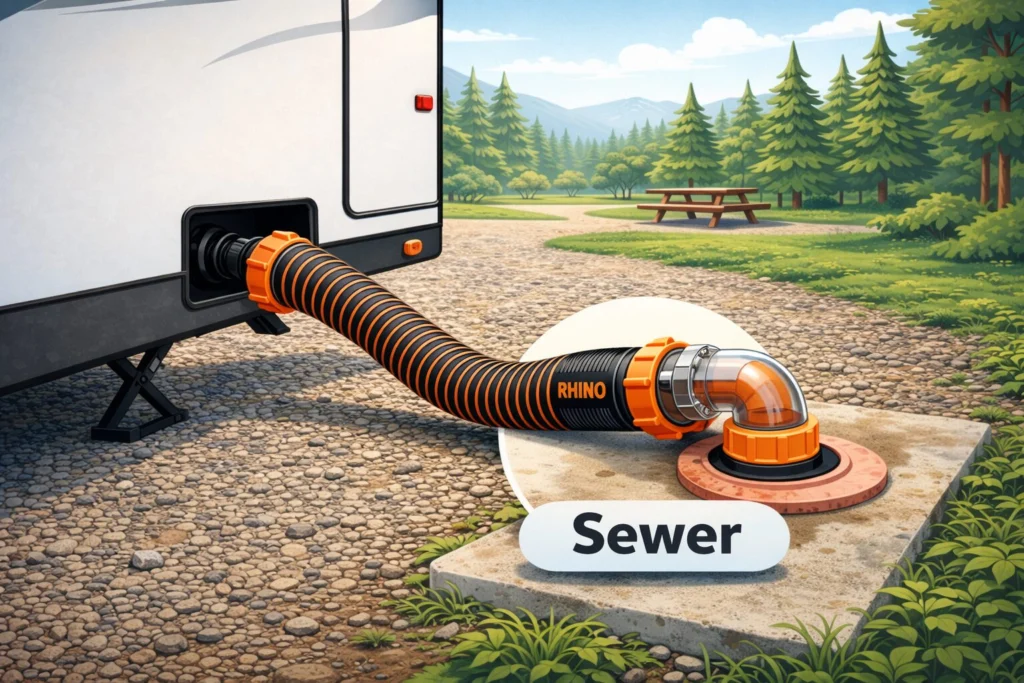
Sewer connections are one of the least glamorous RV starter essentials, but they’re also one of the most important to get right from the beginning. Every RV needs a reliable way to empty gray and black tanks safely, cleanly, and without spills.
At a minimum, you’ll need a dedicated RV sewer hose designed specifically for waste systems. These hoses are reinforced to prevent leaks and collapse and are made to handle repeated dumping. Just as important is having enough hose length to comfortably reach the campground sewer inlet, since dump connections aren’t always positioned close to your RV’s outlet. Many first-time owners underestimate this and end up scrambling to reposition the rig or borrow equipment.
Basic sewer fittings and adapters are also essential. Campgrounds don’t all use the same connection style, and having a simple adapter ensures you can connect securely without leaks. A secure connection not only prevents messes but also makes the dumping process quicker and far less stressful.
Many modern RVs are also equipped with a black tank flush system, which requires a separate, non-potable hose dedicated only to flushing the tank. This hose should never be used for drinking water and should be clearly marked or stored separately to avoid contamination. While flushing isn’t mandatory on day one, having the correct hose ready makes proper tank maintenance much easier from the start.
What most new RVers don’t need right away are elaborate hose supports, storage systems, or specialty accessories. For your first several trips, a quality sewer hose with adequate length, basic fittings, and a dedicated black tank flush hose are enough to dump tanks safely and move on with your day.
A quality sewer hose is essential, but knowing how your black and gray tank system actually works is what prevents messy mistakes. Read our complete RV Sewer System Guide before your first dump station visit.

Superior Dual RV Tank Dumping: Streamline dual tank dumping with the RhinoEXTREME 20' RV Sewer Hose Kit. Made with the toughest RV sewer hose, this complete kit ensures easy & efficient dual tank dumping.
Electrical Power RV Starter Essentials
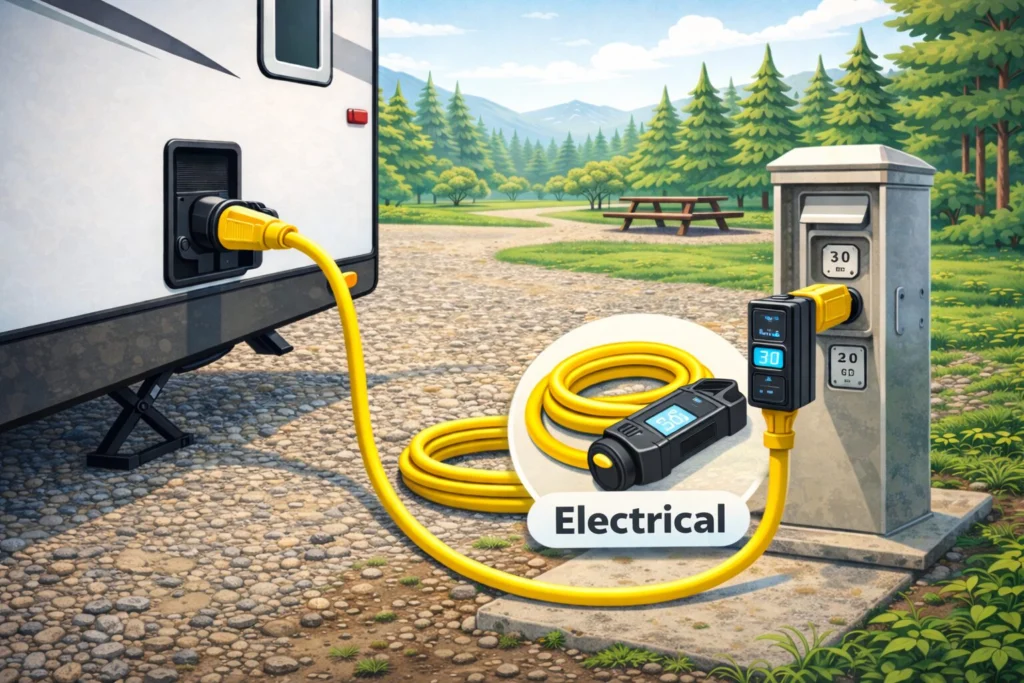
Before worrying about campground hookups, one of the most overlooked RV starter essentials is confirming that your RV actually has a house battery installed and properly connected. Some dealers deliver RVs without a battery, or with a disconnected battery, which can leave first-time owners confused when lights, slides, or basic systems don’t work away from shore power.
The house battery powers essential systems like interior lights, water pump, slides, and control panels when you’re not plugged in. Even if you plan to stay at full-hookup campgrounds, having a working battery is necessary for safe operation and basic functionality.
Once battery basics are covered, shore power becomes the next priority. Every RV is designed to plug into either 30-amp or 50-amp power, depending on the rig. Campgrounds may offer multiple outlet types at a site, but using the correct connection for your RV is critical. A simple shore power adapter allows you to connect safely when the pedestal doesn’t match your RV’s plug.
A surge protector or EMS is another essential piece of electrical safety gear. Campground power can be inconsistent, and voltage spikes or wiring issues can damage RV appliances and electronics without warning. A surge protector helps shield your RV’s electrical system before problems occur.
Many first-time RV owners also benefit from carrying a heavy-duty extension cord rated for RV use. Power pedestals aren’t always positioned conveniently, and having extra reach can save you from repositioning the RV just to connect power. Standard household extension cords aren’t designed for RV electrical loads and should be avoided.
What you don’t need immediately are complex power management systems or advanced monitoring equipment. For your first several trips, a properly installed battery, the ability to connect safely to shore power, and basic electrical protection are enough to camp confidently.
Your power cord, surge protector, and adapters are only part of the equation. Understanding how your RV breaker panel and battery system work together will prevent most first-trip electrical mistakes. Here’s our complete RV electrical system breakdown for beginners.

Durable Design for Outdoor Use: With an IP67 waterproof rating and eco-friendly flame-retardant materials, this surge protector is built to withstand rain, dust, and extreme weather conditions. It’s the ideal companion for camping, road trips, or long-term RV living.
Safety RV Starter Essentials
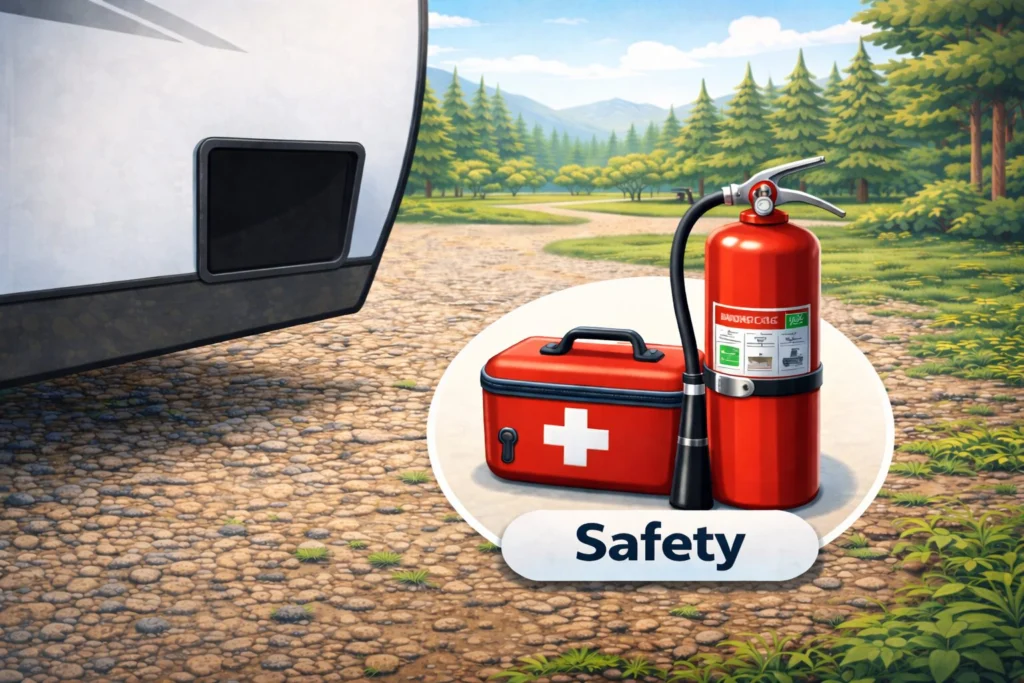
Safety gear is one area where RV starter essentials should never be treated as optional. Even short trips and full-hookup campgrounds come with risks that are easier to prevent than to fix later. A small set of basic safety items protects both your RV and the people traveling in it.
Every RV should be equipped with a working fire extinguisher that’s easily accessible, not buried in a compartment. Many RVs come with one installed, but it’s worth confirming it’s present, properly charged, and located where you can reach it quickly.
Wheel chocks are another essential safety item, especially for travel trailers and fifth wheels. Chocks help prevent unwanted movement while parked and add stability when leveling your RV. Even on seemingly flat sites, they play an important role in keeping the rig secure.
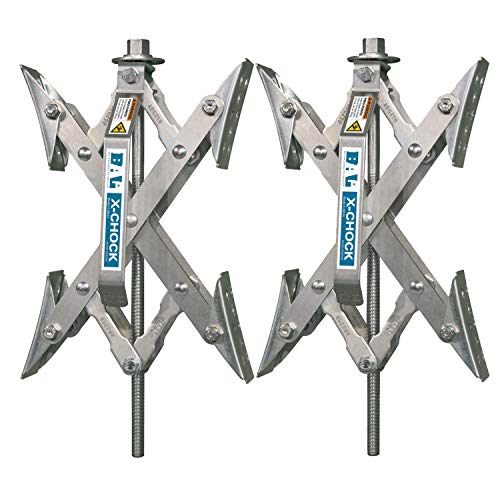
American-Made Durability – Crafted in the USA from rust-resistant, zinc-coated steel for long-lasting performance in harsh outdoor conditions
Basic leveling equipment is also part of safe setup. While leveling blocks or pads are often thought of as comfort items, proper leveling protects appliances like refrigerators and helps doors, slides, and plumbing systems operate correctly.
Inside the RV, make sure smoke detectors and carbon monoxide detectors are installed and functioning. These are critical safety systems that should be tested before your first trip, especially if the RV has been sitting on a dealer lot for any length of time.
What first-time RV owners don’t need immediately are advanced monitoring systems or specialty safety upgrades. For your first several trips, basic fire protection, stability equipment, and functioning detectors provide the safety foundation you need to camp with confidence.
Nice-to-Have RV Starter Essentials After a Few Trips
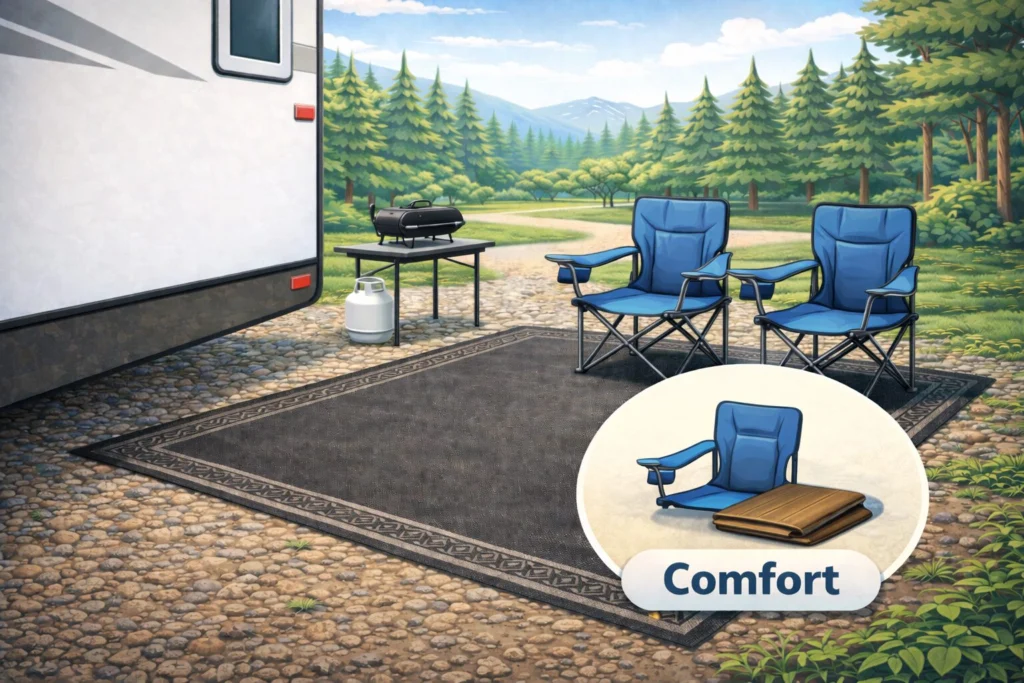
Once you’ve taken a few trips and learned how you actually use your RV, certain upgrades start to make sense. These RV starter essentials aren’t required for your first outing, but they can improve convenience, organization, and comfort once you understand your camping style.
Many RV owners choose to upgrade hoses, fittings, and electrical accessories after their first few trips. Longer sewer hoses, better hose storage, upgraded water filters, and more durable power adapters often become worthwhile once you know how far hookups are positioned at the campgrounds you visit most often.
Comfort upgrades also tend to come later. Camp chairs, outdoor mats, grills, and upgraded bedding are common additions once you’ve spent time outside your RV and figured out how you like to relax at camp. These items are highly personal and depend more on lifestyle than necessity.
Storage and organization products fall into this category as well. After a few trips, you’ll notice where clutter builds up and which compartments are underused. That’s the right time to consider bins, drawer organizers, or pantry solutions—after you know what actually needs a home.
The key with nice-to-have RV starter essentials is timing. Waiting until you’ve camped a few times helps prevent buying items that look useful online but don’t fit your RV or your travel habits.
Skip-for-Now: Common First-Month RV Money Wasters
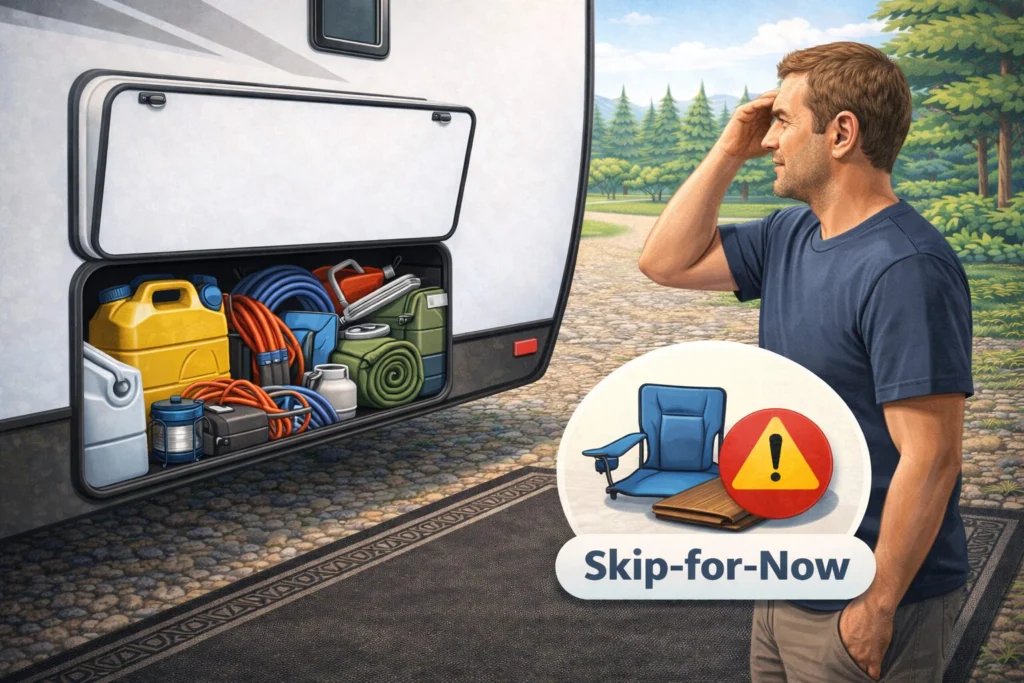
One of the easiest ways to overspend as a new RV owner is buying too much too soon. Many products are marketed as “must-haves,” but in reality, they solve problems you may never have—or problems that only appear after months of use.
A common mistake is purchasing expensive organization systems before you understand how your RV is laid out in daily use. Cabinets, closets, and storage bays all get used differently once you start traveling. Waiting prevents buying organizers that don’t fit or end up unused.
Another frequent overspend comes from premium gadgets and upgrades meant to optimize comfort or efficiency right away. Items like advanced power management systems, elaborate sewer hose supports, or high-end filtration setups often make sense later—but rarely on the first few trips.
New owners also tend to duplicate gear. Buying multiple hoses, adapters, tools, or accessories “just in case” can quickly inflate first-month costs. In most cases, starting with the basics and adding only when a real need appears is the smarter approach.
Skipping these purchases early doesn’t mean you’ll never need them—it simply means you’ll buy them with confidence later, knowing they actually fit your RV and your travel style.
What First-Time RV Setup Really Costs
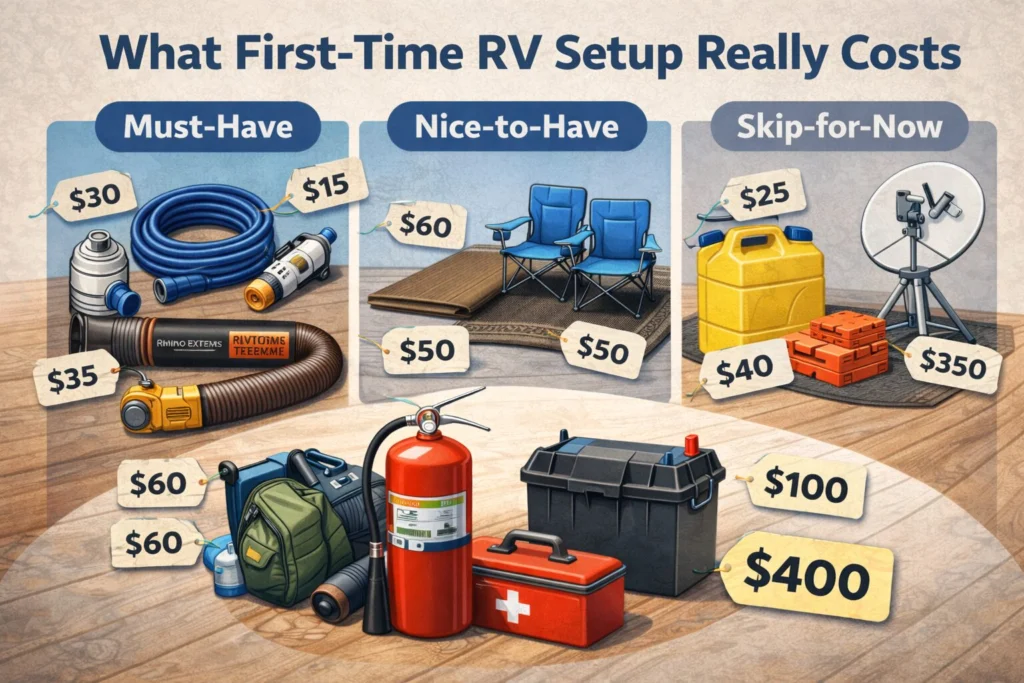
Getting set up for your first RV trip does not have to break the bank, but there will be some unavoidable startup costs. Most of the equipment you buy at the beginning is used on every camping trip, so these expenses are usually one-time purchases that quickly become part of your regular RV setup routine.
Below are realistic price ranges based on common RV starter equipment and typical individual components many first-time owners purchase.
Water Connection Gear
Connecting your RV to fresh water requires a few basic pieces of equipment designed specifically for RV use. A drinking-water-safe RV hose typically costs between $35 and $80 depending on length and quality. A water pressure regulator, which protects your RV plumbing from high campground pressure, usually ranges from $20 to $50. Many RV owners also add an inline water filter to improve water taste and reduce sediment, which typically costs between $20 and $60.
When these items are purchased together, a typical RV water setup usually falls between $75 and $190.
Sewer System Costs
The sewer system is another essential part of RV camping. A quality RV sewer hose long enough to reach the campground inlet generally costs between $45 and $90. Sewer fittings and adapters, which help ensure a tight and secure connection, usually range from $10 to $30. Many RV owners also carry a dedicated black tank flush hose used only for rinsing the sewer system, which typically costs between $20 and $40.
Altogether, a typical sewer setup usually falls between $75 and $160.
Electrical Power Setup Costs
Connecting your RV safely to campground electricity also requires a few important components. A shore power adapter, used to match your RV’s plug to the campground pedestal, generally costs between $30 and $60. A surge protector or power guard, which protects your RV’s electrical system from voltage spikes or wiring problems, typically ranges from $60 to $150. Some RV owners also carry an RV-rated extension cord, which usually costs between $30 and $60.
Together, a basic electrical setup typically totals $120 to $270.
Battery Costs (If Not Supplied by the Dealer)
Some new RVs come with a house battery already installed, but others do not. If your RV needs one, a typical deep-cycle house battery usually costs between $100 and $300 depending on type and capacity. A battery charger or maintainer used during storage can cost between $30 and $80.
If a battery is required, the total usually falls between $130 and $380.
Safety Essentials Costs
A few simple safety items are also important for every RV owner. A fire extinguisher, if your RV does not already have one installed, typically costs between $25 and $60. Wheel chocks used to keep the RV from moving usually range from $20 to $40. Leveling blocks or pads, which help stabilize the RV on uneven campsites, generally cost between $15 and $40.
These safety essentials usually total $60 to $140.
First-Month RV Setup Cost Summary
When everything is added together, most first-time RV owners spend somewhere within a fairly predictable range.
The low end usually falls around $300 to $400.
A more typical range for most setups is $400 to $800.
Higher-end setups, especially those including a new battery or upgraded equipment, can reach $1,000 or more.
The good news is that most of these are one-time setup costs. Once you have the basic gear, ongoing RV expenses like fuel, campground fees, insurance, and maintenance become the larger factors in your monthly budget.
If you want a full breakdown of those long-term costs, you can also read our guide on the real cost of owning an RV in 2026.
Final Thoughts on RV Starter Essentials
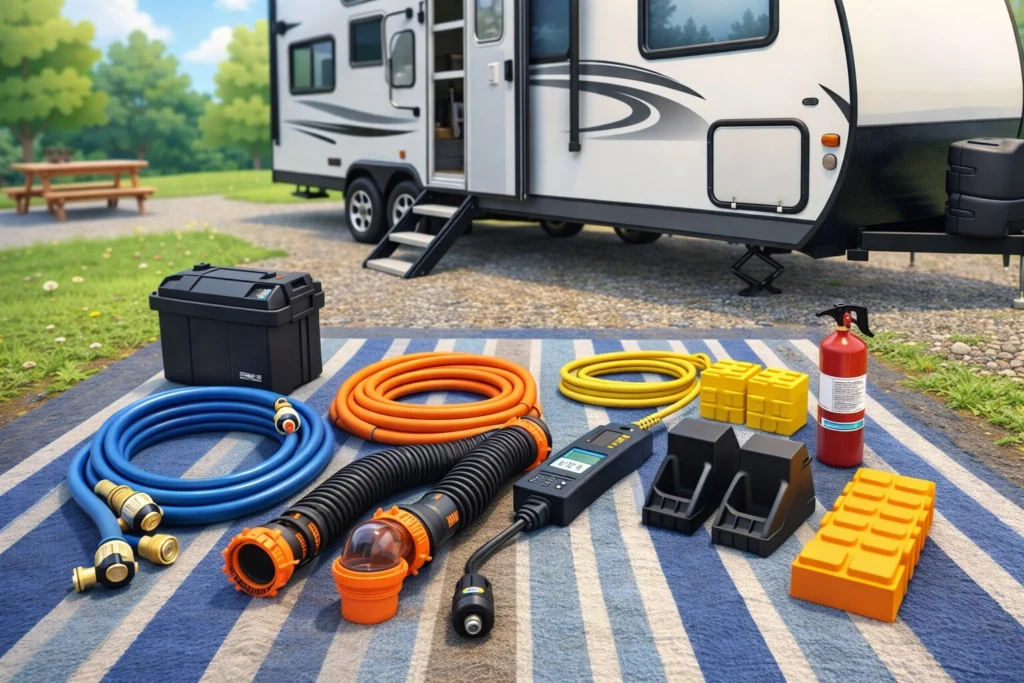
Buying your first RV comes with a learning curve, and setup is where most new owners feel it first. The essentials outlined in this guide are meant to get you safely connected, functional, and comfortable without overspending on things you don’t yet need.
What matters most is starting simple. Once you’ve handled water, sewer, power, and basic safety, you’re ready to camp. Everything beyond that becomes clearer after a few real trips, when you understand how you actually use your RV.
RV ownership is built through experience, not gear lists. As you travel, you’ll naturally identify what improves your comfort and what never leaves storage. Taking that approach keeps your first-month costs reasonable and helps you build a setup that truly fits your lifestyle.
You can find this checklist and other free downloads on our Free RV Guides page.
More great helpful tips.