
Trying to decide between an RV surge protector vs EMS? This guide explains the difference, how campground electricity damages RV electronics, and which protection your RV actually needs.
RVs are not built like houses. Your air conditioner, refrigerator, converter, microwave, and even your water heater control board all rely on stable voltage. Campground power often isn’t stable. Older parks, overloaded summer weekends, long wiring runs, and worn pedestals can all cause voltage problems you will never see — but your RV electronics absolutely will.
Here’s the part most people don’t realize:
The biggest danger to an RV isn’t a lightning strike or a dramatic power surge.
It’s bad campground power.
Many RV owners learn this the hard way. They plug in, everything appears fine, and a few hours later the air conditioner stops cooling… or the refrigerator throws an error code… or the converter quietly burns out. The repair bill usually lands somewhere between a few hundred and a few thousand dollars, and nothing about the campsite looked unusual.
That’s why you keep hearing RVers talk about surge protectors and EMS systems.
They’re not accessories — they’re protection devices.
But the advice online is confusing. Some people say a cheap surge protector is enough. Others insist you must have an EMS. Then you hear about 30 amp vs 50 amp units and it becomes overwhelming fast.
This guide will clear that up in plain English. By the end, you’ll understand what actually damages RV electrical systems and exactly which type of protection your RV needs before you plug into campground power.
If you’re brand new to RV setup, our First-Time RV Starter Essentials checklist walks you through everything you should do before your first hookup.
Why RV Power Protection Matters
Most RV owners assume campground electricity is the same as household electricity. It isn’t.
A house receives power through a regulated service with stable voltage and protection built into the electrical panel. Campgrounds are very different. Power often travels long distances through aging wiring, multiple connections, and pedestals that may have been used thousands of times. On busy weekends, dozens of air conditioners start running at the same time and the electrical system gets stressed.
Your RV, however, depends on clean power.
Modern RVs contain delicate electronics — refrigerator control boards, converter/chargers, microwaves, televisions, and especially the air conditioner compressor. These components are designed to run within a safe voltage range. When the voltage moves outside that range, damage can happen quickly and silently.
The most important thing to understand is this:
A massive surge is not the most common threat to an RV. Low voltage is.
Low voltage happens when the campground electrical system is overloaded. The pedestal still works and your lights still turn on, but the voltage drops below safe levels. Motors, especially the air conditioner compressor, try to keep running while drawing more amperage than they were designed for. Heat builds inside the windings, insulation breaks down, and the component fails.
This is why an air conditioner can be ruined even though nothing “looked wrong” at the campsite.
Other common problems also occur more often than most RVers realize. Pedestals can be miswired, the neutral connection can fail, or a worn outlet can intermittently disconnect power. Each of these conditions can send improper electricity into your RV and damage sensitive electronics within seconds.
Without protection, your RV accepts whatever power the pedestal provides.
Power protection devices exist for one simple reason: they check the electricity before your RV uses it, and they disconnect your RV when the power is unsafe.
In the next section, we’ll clear up the biggest confusion RV owners have — the real difference between a surge protector and a full EMS system.
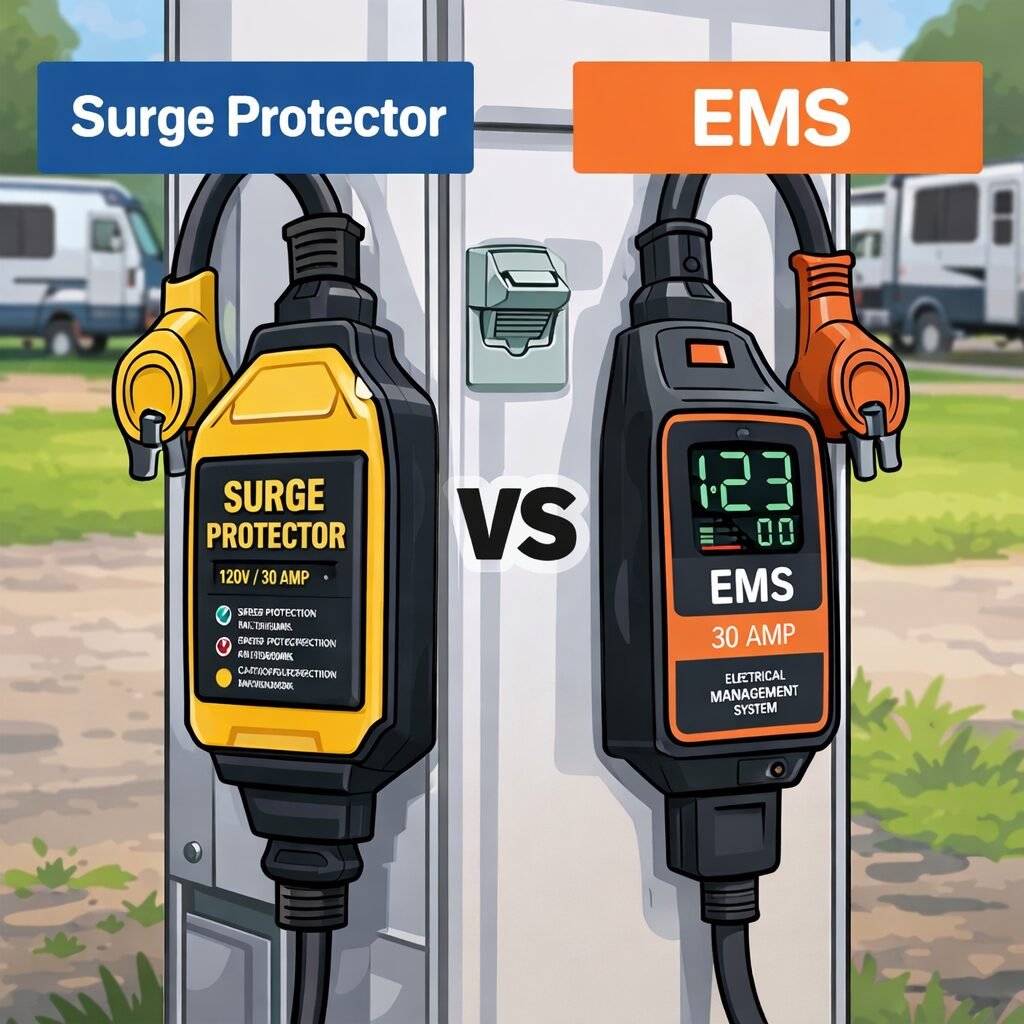
RV Surge Protector vs EMS (Electrical Management System)
If you walk through a campground, you’ll notice many RV owners hang a device from the power pedestal before plugging in. Some are small and simple. Others have displays and look more serious. Almost all of them get called a “surge protector,” but they are not the same thing.
There are actually two completely different types of RV power protection, and the confusion between them is why so many RV owners end up buying the wrong one.
A basic RV surge protector is designed to handle a sudden spike of electricity. The easiest way to think about it is like a household power strip used for a television or computer. If a large surge travels through the electrical line — something like a lightning event or a major utility spike — the device absorbs that hit so it doesn’t reach your RV. After a big surge, the unit often sacrifices itself and must be replaced.
The important part, though, is what it does not do.
A standard surge protector does not watch the power continuously. It does not shut power off if voltage drops. It does not stop an air conditioner from overheating, and it cannot protect your RV from a miswired pedestal. It protects against a dramatic event, but not against the problems RVers encounter most often in real campgrounds.
An EMS, which stands for Electrical Management System, works very differently.
Instead of waiting for a spike, an EMS checks the electricity before your RV is allowed to use it. Every second it monitors incoming voltage and wiring conditions. If the power is unsafe, it simply refuses to connect your RV. When conditions return to a safe range, it reconnects automatically.
This matters because the most common electrical damage in an RV does not come from a lightning strike. It comes from low voltage. On hot afternoons, especially in older parks, everyone’s air conditioner is running at the same time. The pedestal still appears to work and your lights still turn on, but voltage drops below safe levels. The air conditioner compressor continues trying to run and begins drawing more amperage than it was designed for. Heat builds inside the motor windings, and the failure happens quietly.
That is why RVers sometimes lose an air conditioner even though nothing at the campsite looked wrong.
An EMS prevents this by disconnecting your RV the moment voltage becomes unsafe. It also protects against high voltage, wiring faults, and improperly wired pedestals — problems that happen far more often than most new RV owners expect.
So the real difference is simple.
A surge protector protects your RV from a single rare event.
An EMS protects your RV from everyday campground electricity.
Next we’ll clear up another point that confuses almost every new RVer — 30 amp versus 50 amp protection and which one your RV actually needs.
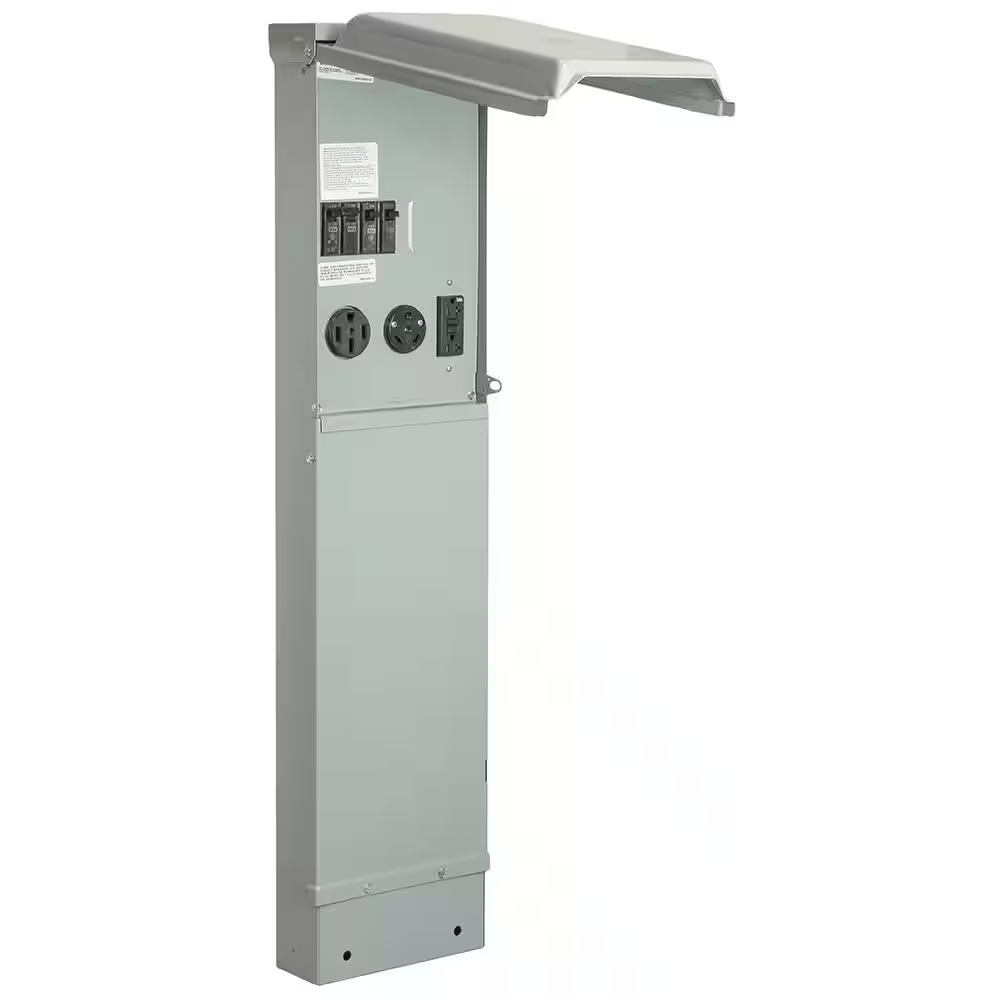
30 Amp vs 50 Amp RV Protection (This Part Is Much Simpler Than It Sounds)
This is the part that confuses almost every new RV owner, but it’s actually very straightforward once you understand one rule.
You do not choose power protection based on the campground pedestal.
You choose it based on your RV’s power cord.
Every RV is built to use either a 30 amp service or a 50 amp service. Smaller travel trailers, pop-ups, and many Class C motorhomes are typically 30 amp. Larger fifth wheels and motorhomes, especially those with two air conditioners, are usually 50 amp.
The difference isn’t just the plug shape — it’s how much electricity the RV is designed to safely use. A 30 amp RV runs all of its systems through a single 120-volt power line. A 50 amp RV actually has two separate 120-volt power legs, which is why larger RVs can run multiple air conditioners, electric water heaters, and residential refrigerators at the same time.
Here’s where many people get tripped up.
At some point you will plug into a pedestal that doesn’t match your RV. A 30 amp trailer may connect to a 50 amp outlet using an adapter, or a 50 amp RV may connect to a 30 amp outlet when that’s all the campsite has available. That is completely normal and adapters are designed for exactly that situation.
But the protection device must always match the RV — not the outlet.
A 30 amp RV should always use a 30 amp surge protector or 30 amp EMS, even when plugged into a 50 amp pedestal with an adapter. A 50 amp RV must use a 50 amp unit, even if you are temporarily connected to a 30 amp hookup.
The reason is simple. The protection device is there to guard your RV’s electrical system. It needs to monitor the type of power your RV was designed to receive.
Once you understand that, choosing the right unit becomes much easier.
Next, we’ll answer the question most people are really asking — which one you should actually buy.
Which One Should You Buy?
By this point, most RV owners already suspect the answer. The real question is not whether you need protection — it’s how much protection makes sense for your type of RV and how you camp.
If you only remember one thing from this guide, remember this:
A surge protector protects against a rare event.
An EMS protects against everyday campground electricity.
For most RVers, an Electrical Management System is the smarter long-term choice. Campground power problems are far more often caused by low voltage and wiring issues than dramatic lightning-type surges. An EMS constantly monitors incoming power and simply refuses to allow unsafe electricity into your RV. When voltage drops too low on a hot afternoon, it shuts power off. When the pedestal is wired incorrectly, it won’t connect at all. When power returns to a safe range, it reconnects automatically.
That single feature prevents the most expensive RV electrical failure — air conditioner compressor damage. One repair can cost more than the protection device itself.
That said, there is a place for a basic surge protector. If you camp very occasionally, stay mostly in newer RV parks, or need a temporary solution while you learn your RV systems, a surge protector is still far better than plugging in with no protection at all. It guards against major spikes and is an inexpensive starting point.
There is also a third option many RV owners eventually choose: a permanently installed (hardwired) EMS. Instead of hanging on the pedestal, it mounts inside the RV. It works exactly the same way as a portable EMS, but it cannot be forgotten, stolen, or left behind at a campsite. This is especially popular with full-time RVers and anyone who wants protection always active without an extra setup step.
So the simple guidance becomes clear.
If you want minimum protection at the lowest cost, a basic surge protector is acceptable.
If you want to actually protect your RV’s appliances and electronics from real campground conditions, an EMS is the right choice.
If you want protection permanently installed and always active, a hardwired EMS is worth considering.
In the next section, we’ll talk about what can actually happen to an RV that plugs into unsafe power without protection — and why so many experienced RVers refuse to connect without one.

What Happens If You Don’t Use Power Protection
Most RV electrical damage doesn’t happen dramatically. There’s no flash, no loud noise, and nothing at the campsite that looks obviously wrong.
Instead, the damage happens quietly.
You plug into a campsite on a hot afternoon. The park is full and nearly every RV has its air conditioner running. Your lights work, the microwave turns on, and everything appears normal. What you cannot see is the voltage slowly dropping below safe levels.
Your air conditioner tries to keep running anyway.
As voltage drops, the compressor begins pulling more amperage to compensate. That extra amperage turns into heat inside the motor windings. Insulation starts breaking down and the compressor weakens. Sometimes it fails immediately. Other times it runs for a few days or weeks before finally locking up, and it feels completely random when it stops cooling.
That is why many RV owners are surprised when an air conditioner suddenly fails after a trip where nothing seemed unusual.
The same thing can happen to other components. Converter/chargers can burn out, refrigerator control boards can fail, and electronic appliances can be damaged by improper wiring at a pedestal. An open neutral or reverse polarity condition can send power through circuits in ways they were never designed to handle, damaging multiple systems within seconds.
Repair costs add up quickly. An air conditioner replacement alone can run well over a thousand dollars once parts and labor are included. A refrigerator control board, converter, or microwave may each cost hundreds more. None of these failures feel connected to the moment you plugged in, which is why many RVers don’t realize campground power caused it.
Power protection devices prevent this in a simple way — they refuse to allow unsafe electricity into the RV in the first place.
In the final section, we’ll bring everything together and give a clear recommendation you can follow with confidence.
If you’re still learning how RV electrical hookups work, read our complete RV electrical system guide here.
Final Recommendation
At this point the choice usually becomes clear.
An RV does not have the same electrical protection a house has. When you plug into a campground pedestal, you are accepting whatever power that park is able to provide at that moment. Sometimes it is perfectly fine. Other times it is unstable, overloaded, or wired incorrectly, and your RV has no way to know the difference on its own.
That is why experienced RV owners rarely plug in without protection.
A basic surge protector is better than nothing. It can stop a large spike and may save your RV from a rare major event. But most RV electrical damage does not come from dramatic surges. It comes from everyday campground conditions — especially low voltage during heavy use.
An Electrical Management System solves that problem. Instead of reacting after damage begins, it prevents unsafe power from ever reaching your RV. If the pedestal is miswired, it will not connect. If voltage drops too low, it shuts power off. When the power becomes safe again, it reconnects automatically.
The important thing to understand is this:
A surge protector protects your RV from a moment.
An EMS protects your RV for your entire trip.
Considering the cost of an air conditioner, refrigerator control board, converter, and other electronics inside a modern RV, power protection quickly becomes one of the least expensive ways to avoid one of the most expensive repairs.
If you camp regularly, travel in older parks, or run an air conditioner in warm weather, an EMS is the level of protection that actually protects the RV you invested in.
In the next guide, we’ll go through specific options and help you choose the right protection unit for a 30 amp or 50 amp RV.
Unexpected electrical failures are one of the hidden expenses we cover in The Real Cost Of Owning An RV.
Frequently Asked Questions
Do I really need an EMS for my RV?
If you plug into campground electricity, yes. Campground power quality varies widely and low voltage is common, especially in older parks and during hot weather. An EMS prevents unsafe power from reaching your RV and protects expensive components like the air conditioner and converter.
Is a surge protector enough for an RV?
A surge protector is better than nothing and can protect against a major spike, but it does not monitor voltage or wiring conditions. Most RV electrical damage is caused by low voltage or miswired pedestals, which a basic surge protector cannot stop.
Should I get a portable or hardwired EMS?
Both protect the RV equally. A portable unit is easy to install and can be moved to another RV. A hardwired unit is permanently installed inside the RV, cannot be forgotten at a campsite, and is protected from weather and theft.
Can I plug my 30 amp RV into a 50 amp pedestal?
Yes. This is normal and is done using an adapter. You still use a 30 amp surge protector or EMS because protection must match the RV, not the campground outlet.
Can bad campground power really damage an RV?
Yes. Low voltage can overheat an air conditioner compressor, and wiring faults can damage converter chargers, refrigerator control boards, and electronics. Many RV owners only discover this after an unexpected repair.