
If you’re thinking about buying an RV this year, you’ve probably already asked yourself the big question: what is the real cost of owning an RV in 2026? Not just the price on the windshield, but the total picture—payments, insurance, fuel, campgrounds, maintenance, upgrades, and all the little “surprise” costs that show up after the first few trips.
Dealers are happy to talk about monthly payments and flashy features. Very few slow down and walk you through what it actually takes to live with an RV for a year or two. That’s how people end up stretched too thin, or worse, resenting a rig they used to be excited about.
The truth is, RV ownership can absolutely be affordable and worth it in 2026—but only if you go into it with clear eyes and a realistic budget. Prices have leveled out since the wild pandemic years, campgrounds are busier but more transparent about their fees, and there are more tools than ever to help you control fuel and maintenance costs. When you understand the full picture, you’re in control instead of reacting to bills.
In this guide, we’re going to strip away the guesswork. We’ll start with how the type of RV you buy shapes your entire cost profile, then break down the big ongoing expenses: insurance, maintenance, fuel, campground fees, and storage. From there, we’ll dig into the “hidden” costs new owners rarely plan for—first-month gear, tires, depreciation, and upgrades based on how you actually camp.
We’ll also put some real numbers to different RV lifestyles. Weekend warrior. Seasonal traveler. Full-timer. You’ll see what each one typically spends per month so you can match the examples to your reality instead of a salesperson’s pitch. Then near the end, we’ll cover a piece almost nobody talks about: where RV ownership may help you at tax time if you use your rig the right way and talk with a good tax pro.
If you’re still deciding whether RV ownership makes sense for you, our buying an RV guide walks through how to choose the right RV and avoid common first-time buyer mistakes.
By the time you reach the bottom of this post, you shouldn’t be wondering “Can I afford an RV?” anymore. You should know, clearly, what it will cost you, what you’re comfortable with, and how to build a budget that lets you enjoy the lifestyle instead of stressing over it.
Ready to see what The Real Cost of Owning an RV in 2026? Let’s start with the one factor that affects everything else: the kind of RV you choose.
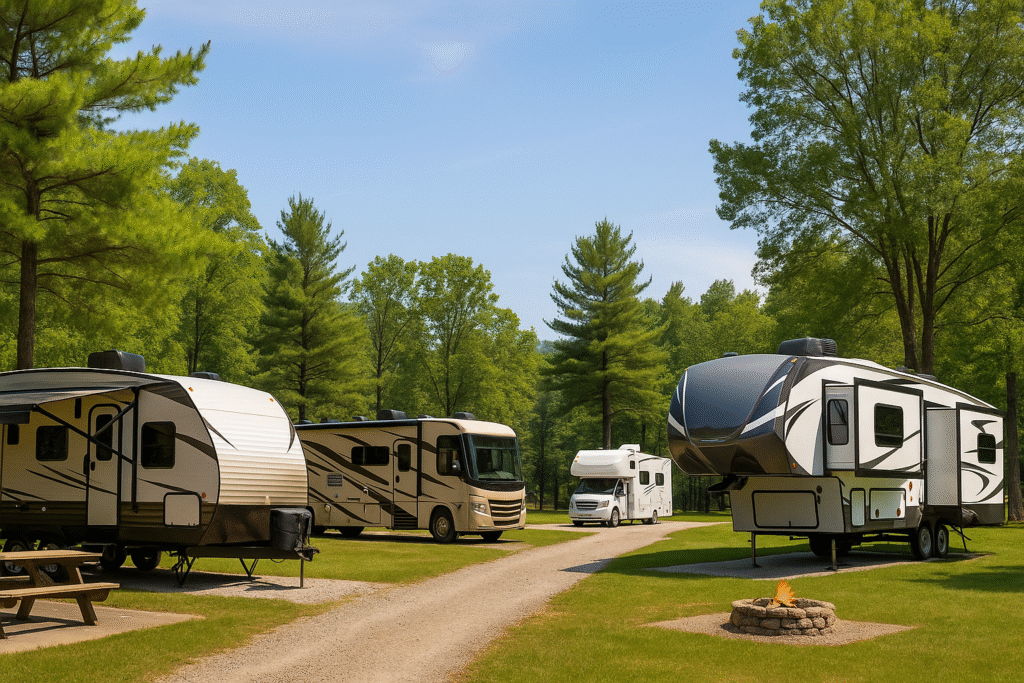
How your RV type shapes the real cost of owning an RV in 2026
Before you think about monthly budgets, you have to decide what kind of RV you’re actually talking about. A 22-foot travel trailer and a 42-foot luxury fifth wheel might both be “RVs,” but they live in completely different financial worlds. Purchase price, insurance, fuel, tires, maintenance, even campsite choices all change based on the type of rig you buy.
In 2026, most towable rigs (travel trailers and fifth wheels) are still the most budget-friendly way to get into RVing. They’re usually cheaper to buy, cheaper to insure, and cheaper to maintain than a motorhome, but they require a capable tow vehicle. If you already own a truck or SUV that can safely tow, your overall cost of ownership stays lower. If you have to go out and buy a heavy-duty truck just to pull the trailer you want, that truck payment becomes part of your true RV cost whether the dealer mentions it or not.
Motorhomes flip that equation. You’re buying your “house” and your “engine” in one package. That can be incredibly convenient on travel days, but it also means you’re maintaining an entire vehicle on top of your rolling home. Oil changes, chassis service, tires, and engine work are all more expensive on a Class A or Super C than on a half-ton pickup. A motorhome also changes how you camp—many owners flat-tow a small car behind them, which adds its own costs for setup, braking systems, and registration.
Bigger rigs, bigger bills
Size matters just as much as type. As you move into bigger, taller, heavier rigs, everything scales up with it. A 40-foot fifth wheel or diesel pusher doesn’t just take up more space on the road—it usually needs longer, more expensive campsites. Many private parks charge extra for “premium” pull-through or big-rig-friendly sites, and some state parks simply can’t fit the largest RVs, which limits your options and pushes you toward higher-cost campgrounds.
Fuel economy also takes a hit as size goes up. More weight and more frontal area mean your tow vehicle or motorhome has to work harder, burning more gas or diesel every mile. On top of that, a bigger RV means more roof to inspect and reseal, more slideouts to keep adjusted and lubricated, more appliances, more ducting, and more systems that all need periodic attention. None of this is a dealbreaker, but it’s why large rigs come with a noticeably higher real cost of owning an RV in 2026.
When “too small” ends up costing more
Going small to “save money” sounds smart, but it can backfire if the rig doesn’t match how you actually camp. If the RV feels cramped, doesn’t have enough storage, or has tiny holding tanks, you may end up spending more than you expected in other areas. People with limited storage often eat out more because cooking in a cramped kitchen is frustrating. Small tanks can push you toward full-hookup sites instead of cheaper dry camping because you can’t comfortably go more than a night or two without dumping or refilling.
Over time, that frustration adds up. A lot of owners who rushed into a small, “starter” rig end up trading it in a year or two later for something bigger. Every trade means more sales tax, more registration fees, and more depreciation you never get back. Those rapid upgrades are one of the sneakiest ways people drive up the real cost of owning an RV in 2026 without even realizing it.
Matching your RV to your real lifestyle
The sweet spot is an RV that fits your real life, not just the dream version in your head. A weekend couple who mostly hits local state parks doesn’t need the same size, tank capacity, or luxury level as a full-time family crisscrossing the country. Someone who boondocks out West on public land will value solar, larger tanks, and higher clearance, while a snowbird who spends winters in full-hookup resorts might care more about interior comfort and storage.
Once you’re honest about how often you’ll travel, how far you’ll go, and how many people you need to sleep comfortably, it becomes much easier to choose a type and size of RV that won’t blow up your long-term budget. Getting this decision right up front sets the foundation for everything else we’re about to cover—because every ongoing cost you’ll see next is shaped by the rig you pick on day one.
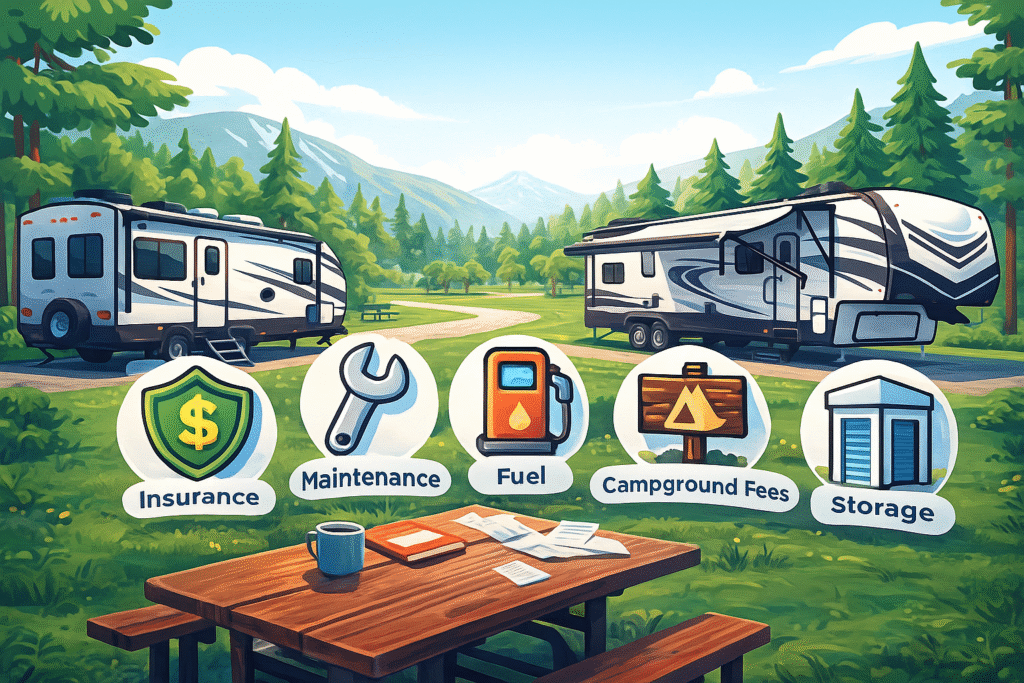
The big 5 ongoing RV costs that drive the real cost of owning an RV in 2026
Once you’ve chosen a rig, the real cost of owning an RV in 2026 question isn’t “what does it cost to buy?” It’s “what does it cost to live with this thing month after month?” The payment is only one line in the spreadsheet. The bills that show up over and over—those are what decide whether RV life feels comfortable or constantly tight.
In 2026, almost every RV owner’s budget is built around the same five categories: insurance, maintenance, fuel, campground fees, and storage. It doesn’t matter if you’re in a small trailer or a big diesel pusher—those five buckets are always there in some form, this is what it cost to own an RV.
Your exact numbers will change depending on the type of RV you own, how often you travel, and where you like to camp, but these are the levers that really move your overall cost of ownership up or down. Get a handle on these, and you’ll have a clear, honest picture of what the real cost of owning an RV in 2026 looks like for you.
Insurance
RV insurance feels like just another bill until something goes wrong, and then it becomes one of the most important protections you have. Premiums are based on the value of your RV, whether it is motorized or towable, how you use it, and where it is registered.
A smaller travel trailer that only hits the road a few weekends a year might cost a few hundred dollars a year to insure, while a high-value Class A or Super C used heavily can climb into the low thousands. Full-timers pay more because their RV is treated more like a primary residence than a toy.
It’s worth taking the time to compare true RV policies instead of just adding the rig to your auto insurance and calling it good. Look closely at how much personal property is covered, what happens if the RV is totaled early in its life, and whether you have vacation liability coverage for when the rig is parked at a campsite. Two policies that look similar on price can be very different when you read the fine print. Getting this right up front gives you predictable annual cost and a lot more peace of mind.
Maintenance and wear items
Every RV, from teardrop to diesel pusher, slowly wears out as it rolls down the road and sits out in the sun and rain. A simple rule of thumb many owners use is to set aside one to two percent of the RV’s value each year for RV maintenance cost. On a modest $30,000 trailer that might mean three to six hundred dollars a year, while a $150,000 fifth wheel or motorhome could easily justify fifteen hundred to three thousand dollars in annual upkeep.
That money goes into roof inspections and sealant touch-ups, air conditioner service, water heater maintenance, brake and bearing service on towables, and chassis service on motorhomes. Eventually it also covers bigger ticket items like replacement tires, batteries, and aging appliances. None of these costs show up in the dealer’s payment quote, but skipping them almost always leads to leaks, breakdowns, and much more expensive repairs later. Building a small, steady maintenance fund into your 2026 budget turns those “surprises” into planned expenses.
Ongoing upkeep is one of the biggest long-term ownership expenses, and it’s often underestimated by new buyers. To see a full breakdown of what owners actually spend, including routine upkeep and annual planning, read our guide on RV maintenance cost per year.
Fuel and travel costs
Fuel is the part of RV ownership you feel every time you pull out of the driveway. A light trailer behind a half-ton truck might see ten to twelve miles per gallon when towing. A bigger fifth wheel or gas Class A can drop into the single digits, and a large diesel pusher or Super C often lands somewhere in between depending on how and where you drive. When you spread those numbers over real trips, you start to see patterns. A nearby state park weekend might only add a tank or two of fuel to your month. A cross-country run to Florida or Arizona will show up very clearly on the credit card.
The good news is that fuel is one of the most controllable parts of the real cost of owning an RV in 2026. Slowing down a little on the highway, planning shorter hops between destinations, and staying longer in each place all reduce what you burn. Choosing a rig that matches your tow vehicle instead of forcing an upgrade helps even more. The more honest you are about how far and how often you’ll really drive, the more accurate your fuel budget will be.
Campground and overnight fees
Your nightly site cost changes your monthly RV budget more than almost anything else. A basic site at a state park with electric and water might run in the twenty-five to forty-five dollar range in many areas. Private parks with full hookups, a pool, and more amenities often live in the forty-five to eighty dollar range. High-demand resort areas, coastal spots, and snowbird destinations can go well beyond that, especially in peak season or for large pull-through sites.
How you like to camp matters just as much as the posted rates. Someone who loves boondocking on public land and only needs hookups occasionally can keep this category surprisingly low. Another RVer who wants full hookups, cable, and a hot tub every night will see campground fees become one of their largest monthly expenses. Neither style is “wrong.” You just want to be sure the way you prefer to camp is reflected in the numbers you build your 2026 budget around.
Storage when the RV is not in use
If your RV lives at home in a side yard or driveway, storage might be almost free. For many owners, though, especially in neighborhoods with HOAs or tight driveways, paid storage is part of the equation. An outdoor storage lot is usually the least expensive option, offering a basic space on gravel or pavement. Covered storage costs more but protects your roof, seals, and paint from constant sun and weather. Fully enclosed storage with a roll-up door is the premium choice and comes with premium pricing to match.
Storage costs can quietly add hundreds or even thousands of dollars a year to the total cost of ownership, especially if you keep a larger rig or use climate-controlled space. It’s worth running the math both ways: what it would take to make space at home versus what local facilities charge. Either way, thinking about where your RV will sit when you are not traveling is a key part of understanding what it truly costs to own.
Many first-time buyers underestimate how much the smaller, ongoing expenses add up over time. These hidden RV costs most buyers don’t expect often surprise owners after the first few trips.
The “surprise” RV costs new owners never see coming
Even when you’ve done your homework, most first-time owners still run into a few expenses they didn’t see coming. These aren’t disasters, just steady little hits that quietly raise the real cost of owning an RV in 2026 if you don’t plan for them. They tend to show up in the first year, after the excitement of the purchase and that first big trip.
A lot of this comes down to a simple pattern: the RV you buy rarely comes with everything you need, the parts that wear out do it on their own schedule, and the way you actually camp nudges you toward a few upgrades you didn’t think about on the lot. If you know these “surprise” categories ahead of time, you can turn them from stress into line items in your budget.
First-month gear and setup costs
Almost every new owner has the same moment: you bring the rig home, park it, and realize how much basic gear the dealer did not include. That’s when the first-month spending really starts. You’ll need a proper sewer hose with fittings, a dedicated drinking water hose, a water pressure regulator, a surge protector or EMS, wheel chocks, leveling blocks, maybe a better water filter, and a starter set of tools just to handle the normal little adjustments RVs always seem to need.
On top of the “hard” essentials, there are comfort items that quickly stop feeling optional once you camp a night or two. A decent mattress topper, a better shower head, a ground mat outside the door, camp chairs, a small folding table, storage bins, and organizers all make the RV feel usable instead of bare.
It’s very normal for a new owner to spend a few hundred dollars in that first month just getting the rig truly ready to camp. That money isn’t wasted, but it absolutely belongs in your picture of the real cost of owning an RV in 2026, not treated like some random one-off.
Many of these first-month expenses come from basic setup items dealers don’t include. We break down what you actually need—and what you can skip—in our RV starter essentials guide.
Tires and batteries that don’t care about your timeline
Tires and batteries are classic “I’ll deal with that later” items, right up until they aren’t. RV tires, especially on trailers and fifth wheels, often age out before they wear out. By year five or six, even if they still have tread, the rubber can be tired from UV, heat, and sitting in one spot. That’s when blowouts and sidewall failures start showing up, and those can take pieces of your RV with them. Replacing a full set of quality trailer tires or big motorhome tires isn’t cheap, but it’s far cheaper than body work on the side of your rig.
House batteries follow a similar pattern. They gradually lose capacity, especially if they’ve been deeply discharged, left sitting dead, or never fully charged. The first thing you notice is shorter boondocking time or the converter running constantly. Then the batteries simply can’t keep up anymore. Whether you stay with lead-acid or upgrade to AGM or lithium, at some point you’re writing a check. Planning ahead for tires and batteries every few years instead of pretending they’ll last forever keeps this from feeling like a crisis when the time comes.
Depreciation and trading too often
Depreciation is the quiet background cost of almost anything with wheels, but it hits RVs harder than many new owners realize. New rigs typically lose a chunk of value in the first couple of years, then settle into a slower, steadier decline. That’s not a reason to avoid buying new if it fits your plan, but it is a strong argument for choosing the right RV the first time instead of treating it like a short-term placeholder.
Where people really get burned is trading too quickly. You see it all the time: someone buys a small trailer to “start cheap,” realizes it’s too small, and trades into a bigger fifth wheel a year later. Or they jump on a floor plan that looks great at a show but doesn’t fit real-world camping, so they swap rigs after their first season. Every trade means sales tax, fees, and taking a hit on the previous RV’s value. Do that two or three times and the invisible cost of those swaps can rival what you spent on actual camping.
Being honest about your needs up front and resisting the urge to “upgrade just because” keeps depreciation from quietly chewing up your budget.
Upgrades that follow how you really camp
The last surprise category is upgrades driven by how you actually end up using the RV. On paper, the factory setup might seem fine. After a few trips, you figure out where it’s not. Full-hookup campers often decide they want better steps, a sturdier entry handle, or nicer outdoor furniture because they spend so much time going in and out. People who fall in love with boondocking quickly realize solar, more battery capacity, and maybe a better inverter move from “nice to have” to “must have.” Winter chargers discover heated hoses and tank pads are suddenly on the shopping list.
None of these upgrades are mandatory on day one, and you don’t have to do them all at once. When calculating the real cost of owning an RV in 2026, it’s wise to assume you will put some money into dialing in the rig to match your style. If you build a little “upgrade cushion” into your 2026 RV budget—maybe a small monthly amount set aside—you’ll be ready when the time comes to improve the mattress, add a rear camera, swap out lights, or install a small solar setup. Then those changes feel like intentional improvements to your RV life, not surprise hits to your wallet.
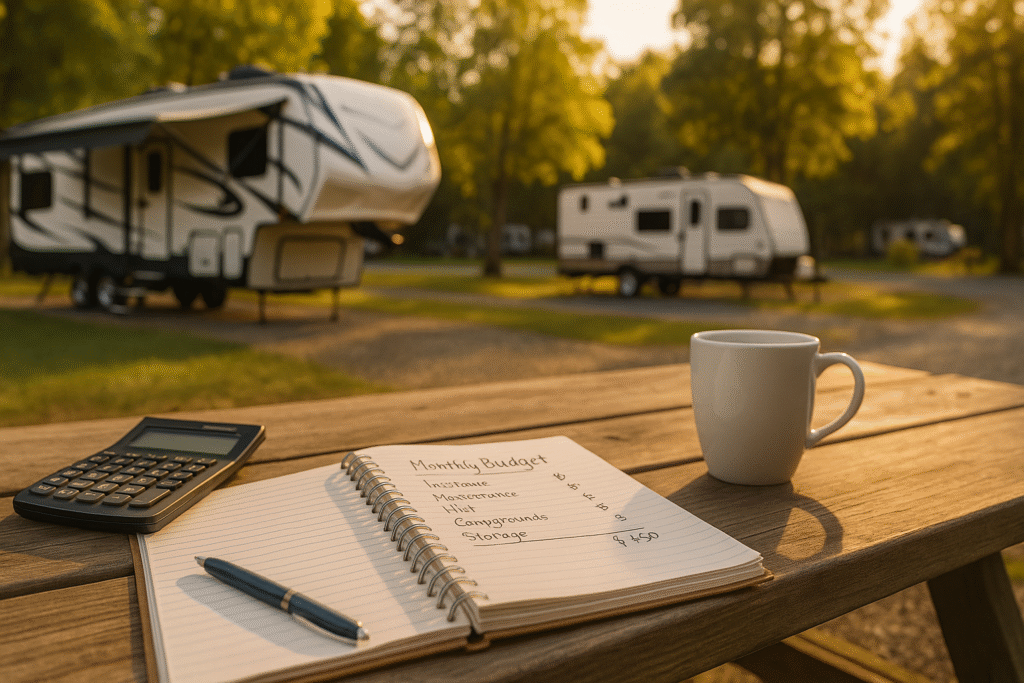
What RV ownership really costs per month in 2026
At some point you have to turn all these pieces into real numbers. The question isn’t just “what’s my payment?” It’s, “what does the real cost of owning an RV in 2026 look like month to month, once everything is added up?”
There’s no single magic number that works for everyone. Your fuel bill, campground choices, and maintenance needs will never look exactly like someone else’s. But you can get surprisingly close by thinking in terms of how you actually use the rig, instead of trying to chase an average that doesn’t exist.
For most people, RV life falls into one of three buckets: light weekend camping, active or seasonal travel, and full-time living. Once you see what those three lifestyles typically spend in a month, it becomes much easier to plug in your own situation and get a realistic picture of your personal monthly RV cost.
Light weekend camper
This is the person or family who heads out one or two weekends a month and maybe takes a longer trip once or twice a year. Most are in a smaller travel trailer or mid-size fifth wheel, often stored at home or in a simple outdoor lot.
Their ongoing costs are there, but they stay fairly controlled. Spread over a year, insurance, registration, basic maintenance, fuel for short trips, and a few campground stays usually land somewhere around $250–$450 per month before any RV or truck payment.
For many people, that’s less than they’d spend on a couple of hotel-and-restaurant vacations, but you get a lot more weekends away and a rig that’s ready to roll whenever you are.
Active traveler or seasonal camper
Active travelers use their RV more often. They might camp several weekends a month, take multiple longer trips, or spend a season in one region as a part-time snowbird. Rigs here are often mid-to-large trailers, fifth wheels, or Class C / Class A motorhomes.
Because they’re on the road more, fuel, campground fees, and maintenance all step up. Once you average things over a year, this group typically lands in the $500–$1,200 per month range in real RV ownership costs for 2026, again before any loan payments.
It’s a bigger number, but it’s buying a lot of time on the road—more miles, more campfires, and more of the “we actually use this thing” kind of lifestyle.
Full-time RVer in 2026
Full-timers are using their RV as home, not just as a toy. Their costs look less like “trip expenses” and more like rent or a mortgage, just shaped differently. Most are in larger fifth wheels, Class A’s, Super C’s, or well-equipped Class C rigs.
How they camp makes a huge difference. A slow-travel, budget-conscious full-timer who uses monthly rates and some boondocking might land near $1,200–$1,800 per month. Someone who prefers resorts in popular areas and moves more often can easily be in the $2,000–$3,000+ per month range, all before payments.
The key is that full-timers are trading a traditional house payment and utility bills for a rolling version of the same idea. When you look at the real cost of owning an RV in 2026 through that lens, it becomes easier to decide whether full-time RV life fits your budget and comfort level.
Monthly cost comparison at a glance
As for the real cost of owning an RV in 2026, use this table as a starting point, then tweak the numbers to match your rig, fuel prices, and camping style.
| Lifestyle | Insurance & Reg. (mo.) | Maintenance Fund (mo.) | Fuel (mo.) | Campgrounds (mo.) | Storage (mo.) | Approx. Total (mo.)* |
| Light weekend camper | $40–$80 | $25–$60 | $75–$150 | $100–$200 | $0–$75 | $250–$450 |
| Active traveler / seasonal camper | $50–$100 | $60–$150 | $150–$300 | $300–$700 | $50–$150 | $500–$1,200 |
| Full-time RVer | $80–$180 | $150–$300 | $150–$400 | $600–$2,500 | Usually $0 | $1,200–$3,000 |
*These ranges are rough estimates for planning, not hard rules. Your real numbers will depend on your rig, location, fuel prices, and how you like to camp.
RV ownership tax breaks: where an RV might actually help at tax time
tighten the intro
reinforce the main keyword “real cost of owning an RV in 2026” once
smooth the legal disclaimer
keep your clear teaching tone
Here is the cleaned-up version you can paste in:
RV Ownership Tax Breaks: Where an RV Might Actually Help at Tax Time
An RV will never be completely “free,” but it doesn’t always have to be just a money drain either. Depending on how you use your rig, certain parts of RV ownership may help reduce your overall tax burden. While recent tax law changes removed some older green-energy incentives, there are still situations where an RV can qualify for deductions if it meets certain IRS requirements.
In some cases, an RV may qualify as a second home, support a small business, or even play a role in remote work or travel-based income. When those situations apply, certain expenses tied to the RV may become partially deductible. That doesn’t eliminate the cost of ownership, but it can slightly reduce the real cost of owning an RV over time.
This still isn’t legal advice, and the rules can change, but as of right now these are the key areas worth exploring with a tax professional if you want to turn your RV from a pure expense into something that works a little harder for you. You can get more info from the IRS website.
When your RV can count as a home
For IRS purposes, a home is defined as any property that includes sleeping, cooking, and toilet facilities. That definition can include a traditional house, a boat, or an RV.
If your RV meets those requirements and the loan is secured by the RV itself, the interest on that loan may qualify as home mortgage interest on a primary or secondary residence. However, there are limits on the total amount of mortgage debt that can qualify, and you must itemize deductions rather than take the standard deduction.
For RV owners who already itemize their taxes, this means a portion of the interest paid on an RV loan could reduce taxable income slightly. It won’t eliminate the costs of ownership, but it can help lower the long-term real cost of owning an RV.
Business use, Section 179, and accelerated depreciation
This type of tax treatment usually applies to specific situations. For example, some traveling professionals live in their RV while working near temporary job sites. Certain mobile businesses also operate directly from their RVs while providing services, training, consulting, or event support. In other cases, serious content creators or media professionals may use an RV as part of their production environment or brand presence.
However, the key factor is legitimate business use. If an RV is claimed as a business asset, owners must be able to document how it supports the business through mileage logs, work schedules, contracts, and income records. The IRS expects clear documentation that the RV is truly part of the operation rather than simply a personal vehicle being partially reclassified.
It is also important to understand that some of the more generous upfront depreciation rules are gradually phasing down under current law, which means timing and percentages can matter. A qualified tax professional who understands Section 179 and vehicle depreciation rules can help determine whether a specific situation actually qualifies.
For RV owners who legitimately use their rig as part of a business, these deductions can offset a meaningful portion of the long-term cost. When handled correctly, business use can help reduce the real cost of owning an RV in 2026, though it’s something that should always be approached carefully and with professional guidance. rules.irs.gov A tax pro can help you translate those rules into RV-specific planning.
Big picture and a necessary disclaimer
Before wrapping up this section, it’s important to step back and look at the big picture around RV tax deductions.
First, this article is not tax advice. Tax laws change, individual situations vary widely, and the rules around RV deductions can be complicated. The information here is meant to help you understand the general concepts that sometimes apply to RV ownership, not to replace professional tax guidance. If you’re considering claiming deductions related to an RV, the safest approach is to speak with a qualified CPA or tax professional who understands how these rules apply to your specific situation.
In general, the way an RV is used determines whether any meaningful tax benefits may exist. When an RV is legitimately used as part of a business, mobile work setup, or professional content creation environment, there can sometimes be larger deductions available through depreciation, Section 179 expensing, or business travel expenses. These situations require careful documentation and clear business purpose.
On the other hand, if the RV is used purely for personal travel and vacations, it will usually remain just that—a personal expense. In some cases a small tax benefit may exist if the RV qualifies as a second home and the owner itemizes mortgage interest, but those situations tend to be limited and highly dependent on individual circumstances.
The key takeaway is simple. Used strictly as a recreational toy, an RV will almost always be a cost. Used thoughtfully, and with proper guidance, there may be situations where certain tax rules slightly reduce the real cost of owning an RV. The important part is making sure any deductions are legitimate, documented, and handled correctly. will always be a cost. Used thoughtfully, and paired with good advice, the tax side can at least soften part of the real cost of owning an RV in 2026 instead of making it all downside.
Is the real cost of owning an RV in 2026 worth it?
Once you’ve seen the numbers laid out, the question naturally becomes, “Okay, but is it worth it for us?” The truth is, the real cost of owning an RV in 2026 is only “expensive” or “cheap” when you compare it to the life you actually want to live and what you’d spend on other types of travel.
For some people, the RV is basically a rolling cabin that replaces hotels, flights, and restaurant-heavy trips. For others, it’s a second home, a retirement base, or even part of how they earn a living. If you line up the monthly costs next to what you already spend (or plan to spend) on vacations, weekend getaways, or housing, the picture usually gets a lot clearer.
When the numbers make sense
RV ownership tends to make the most sense when the rig is actually used regularly. For people who take frequent weekend trips, seasonal travel, or longer road adventures throughout the year, the cost of owning an RV spreads across many experiences instead of being tied to a single annual vacation.
Another important factor is whether the full monthly cost fits comfortably inside your budget once everything is included. That means looking beyond the payment and accounting for insurance, maintenance, fuel, campground fees, and storage if needed. When those numbers still fit within what you’re already comfortable spending on travel, the financial picture often becomes much clearer.
Many RV owners also value the flexibility the lifestyle offers. Being able to chase good weather, visit family, or spend a few days beside a lake without months of planning is a big part of the appeal. When that freedom is something you know you’ll use often, the real cost of owning an RV in 2026 starts to look less like a luxury purchase and more like paying for a lifestyle you actively enjoy.
When it might not be the right time
On the other hand, there are situations where owning an RV may feel heavier than expected. If monthly finances are already tight, adding another large payment and ongoing travel expenses can quickly turn what should be an exciting purchase into a source of stress.
Ownership can also be frustrating when the RV sits unused most of the year. Many people imagine traveling far more often than their schedule or energy realistically allows. When that happens, the rig becomes an expensive driveway decoration instead of the adventure tool it was meant to be.
In those situations, it can make sense to slow down before committing. Renting an RV for a season, borrowing from friends, or simply waiting until work and finances feel more stable can often lead to a better experience later. The RV lifestyle isn’t going anywhere, and many people enjoy it much more when they start at a time when it truly fits their life.ue.
How to use this guide going forward
The goal of this guide isn’t to push you toward buying an RV or to talk you out of it. The goal is simply to give you a clear, honest look at the real cost of owning an RV in 2026 so you can make a decision that fits your situation.
One helpful approach is to plug your own numbers into the ranges we’ve discussed and compare them with what you already spend on travel. Looking at those numbers alongside the type of RV you’re considering can give you a much clearer picture of what ownership might look like in your real life.
It’s also worth pairing this cost guide with a solid buying guide so you avoid purchasing more RV than you actually need. When the size of the rig, the travel style, and the budget all match, the entire ownership experience tends to feel much more manageable.
Many readers also find it helpful to combine this article with other RV guides and planning tools so they can move from the question of “What should I buy?” to “What will it really cost?” in one place.
If, after looking through the numbers, the lifestyle still feels exciting and the costs feel reasonable, that’s usually a good sign. At that point the RV stops being just a big purchase and starts becoming what it was meant to be — a tool that helps you travel more often, explore more places, and build the kind of experiences people remember long after the trip ends.hat’s your green light. At that point, the RV isn’t just a big toy—it’s a tool you’re using on purpose to get more freedom, more memories, and more time where you actually want to be.
Read more helpful guides.