
Winter RV driving can feel intimidating — and honestly, it’s completely normal to be nervous. Ice, snow, fog, steep grades, wind gusts… winter throws a lot at you, especially when you’re handling a big rig or towing a heavy fifth wheel. But here’s the good news: with the right techniques, the right mindset, and a little preparation, you can drive confidently in winter conditions.
In this guide, we’ll break down everything you need to know to stay safe and in control — from spotting black ice and driving through deep snow to managing fog, handling wind gu1sts, and conquering both uphill and downhill mountain grades. Whether you’re brand new to winter RV travel or you just want a refresher before heading out, this step-by-step 2025 winter RV driving guide will give you the skills and confidence to enjoy your trip instead of fearing the road.
Let’s get you ready for whatever winter throws your way.
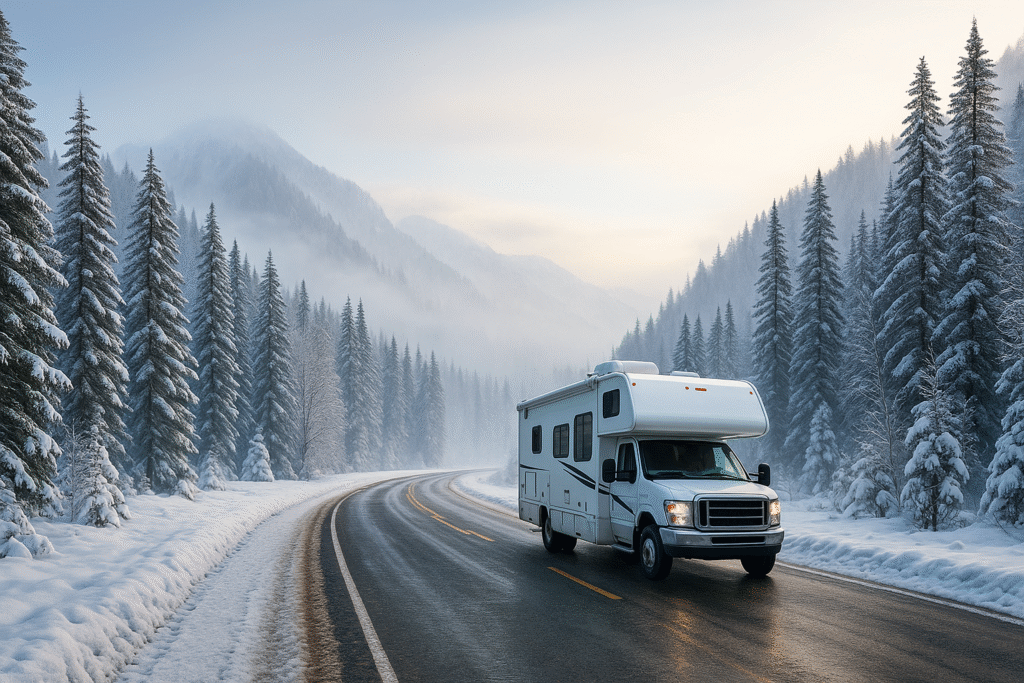
Winter RV Driving Basics (What Every RVer Must Know)
Winter RV driving isn’t about being fearless — it’s about being prepared, staying aware, and understanding the way your RV behaves when temperatures drop and the road surface changes. Cold weather affects everything: your traction, your braking, your visibility, and even the way your RV or trailer reacts to steering inputs. Before we jump into specific dangers like ice, snow, fog, steep grades, and high winds, it’s important to get grounded in the fundamentals. When you understand what’s happening underneath your tires and around your rig, winter driving transforms from something stressful into something manageable. These basics will give you the confidence to make smart decisions, handle unexpected conditions, and enjoy every mile instead of worrying about what’s ahead.
Why Winter Is Different for RVs
Winter driving affects RVs in ways that surprise even experienced drivers, and a lot of it comes down to size, weight, and how these rigs are built. An RV carries far more mass than a regular vehicle, which means it takes longer to slow down and much more distance to come to a full stop—especially when the pavement is slick or covered in ice. That extra weight creates momentum that doesn’t simply disappear when you hit the brakes.
Height plays a big role too. A tall RV catches winter winds the way a sail catches air, and when you combine cold, slick pavement with sudden gusts, it can make your rig feel unstable or push you toward the edge of your lane. The length of your RV or trailer adds another layer of complexity. Longer wheelbases respond more slowly to steering inputs, which means any quick movements—especially on ice—can create sway or cause the rig to drift instead of following your steering smoothly.
Towable RVs introduce their own winter challenges. A trailer can push your truck downhill if gravity takes over, or start to sway on a snowy curve long before you feel it in the steering wheel. Correcting too sharply can make the trailer swing wider or even start a jackknife if the tires lose traction. Motorhomes aren’t immune either. Their weight distribution, traction points, and braking characteristics behave differently in cold weather, and once those tires slip, a big Class A or Class C can be just as difficult to stabilize.
Understanding these differences—and respecting them—is the foundation of safe winter RV driving. Once you know how your rig reacts to cold temperatures, snow, wind, and slick surfaces, you’ll make calmer decisions and stay in control even when the conditions change fast.
How Winter Weather Affects RV Handling
Winter doesn’t just change the scenery — it changes the way your RV behaves on the road. Cold temperatures can stiffen your tires, reducing their ability to grip the pavement the way they normally would. Even roads that look dry can have a thin film of frost that lowers traction just enough to make stopping or turning feel different. When you add slush into the mix, you get uneven traction from side to side, which can cause your RV or tow vehicle to drift slightly or feel like it’s being gently pulled in one direction.
Bridges, overpasses, and areas that stay shaded throughout the day freeze much faster than open sections of highway. You can be driving on perfectly wet pavement one moment and hit a completely frozen patch the next, without any warning. These sudden changes catch a lot of drivers off guard, especially when towing. On top of that, your brakes can behave differently in extreme cold. Moisture can freeze, response times can vary, and brake pressure might feel uneven if your system isn’t warming up the way it normally does.
Visibility also becomes a core part of winter handling. Fog, frost, blowing snow, and shorter daylight hours all combine to reduce how far you can see and how quickly you can react. Even experienced RVers tend to underestimate how much slower you must drive when your visibility is limited. When all of these factors stack together — reduced traction, sudden ice patches, unpredictable braking, and limited visibility — the RV simply handles differently, and giving yourself extra time and space becomes essential.
Road Condition Resources Every RVer Should Use
One of the smartest ways to stay safe in winter is to know what the road looks like before you ever start driving. Winter weather can change by the hour, and road conditions shift quickly between clear, icy, snow-packed, foggy, or fully closed. Checking the right resources can make the difference between a smooth travel day and getting caught in a dangerous situation you could have avoided.
Every state offers its own “511” road condition system that provides live updates on traffic cameras, closures, current chain requirements, and highway alerts. These tools are incredibly accurate for mountain passes and high-altitude routes, where conditions can shift faster than forecasts predict. Simply searching for a state’s 511 page gives you instant access to all of this in one place. You cam go to National 511 Directory (All States).
The National Weather Service is another resource you should never skip. Their winter advisories, storm warnings, wind alerts, and snow squall warnings are updated constantly and often give you several hours of advance notice. Pairing their information with the live radar on Weather.gov helps you see exactly where snow bands or icy rain are forming — and whether they’re moving toward your route.
Apps like Windy are favorites among RVers because they let you visualize wind gusts, visibility, temperature changes, and even the likelihood of ice forming in shaded or mountain areas. Google Maps and Waze add crowd-sourced reports of accidents, hazards, and sudden slowdowns, which are extremely helpful once you’re already on the road.
For longer trips or mountain routes, truck-focused apps like Trucker Path will show you the uphill and downhill grades ahead, chain-up stations, closed passes, safe pull-off locations, and parking areas for waiting out storms. And if you have an RV-specific GPS — especially from Garmin or Rand McNally — you’ll get warnings about low-clearance bridges, propane-restricted tunnels, sharp grades, and winter-related hazards along your exact path.
Using these tools together gives you a complete picture of what’s happening on the road long before you get there. Planning ahead with accurate info is one of the best ways to stay safe during winter RV travel.
Whether you’re a seasoned RV traveler or new to the lifestyle, the RV LIFE GPS is an essential tool for navigating with ease and peace of mind. With its customized turn-by-turn directions (specific to your RV’s height, weight, and length), you can journey with confidence.
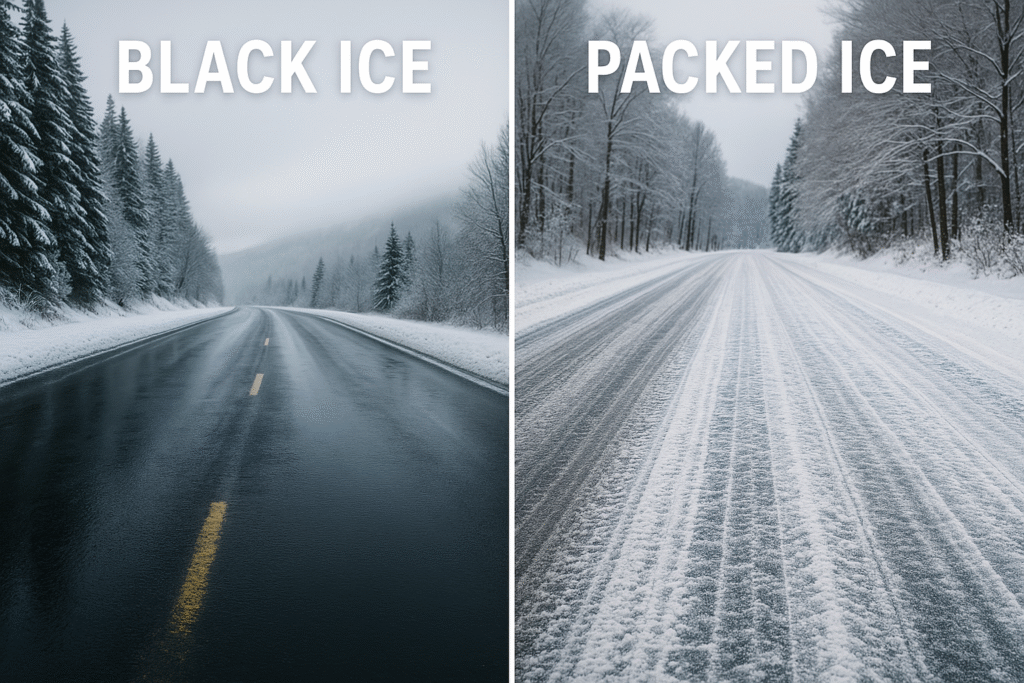
Conquering Ice (Black Ice, Bridge Ice, Packed Ice)
Ice is the most deceptive and dangerous challenge you’ll face in winter RV driving, mainly because it gives you almost no warning. Snow announces itself — you can see it on the road, hear it under your tires, and adjust your speed long before it becomes a problem. Ice, on the other hand, blends into the pavement so well that the road often looks completely normal right up until your tires break traction. One second everything feels fine, and the next you feel the rig lighten beneath you, the steering go soft, or the trailer start to nudge your truck from behind.
For RVers, especially those towing heavy fifth wheels or travel trailers, even a momentary slip can turn into something serious if you react too quickly or too aggressively. A small slide can become sway, a light push from the trailer can send you drifting toward the shoulder, and a mistimed brake press can make the skid worse. That’s why learning to recognize icy conditions and knowing exactly how to respond when traction disappears is one of the most important winter driving skills you can build.
Ice doesn’t care how much experience you have or how confident you feel; it demands respect, calm thinking, and a steady hand. When you understand how ice forms, where it hides, and how your RV behaves when you hit it, you’ll be miles ahead of the average winter driver.
How to Spot Black Ice
Black ice is the most dangerous part of winter RV driving because it hides in plain sight. It forms a thin, glassy layer that makes the pavement look wet even when it’s actually frozen. The biggest giveaway isn’t just how the road looks — it’s the combination of temperature and location. Any time the outside temperature sits between about twenty-five and thirty-four degrees, assume the “wet” pavement might be ice, especially on bridges, overpasses, and shaded areas that don’t get much sunlight.
You can often spot black ice by the way the road surface changes. It may look slightly darker or shinier than the pavement around it, almost like someone poured water on the road. One of the best real-world clues comes from the vehicles ahead of you: if the road looks wet but you no longer see water spraying from their tires, the road is freezing. That’s a classic black ice indicator that truckers rely on all winter long.
Your RV can also tell you when you’re rolling onto ice. The steering may suddenly feel lighter or less connected to the road, and the rig might respond a little slower when you try to turn. Sometimes the trailer will give a tiny nudge or drift that feels “off.” Even your mirrors and windshield can warn you — if they’re icing up quickly while the road still looks clear, the conditions are perfect for black ice to form.
Spotting black ice comes down to paying attention to these subtle clues. When you stay aware of the temperature, the look of the pavement, and how your RV feels under your hands, you’ll catch the warning signs long before most drivers even realize the road has frozen.
What To Do If You Hit Ice
Hitting ice happens fast, and the worst thing you can do is panic. When your tires start to slip, stay calm and let off the accelerator. Don’t touch the brakes and don’t jerk the steering wheel — sharp inputs only make the slide worse. Keep the wheel straight, make smooth, tiny corrections, and let the rig settle back into traction on its own.
If you’re towing and the trailer starts to drift or push the truck, a light squeeze of the manual trailer brake can help straighten the whole rig without locking up your truck’s tires. Motorhome drivers won’t have that option, so staying smooth and patient is even more important. The goal isn’t to “fix” the slide instantly — it’s to give the tires a chance to regain grip.
As soon as the RV stabilizes, ease your speed down and keep your movements slow and deliberate until conditions improve. Ice rewards calm drivers and punishes fast reactions. When you stay relaxed and give the rig time to correct itself, you take away most of the danger.
Preventing Ice-Related Skids
Most ice-related problems come from driving just a little too fast for the conditions. Slowing down gives your tires more time to grip and keeps your trailer from pushing the truck when the road turns slick. Cold air also drops your tire pressure, which reduces stability, so checking PSI before you roll out is a simple way to stay safer.
Good traction starts with preparation. If you’re heading into mountain passes or states with chain laws, carrying chains or modern traction socks gives you a huge advantage when the pavement turns to solid ice. They can be the difference between climbing a hill smoothly and spinning out halfway up. Even if you never plan to put them on, having them with you prevents you from getting turned around or denied access during storms.
The biggest key is driving smooth — slow inputs, gentle throttle, and plenty of space between you and the next vehicle. Ice punishes rushed decisions. When you stay ahead of the conditions and keep your rig settled instead of reacting suddenly, you eliminate most of the situations that cause RVs to skid in the first place.
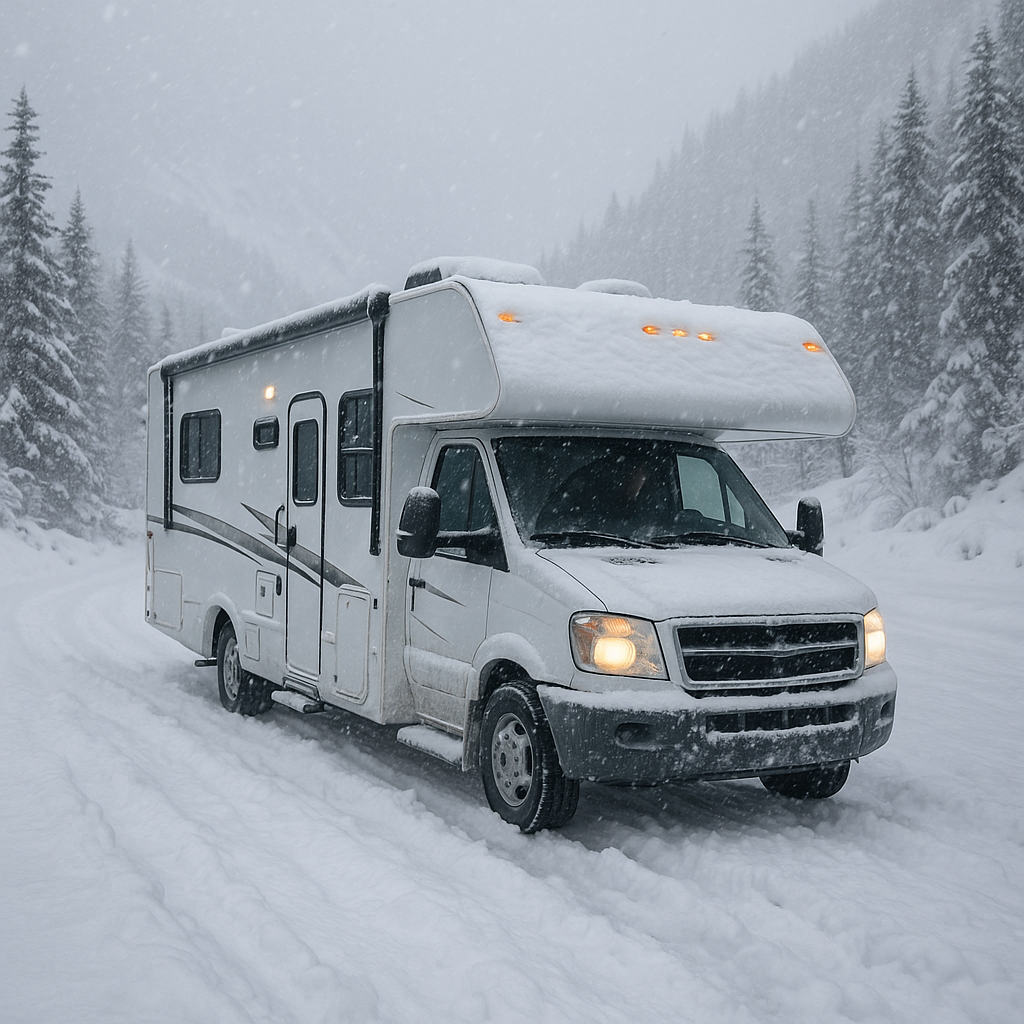
Conquering Snow
Snow is a completely different challenge from ice, but it brings its own set of problems that can sneak up on RVers quickly. The good news is that snow gives you visual clues — you can see it building on the windshield, piling on the shoulders, or drifting across the road. The challenge is knowing how your RV behaves as the depth, density, and texture of that snow changes. Light snow and packed snow feel nothing alike, and slush or deep ruts can throw a trailer or motorhome off balance faster than most people realize.
Light snow
Light snow usually gives you the easiest conditions, but it can hide slick spots underneath or create that soft “floating” feeling when your steering loses some bite. Your RV might take longer to respond or drift just slightly off center, which is why smooth inputs matter. Heavy snow changes everything — traction drops fast, stopping distances increase, and deep, soft snow can start to pull your wheels into ruts that you don’t choose. The heavier the rig, the more it wants to continue straight even when the road curves.
Deep snow
Deep snow is a different beast altogether. If the snow on the road is higher than the bottom of your front bumper or hitch, your RV can start to plow through it rather than roll over it. This creates resistance that slows you down unevenly, especially if one side of the RV hits deeper snow than the other. That difference in drag can start a sideways pull — and on a curve, that’s one of the easiest ways for a trailer to sway or for a motorhome to slide toward the outside of the turn.
Driving in snow
The key to driving in snow is to build momentum before you need it and protect it once you have it. On flat roads, that means keeping a steady, gentle throttle and avoiding sudden changes. On hills, it means having enough speed at the bottom to climb, while staying slow and controlled when descending. Cruise control should never be used in snow because it reacts too slowly and can apply throttle at exactly the wrong moment, which is the last thing you want when the tires are struggling to grip.
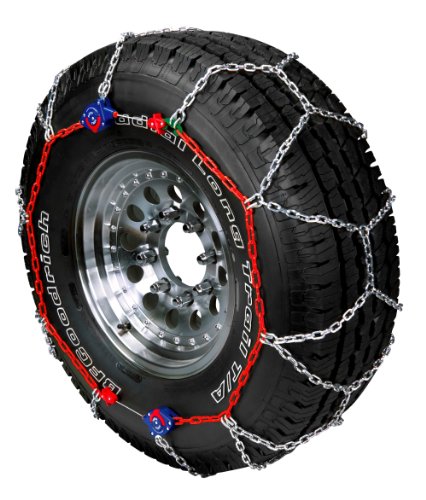
Worry-Free Self-Tightening Ratchets Provide Automatic Tightening And Centering
Braking in snow
When winter RV driving in the snow your braking should be slow and early. Snow reduces friction dramatically, even when it looks packed. Tapping the brakes gently and gradually gives your tires a chance to bite instead of sliding across the top of the snow. Using Tow/Haul mode helps a lot in these conditions by keeping your transmission in lower gears longer and using engine braking instead of relying entirely on your foot brake. If you are going to use your engine brake down a hill in snow, start at the top of the hill or lightly apply breaks before the engine brake comes on so you don’t loose traction.
Visibility in snow
Visibility also plays a big role. Falling snow reduces distance, and blowing snow can hide the edges of the road completely. When visibility drops, slow down and give yourself more space than you think you need. A whiteout can happen in seconds, especially when passing plowed fields, open plains, or high ridges where the wind sweeps snow across the highway.
Snow isn’t something to fear — it’s something to respect. When you understand how different types of snow change the way your RV responds, you can adjust your driving naturally and stay well ahead of the conditions. Smooth inputs, steady momentum, and early slowing are the three big keys to staying in control, no matter how much winter decides to bring down around you.
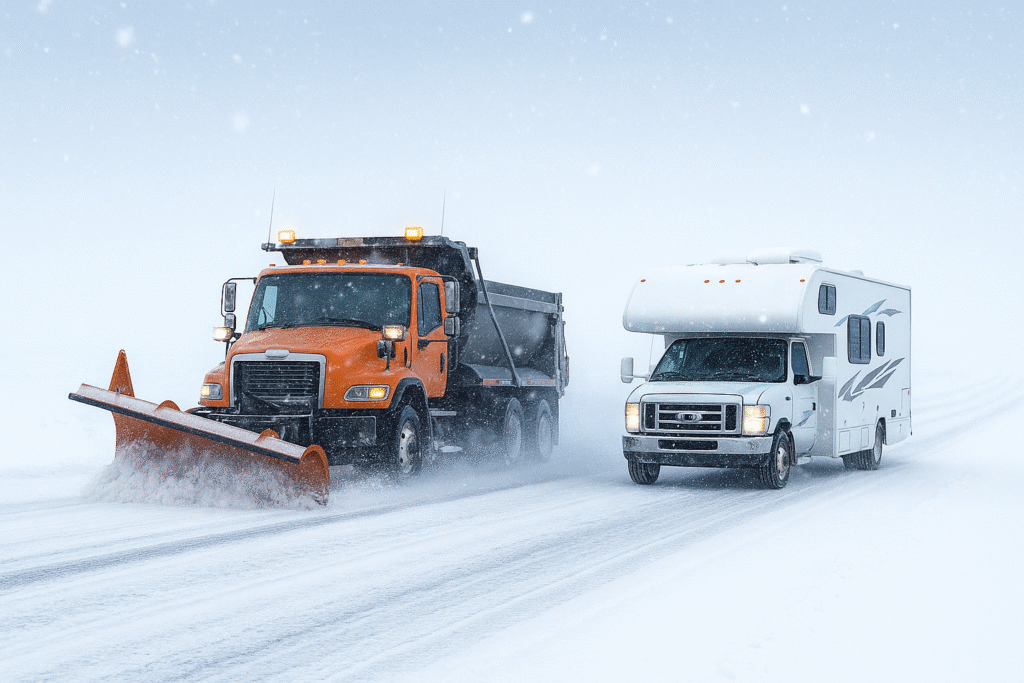
Driving Safely Around Snow Plows
Sharing the road with snow plows is a normal part of winter RV driving, and giving them plenty of space is absolutely critical. Plows work in the worst conditions—whiteouts, drifting snow, icy pavement, and constantly changing traction. They travel much slower than regular traffic, stop often, and sometimes shift lanes without warning as they clear the road. The safest place for you is well behind the plow, never beside it, and definitely never in front of it.
As they work, plows throw large amounts of snow, chunks of ice, and rocks across multiple lanes. On top of that, many plows spread salt, sand, or a salt-brine mixture behind them to melt ice and improve traction for everyone following. Driving behind a plow actually puts you on the safest, most treated part of the road. But if you try to pass, you risk moving onto untreated pavement or into a ridge of deep snow that hasn’t been cleared yet — and that’s exactly where traction disappears and skids happen.
Be patient, give the plow driver room to work, and take advantage of the freshly cleared surface they’re creating. They’re out there making the road safer for you, and staying back those few extra minutes is always the smarter, safer move in winter conditions.
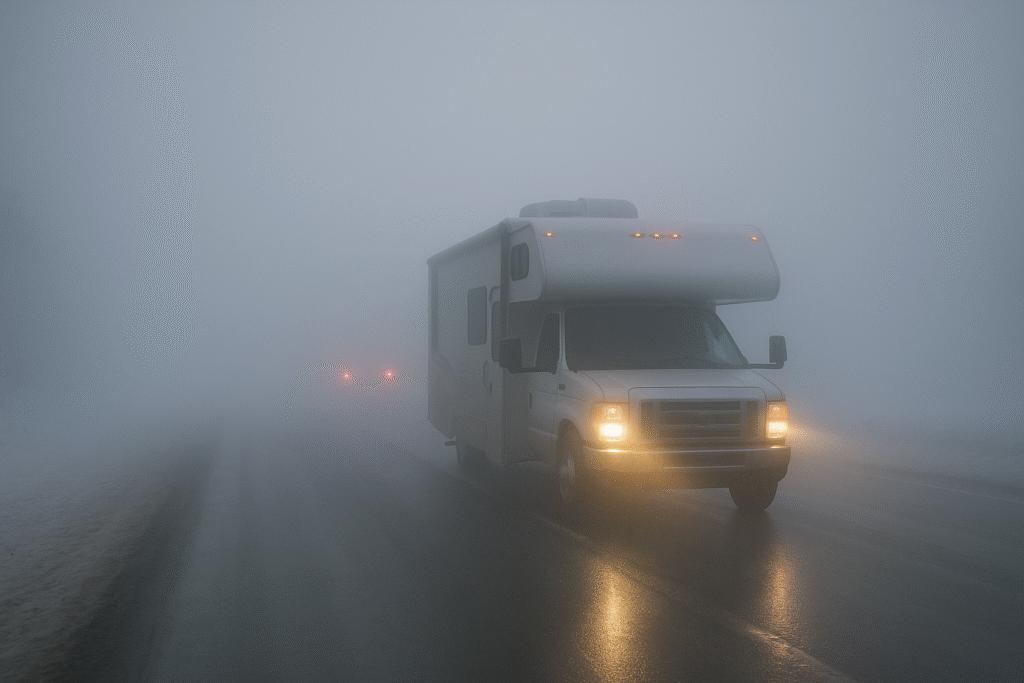
Conquering Fog
Fog is a completely different kind of hazard in winter RV driving because it doesn’t just limit what you can see — it limits how fast you can react. Winter fog builds quickly, settles into valleys, blankets mountain passes, and can drift across the highway without warning. And when moisture in the fog meets a freezing road surface, it often creates thin, invisible layers of ice that blend right into the gray haze. That combination — low visibility and hidden slick spots — is one of the biggest challenges for RV drivers in cold weather.
How Fog Reduces Your Margin for Error
In clear weather, you’re driving based on everything you can see ahead: curves, brake lights, traffic, and the flow of the road. Fog takes all of that away. You lose depth perception, distance awareness, and the ability to see hazards until you’re already close to them.
RVs and tow vehicles need more space to slow down, more distance to make corrections, and more room to stabilize a trailer if it starts to drift. Fog shrinks your reaction window dramatically, which is why winter RV drivers must immediately drop their speed and increase their following distance the moment visibility starts to drop.
Fog also plays tricks on your sense of speed. Thick fog can make it feel like you’re crawling even when you’re going too fast. That’s why you always trust your speedometer — not your gut — in these conditions.
Fog + Freezing Temperatures: The Hidden Ice Danger (Frozen Fog)
This creates a slick surface that’s nearly impossible to see. You may notice the pavement suddenly looking shinier or darker in the fog — that’s usually the first sign you’re rolling onto ice.
Fog also hides snow drifts on open stretches and masks lane lines, shoulders, and even the edge of the pavement. That’s why slowing down and staying centered in your lane are so important.our speedometer — not your gut — in these conditions.
How to Spot Frozen Fog on the Road
Frozen fog doesn’t look like typical ice. Instead, it forms a thin, even glaze that makes the pavement appear “greasy” or overly smooth. If the fog is thick enough that it moistens your mirrors or windshield, and the temperature is near freezing, you should assume the road is freezing as well—especially if you start to notice the road surface turning darker with a dull shine. Another clue is how your steering feels. If your RV suddenly feels lighter or less connected to the pavement, frozen fog may have turned the road slick without any visual warning.
You can also watch the vehicles ahead of you. If the pavement looks wet but you no longer see water spray coming off their tires, the moisture has frozen. This is one of the most reliable signs of fog-induced ice and something professional drivers watch for constantly.
Using Your Defroster Correctly in Fog Conditions
When winter RV driving in fog, your windshield is constantly taking moisture from the air. If that moisture meets cold glass, it fogs or freezes instantly, cutting your visibility even further. Running your front and rear defrosters helps keep the glass warm enough to prevent this, and mixing in a small amount of warm air from your heater helps keep your windshield clear.
If the inside of your windshield starts fogging up, run your defroster with A/C on. The A/C system pulls moisture out of the air and clears the glass much faster. Adjust the temperature so the air is warm but still dehumidifying. And keep your wipers on a slow, steady interval—fast wiping can smear moisture in heavy fog, especially if freezing fog is forming ice on the edges of the blade.
Keeping your mirrors and windshield clear in fog isn’t just about comfort—it’s a major part of staying safe, especially when black ice may be hiding underneath the haze.
How to Drive an RV Safely in Fog
The moment you hit fog, your goal changes from “getting there” to maintaining control and visibility. Reduce your speed early and stay smooth with every input — braking, throttle, and steering. Abrupt moves can cause skids, especially if the fog is hiding icy patches.
Turn on your low-beam headlights immediately. Low beams cut through fog and help other drivers see you.
Never use high beams in fog. High beams reflect off the moisture in the air, bounce light back at you, and make visibility far worse. They can turn thick fog into a bright white wall.
Use fog lights if your RV has them, and keep your windshield and mirrors clear using defrost and wipers. Cruise control should stay off at all times because it reacts too slowly and can apply throttle at the worst possible moment.
If you come up behind another driver, back off and give them plenty of space. Avoid driving in packs — everyone needs room to react, and one driver’s mistake shouldn’t become your emergency.
Fog rewards patience and punishes rushed decisions. When you slow down, stay centered in the lane, and drive with the mindset that visibility could drop even more at any moment, you stay ahead of the danger instead of getting surprised by it.
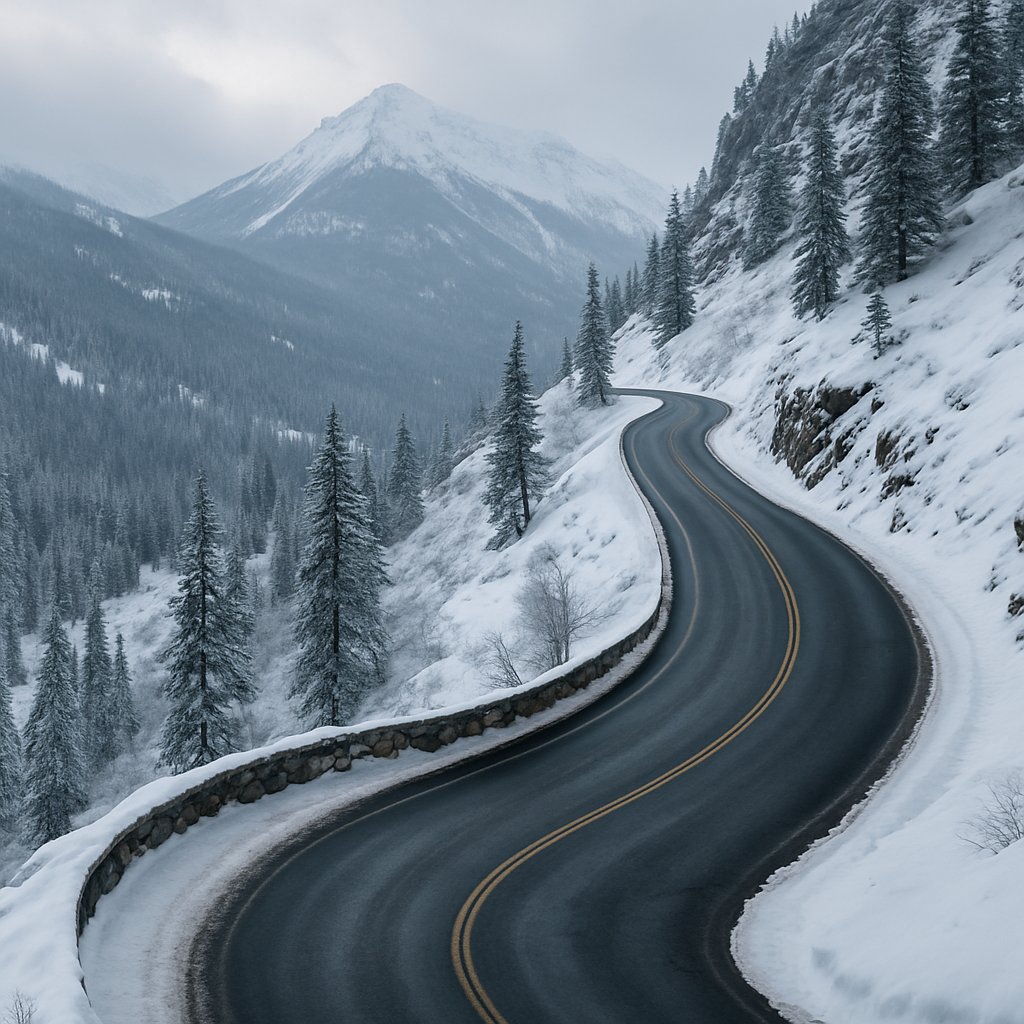
Conquering Winter Grades (Uphill and Downhill)
Winter grades are where even experienced drivers get into trouble. Uphill climbs expose traction issues fast, and downhill grades demand absolute control because gravity, ice, and RV weight all work against you. Towing a fifth wheel or travel trailer adds even more complexity, but with the right technique, you can climb and descend safely even in tough winter conditions.
Winter grades aren’t about power — they’re about momentum, traction, and control. Whether the road is snowy, icy, slushy, or a mix of everything, the approach stays the same: go slow, stay smooth, and make decisions early. Grades don’t forgive last-second mistakes, especially in cold weather.
Before we split this into uphill and downhill, there are a few things every winter driver should do before the grade begins.
Before Tackling Any Grade
Winter RV driving on hills demand a different setup than normal driving. Before you start climbing or descending, you want your RV, your tow vehicle, and your mind ready.
First, Tow/Haul mode should be on. This changes your shift points, gives you better engine braking, and prevents the transmission from hunting for gears when you need stability most. Cruise control should be off — it can’t react fast enough on slippery grades, and any unexpected throttle input can break traction.
Approach every grade slower than you think you need to, giving yourself room to adjust without panic. Make sure your steering is steady and your tires are straight as you reach the hill. If you’re towing, double-check your trailer brake gain so you know how much manual braking you have available if the trailer starts pushing.
Winter grades reward the drivers who get set up before anything goes wrong.
Uphill Grades
Climbing in winter conditions is all about momentum, not speed. You don’t want to charge the hill, and you don’t want to crawl up it — you want a controlled, steady approach that uses traction efficiently.
Start by building gentle momentum before the base of the hill. This helps the RV climb without forcing your tires to work too hard on the steepest part. Once you’re committed to the hill, hold a steady throttle. Sudden power increases can break traction, and gear shifts in the middle of a climb can cause a momentary lose of power that interrupts your forward progress. Tow/Haul mode helps prevent this by holding lower gears longer.
If you hit a patch of ice or packed snow on the way up, resist the urge to stab the throttle. Let the tires regain grip naturally, and gently ease back into your original power. If your wheels spin, back off slightly until traction returns. For towables, avoid letting the trailer “wag” behind you — smoothness is key.
Stopping on an icy uphill is something you should avoid at all costs. Getting moving again with a heavy RV behind you is extremely difficult on slick surfaces. If traffic is stopped ahead, give yourself plenty of space and slow early so you don’t lose your forward motion. In truly severe conditions, you may need chains or traction socks to maintain grip. If the hill looks unsafe or traffic is stalled, it’s always smarter to wait it out than force a risky climb.

Paint Protection Design: The bristle head looks lighter in color and finer because we polished the head of the bristle, and each bristle head was split into several strands for being softer (not faded and worn) to avoid scratching the car paint.
Downhill Grades (The Most Dangerous Part of Winter Driving)
Downhill winter RV driving is where things get truly serious. Gravity, ice, and RV weight all work together to push you faster than you want to go. Your number one job on a winter descent is to set your speed at the top — because once you’re on the hill, it is too late to slow down safely if you’re going too fast.
Before you start descending, downshift into a lower gear using Tow/Haul mode. This allows your engine to handle most of the braking instead of your foot brake. Relying too heavily on your brake pedal on a slick downhill can lead to locked wheels, overheated brakes, or a trailer pushing the tow vehicle sideways.
Once you’re on the descent, use gentle, controlled brake pressure if you need to reduce speed, tapping rather than holding the brakes. Long, steady brake pressure builds heat and reduces your braking power — something no RVer wants on a frozen downhill.
If you feel the RV start to slide, lift off the brake immediately. Let the tires roll until they regain traction, and keep the steering wheel straight. Towing? This is where your manual trailer brake can save the rig. A gentle squeeze can slow the trailer without locking up your truck’s wheels, helping pull everything back into line.
The one thing you should never do on downhill ice is slam the brakes or make sudden steering corrections. That’s how jackknifes and side-slides start. Descend slower than you climbed, and always leave yourself an escape path if other drivers are going too fast.
Mountain Pass Safety Tips
Mountain passes in winter combine everything: curves, grades, wind, and sudden weather changes. Shaded areas can stay icy all day. Frost can build on signs and guardrails even when the pavement looks clear. When passing semi trucks, expect wind gusts and draft changes that can push your rig sideways. Chain signs aren’t suggestions — they’re based on real conditions that catch unprepared drivers.
Stay alert, stay patient, and always assume the worst conditions are hiding around the next turn.
Mountain Pass Safety Tips
Before every winter grade, make sure Tow/Haul mode is engaged, cruise control is off, and your speed is already reduced. Keep your hands steady at nine and three, check your mirror for trailer sway often, and scan far ahead for brake lights, stalled vehicles, or icy patches. On downhills, descend slower than you climbed, and let engine braking do the heavy work. Smoothness is the key to getting down safely.
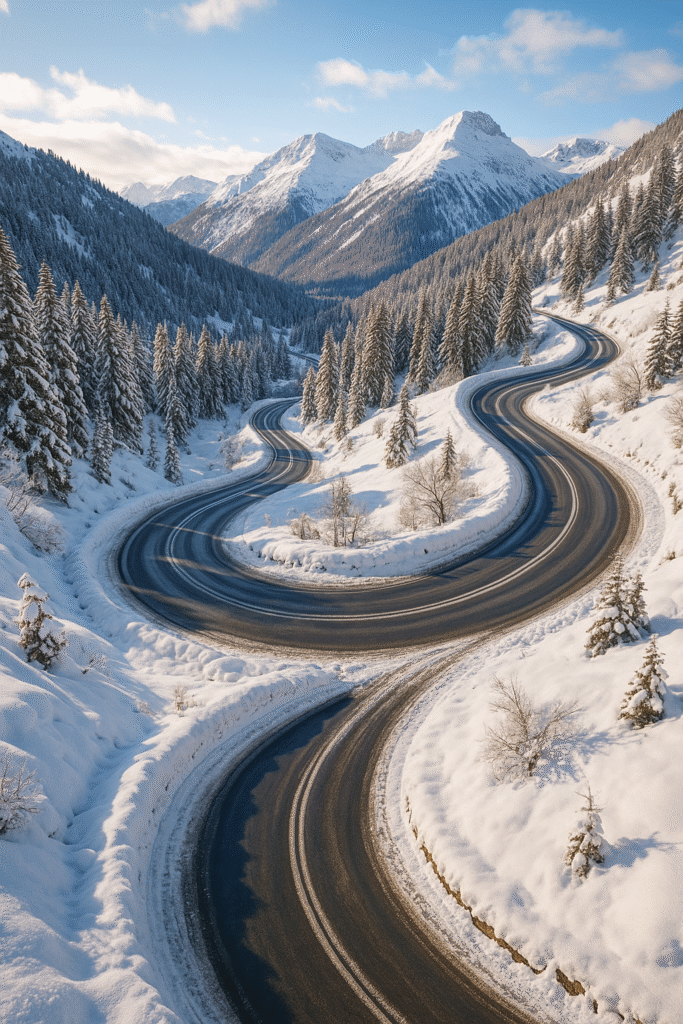
Conquering Curves & Mountain Roads
Curves in winter RV driving demand a completely different mindset than straight-line driving. Snow, ice, fog, and uneven traction all work against you the moment you start turning. RVs handle differently from cars — they’re longer, heavier, slower to react, and much less forgiving when a curve sneaks up faster than expected. Whether you’re in a Class A or towing a fifth wheel, curves are where winter mistakes happen the quickest.
Winter curves are all about controlling your speed before the turn, not during it. Once you enter the curve, your options shrink fast. Any braking, downshifting, or sudden steering inside the turn can break traction instantly. That’s why the smartest drivers slow early, steer smoothly, and protect momentum instead of trying to adjust mid-turn.
The combination of elevation, drop-offs, shaded corners, and drifting snow makes winter mountain roads even more unpredictable. Shaded curves often stay icy all day, even when the rest of the highway is clear. Wind gusts can hit you the moment your rig comes around a bend. And if you’re towing, the trailer will always want to continue in a straight line while your truck is trying to turn — that’s where sway starts if you aren’t smooth.
Below are the core principles that make winter curves manageable and safe.
Slow Down Before the Curve
The single most important rule for winter curve driving is simple: set your speed before the turn begins. Once you start turning, your options shrink fast. Braking inside a curve is dangerous because the moment you touch the brake pedal, the weight of your RV shifts forward. That shift takes traction away from the rear tires—the very tires you need to stay planted and stable. In winter, where the road already offers limited grip, that sudden shift can turn a small correction into a full-blown skid.
As you approach the curve, slow down early and let your engine braking do most of the work. Keep the rig settled and balanced, and enter the turn at a speed you’re fully confident you can hold all the way through. If you misjudge the curve and it comes up sharper than you expected, that’s your signal to slow down earlier next time. Snow-covered signs, drifting snow, fog, or low visibility can easily hide how tight a curve really is until you’re already committed.
Light Throttle Through the Curve
Once you’ve set your speed before the curve, the goal inside the turn is to keep the RV balanced and predictable. A light, steady throttle helps your rear tires stay planted by maintaining just enough forward momentum to keep the rig settled. You don’t want to suddenly lift off the throttle or press down harder mid-curve—either move can upset the balance of your RV and reduce traction when you need it most.
Smooth steering is just as important. Hold your wheel steady, guide the rig through the arc of the turn, and avoid any quick or sharp movements. Winter curves reward calm, steady hands, and they punish overcorrection. When you combine a stable entry speed with gentle throttle and controlled steering, you stay in complete control, even on slick surfaces.
Trailer Sway on Curves
Towable RVs behave differently than motorhomes in winter curves because a trailer always wants to continue in a straight line while the tow vehicle is trying to turn.
On a dry road, this is easy to manage, but on snow or ice, that small “push” from the trailer becomes much more noticeable. You might feel the trailer tug the truck outward or sense a slight drift pulling you toward the outside of the curve. The worst reaction is to brake suddenly, because that shifts weight forward and makes it even easier for the trailer to start sliding or swinging.
The right approach is to stay calm, ease off the throttle slightly, and keep the steering smooth and steady. If the sway continues or becomes more noticeable, a quick, gentle tap of your manual trailer brake can bring the rig back into line without causing the truck’s wheels to lose grip. The key is to avoid panic and let the combination settle back into traction naturally.
Mountain Road Checklist for Winter Curves
Mountain curves in winter RV driving come with hazards that don’t always show themselves until you’re already committed to the turn, which is why they demand more attention than flatland driving. Shaded corners often stay icy all day, long after the rest of the highway has thawed. You can roll from dry pavement into a frozen patch in seconds, especially on north-facing slopes or tight canyon walls where sunlight never reaches. On top of that, winter winds tend to funnel through mountain passes and can hit your RV the moment you come around the bend, pushing the rig sideways when the tires have the least amount of grip.
Snowbanks create another risk by hiding the true edge of the road. In drifting conditions, the plowed edges can blend into the horizon, and you might not realize how close you are to the shoulder until your tires start pulling toward it. Blind corners add to the danger, because you never know what’s around the next bend—a stalled car, a slow-moving truck, or a plow working the curve ahead. Visibility can change instantly as fog rolls across ridges or snow drifts sweep across the pavement.
Driving winter mountain curves safely is all about expecting these hazards before they appear. Treat every corner as if it might be sharper, icier, or more unpredictable than the last one. When you slow early, stay centered, and keep your inputs smooth and controlled, you give yourself the best chance to stay in control even when the conditions change without warning.
Conquering High Winds
High winds are one of the most underestimated dangers in winter RV driving. Snow and ice get most of the attention, but a strong crosswind can push a motorhome or trailer several feet sideways in an instant, especially on open highways, high bridges, and exposed mountain passes. Winter winds tend to be sharper and more unpredictable because they funnel through valleys, accelerate over ridgelines, and hit your RV with sudden, violent gusts. The taller your RV is, the more it behaves like a sail — and the more the wind dictates your line instead of your steering wheel.
Why Winter Winds Are More Dangerous for RVs
Winter storms often bring fast-moving cold fronts, pressure changes, and open-plains gusts that hit harder than summer winds. What makes winter winds especially dangerous is how easily they combine with slick pavement. Even a mild gust can push a thirty-foot RV sideways if the tires have limited traction, and a fully loaded trailer can start drifting toward the shoulder before you even process what’s happening. Many winter wind events also come with blowing snow, making lane lines, shoulders, and oncoming vehicles harder to see.
How Crosswinds Push and Tilt an RV
When a strong gust hits the side of your RV, it tries to push the rig sideways and tilt it at the same time. Your natural instinct is to countersteer quickly, but sudden wheel inputs only make the rig less stable. In towables, the trailer tends to lag slightly behind the tow vehicle, and when the wind hits both at different angles, you feel that tug through the steering wheel. That tug becomes more aggressive on icy pavement because the truck has less grip to fight back with. Motorhomes feel wind differently, but the effect is the same — the wind chooses your line, not you.
Signs You’re Driving in Unsafe Wind
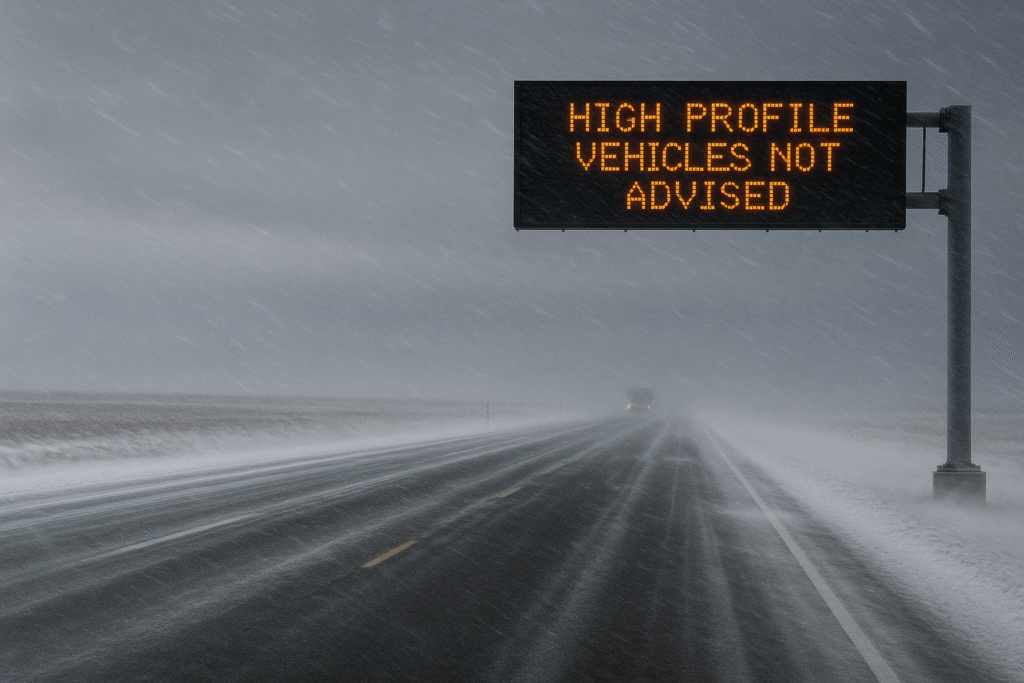
You’re driving in unsafe wind long before you feel like you’re losing control. The first warning signs are subtle: constant steering correction, the wheel feeling lighter than normal, or the RV slowly drifting toward the leeward side of the lane. In stronger gusts, the entire rig may lean, or the trailer might start pulling the truck outward. If you feel yourself tightening your grip on the wheel or fighting to stay centered, the wind is too strong for the speed you’re traveling. Overhead DOT signs or flashing advisories for “HIGH PROFILE VEHICLES” are another indication that the conditions ahead will only get worse.
The Right Speed for Strong Winds
Speed is everything when it comes to safe wind driving. A gust that can shove your RV three feet sideways at fifty-five miles an hour may barely move you at thirty-five. The slower you go, the less surface area the wind has to work with, and the more time you have to correct safely. Wind strength goes up exponentially with speed, so dropping even ten miles an hour makes a massive difference. The key is to slow early and slow more than you think you need to. In winter conditions, speed discipline is what keeps the rig under control when wind and traction start working against you.
Safe Driving Techniques in High Winds
The safest way to handle strong crosswinds is with smooth, steady steering. Let the rig move slightly when a gust hits, then guide it gently back to center. Overcorrecting is what sends RVs into trouble, especially if the pavement is slick. Keep your eyes far ahead and avoid driving beside tall trucks, buses, or other RVs — their wind shadow can hit you with a sudden blast that catches you off guard. Bridges, open farm fields, and long, exposed straights are where wind hits hardest, so enter these areas expecting a gust at any moment. Give yourself room, stay calm, and let the rig settle naturally after every hit.
When to Pull Over and Wait It Out
There are days when the wind simply wins. If you’re fighting the wheel, constantly correcting, or feeling your trailer push you around more than you’re comfortable with, it’s time to stop. Pull off at a safe exit, rest area, or truck stop — never on the shoulder — and wait it out. Winter winds rarely stay extreme all day, and conditions can improve dramatically in an hour. The smartest drivers know when to push and when to pause. There’s no shame in choosing safety over schedule, especially when gusts are strong enough to overturn high-profile vehicles.
Where Winter Winds Hit the Hardest
Winter winds are most aggressive on open plains, long bridges, river valleys, high passes, and in wide-open farmland where there’s nothing to block the gusts. In these areas, blowing snow often sweeps across the highway horizontally, reducing visibility and making lane lines hard to follow. The combination of limited traction and strong side gusts is where many winter accidents happen. When you know you’re entering one of these zones, slow down early and prepare for sudden hits.
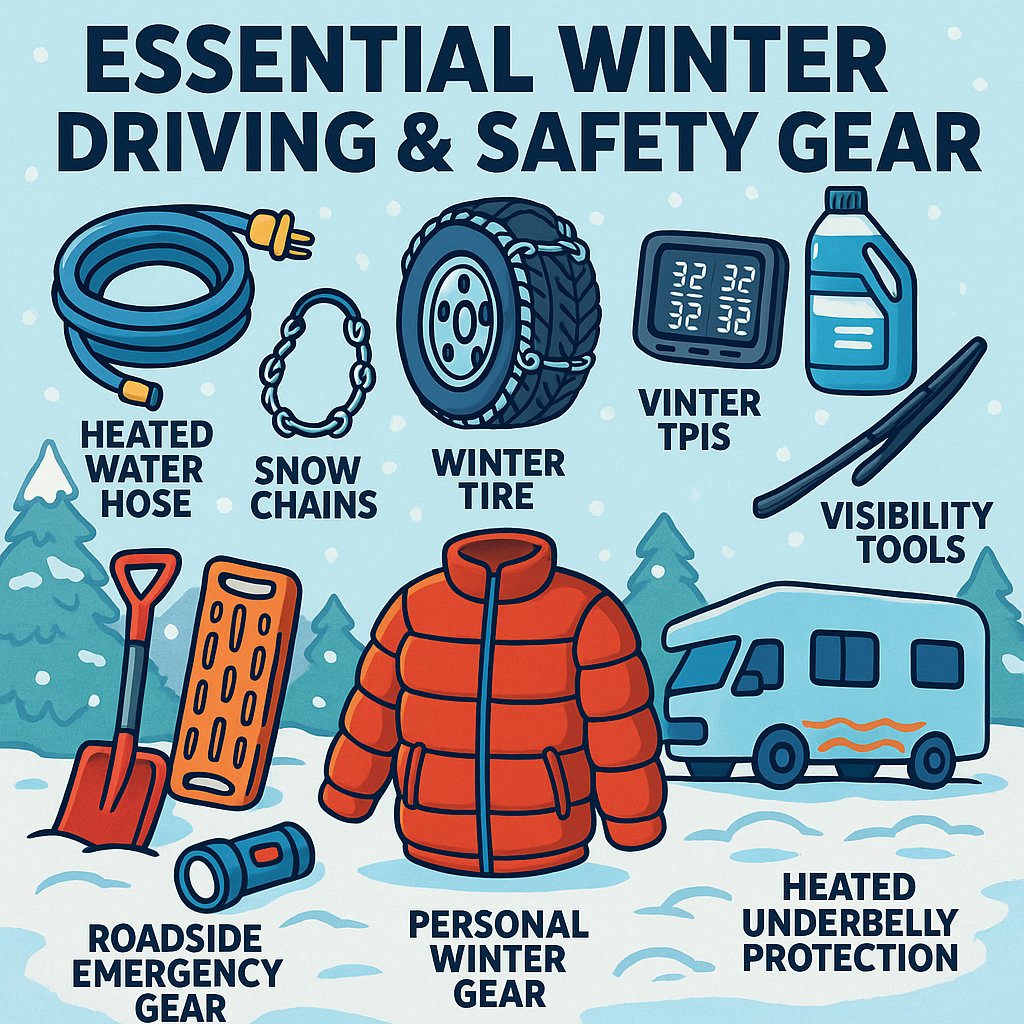
Essential Winter Driving & Safety Gear
Winter RV driving demands a different level of preparation than summer travel. The gear you carry in your rig can easily become the difference between maintaining control in tough conditions and finding yourself stuck, sliding, or stranded. This isn’t about having “extra stuff.” It’s about equipping yourself with the tools that directly improve traction, stability, visibility, and safety when winter roads are at their worst.
Below is the gear that truly matters.
Traction Control: Chains, Socks, and Correct Winter Tires
The most important winter gear you can carry is anything that improves traction when the pavement turns to ice or packed snow. Chains remain the gold standard in extreme conditions, especially on steep grades or icy mountain passes where stopping or climbing becomes nearly impossible without them. High-quality modern traction socks are easier to install and are legal in many states where chain laws apply. They grip surprisingly well on ice and packed snow, but they wear quickly on exposed asphalt — which is why chains remain the most durable option for true winter driving.
Even if you never plan to install chains, you must carry them in regions where chain controls are enforced. Without them, you can be turned around or fined, and you won’t have the option to move forward if conditions deteriorate. Correct tire choice matters just as much. All-season tires become harder and lose grip when temperatures fall below 40°F. An RV or tow vehicle running on all-terrain tires with a proper winter rating (3PMSF) will maintain far more traction, especially in cold, dry, icy conditions where all-seasons struggle badly. Traction gear isn’t optional — it’s the backbone of winter road control.
Tire Pressure Monitoring Systems (TPMS) for Real-Time Safety
Winter driving makes tire pressure unpredictable. A sudden temperature drop can reduce PSI dramatically in just a few hours, and underinflated tires dramatically increase sway, braking distance, and instability on slick surfaces. A modern TPMS gives you live pressure and temperature data for every tire on your truck and RV. It alerts you to slow leaks, cold-weather PSI drops, or a tire that’s heating up from friction — all early warning signs of a potential blowout or traction loss.
When the road is icy, you cannot afford a surprise tire problem. A TPMS turns every mile of winter travel into monitored, controlled driving with no guesswork. It’s not a convenience tool — it’s a safety requirement.
Winter Visibility Gear That Actually Works
Visibility failures cause more winter accidents than snow or ice. Your visibility gear needs to be designed for freezing conditions, not summer rain. Winter-rated wiper blades are built with a sealed structure that prevents ice buildup, keeping them flexible and effective even in slush and freezing rain. A hydrophobic windshield treatment dramatically improves your ability to see in sleet and wet snow by helping water bead and roll off instead of smearing across the glass.
Your defroster must stay ahead of the moisture in the air. Running the defroster with the A/C compressor engaged pulls humidity out of the cabin and keeps the inside of the windshield from fogging — essential in freezing fog conditions. In whiteout conditions, where visibility drops to almost nothing, this combination of winter blades, treated glass, and strong defrost is what keeps you seeing enough to stay in your lane.
Freeze Protection While Driving in Cold Temperatures
Your RV’s water system doesn’t only need protection at the campsite — it can freeze while you’re driving too, especially during long stretches in sub-freezing temperatures. Many RVers assume that the movement and interior heat of the RV will keep everything warm enough, but that’s not always true. High winds, highway speeds, and below-freezing air can pull heat away from exposed plumbing faster than the furnace can replace it, and cold air constantly pushes across the underbelly while you’re moving at 60 mph. That combination can turn a simple travel day into a freeze-up you don’t discover until you stop for the night.
If your RV has an enclosed and heated underbelly, you’re already ahead — the furnace ducting and enclosed design help keep tanks and water lines warm while driving. But even those systems have limits; sustained highway speeds in single-digit temperatures can overwhelm factory insulation. That’s why tank heaters matter. They keep your fresh, gray, and black tanks from dropping below freezing during long travel days, preventing ice formation that can crack fittings, damage tank sensors, and block your dump valves.
Any exposed plumbing — such as the low-point drains, outdoor shower lines, water pump compartment, or parts of the wet bay — can freeze while driving. Heat tape and foam insulation help tremendously here, especially if you know you’ll be crossing mountain passes or driving through arctic air. Many RVers shut off the water pump and run the RV on bottled water during severe cold snaps just to avoid pulling cold air into the system, which is also a smart move if your rig has marginal insulation.
Freeze protection while driving isn’t a luxury — it’s what keeps your RV functional when you reach your destination. With the right gear protecting your water system during long, cold travel days, you avoid cracked pipes, frozen tanks, and the exhausting repairs that follow.
Worry-Free Self-Tightening Ratchets Provide Automatic Tightening And Centering
Paint Protection Design: The bristle head looks lighter in color and finer because we polished the head of the bristle, and each bristle head was split into several strands for being softer (not faded and worn) to avoid scratching the car paint.

Anti-Freeze Heating Design: Our heated sewer hose is specifically designed for RV use, preventing freezing in the winter and ensuring smooth waste disposal. It features an automatic temperature control system and built-in thermostat, keeping the sewer hose clear without the risk of overheating.

Our heated water hose for rv through the intelligent heating control system in order to keep the water flow will not freeze in the hose, even when the temperature outside drops to -45°F. It's a well-known fact that in most areas during winter nights, regular hoses freeze due to low temperatures.

Great for RV winterizing

LED DISPLAY FOR EASY MONITORING – Equipped with a smart LED screen that shows both battery status and heat level.
Winter Roadside Emergency Gear (The No-Excuses List)
Winter breakdowns aren’t just inconvenient — they can be dangerous. Every RV traveling in winter should carry a shovel capable of cutting through crusted snow, traction boards for getting unstuck, a tow strap rated for the weight of your rig, chemical hand warmers, and a headlamp you can operate easily with gloves on. A compact jump starter is essential because cold weather drains batteries much faster, and calling for roadside assistance during a storm can take hours.
If you slide off a road or get stuck in a snow drift, this gear lets you respond immediately, safely, and without exposing yourself to the cold for longer than necessary. Winter punishes unprepared drivers, but the right emergency kit turns a crisis into a manageable inconvenience.
Personal Winter Survival Gear
Driving an RV in winter means stepping outside into harsh conditions for checks, hookups, tire work, chain installation, or clearing snow. Having insulated gloves, waterproof boots, a windproof jacket, and a warm hat isn’t just about comfort — it’s about maintaining dexterity and clear thinking when you need to perform a task safely. Even a simple job like tightening a hitch pin can be dangerous if your hands are numb or you’re rushing to escape the cold. Keeping yourself warm and protected is part of keeping the RV safe.
Final Word on Winter Safety Gear
Winter road conditions don’t forgive a lack of preparation. Every piece of equipment in this section directly improves your safety, traction, visibility, or ability to solve problems in harsh conditions. Winter RV driving becomes dramatically safer when you have the right gear on board — not because it eliminates the danger, but because it gives you the tools to handle whatever winter RV driving decides to throw at you.
Visit The RV Info Gide’s RV Essentials page for more gear.
Winter RV Driving Safety Checklist
Winter RV driving is all about stacking small advantages before you ever hit the road. Cold weather doesn’t forgive missed steps, and a simple oversight — low tire pressure, a half-frozen water line, a fogged windshield — can turn into a dangerous situation once you’re out on the highway. This winter driving checklist brings everything together and gives you a quick mental workflow to follow every time you prepare for a cold-weather trip.
Before You Start the Engine
Before you ever roll out, take a moment to set your RV up for winter conditions. Check your tire pressures on both the tow vehicle and the RV, because cold air can drop your PSI dramatically overnight and underinflated tires lose traction fast. Your TPMS should show stable readings across all tires, and if anything is low, fix it now — not when you’re on icy pavement. Clear all snow and ice from your roof, slide toppers, awnings, headlights, cameras, and mirrors so you don’t lose visibility on the road.
Inside, warm the windshield gradually using your defroster so fog or frost doesn’t appear the moment you hit colder air. If temperatures are severe, turn on tank heaters and make sure your furnace is getting proper airflow to keep your underbelly warm. Double-check that Tow/Haul mode is active and turn cruise control off — you won’t need it on winter roads.
While You’re on the Road
Once you’re rolling, winter driving becomes a game of awareness and patience. Your speed should always match visibility and traction — not the speed limit. Keep your eyes trained far ahead and look for glints on the pavement, tire spray from other vehicles, drifting snow, or sudden lane disappearances. These little details tell you more about the road than any dashboard reading.
Steering should stay smooth and steady. Avoid sudden corrections, and let the RV settle naturally after wind gusts or bumps. In snow or fog, run your low beams and keep your defroster on to prevent moisture buildup. Check your mirrors often for signs of trailer sway, especially in curves, wind tunnels, or long descents. If traction feels questionable, slow down early, not late — you never want to brake hard on slick pavement.
And remember: the safest speed is the one that lets you react without panic. Winter travel rewards drivers who think a half-mile ahead.
When You Arrive at Your Destination
Pulling into a snowy campground or rest area comes with its own challenges. Drive slowly as you enter the site because the snow can hide ice patches, ruts, or uneven ground. Before setting up, walk the site to check for deep snow, frozen water spigots, soft areas, or slopes that might cause trouble when leveling.
Once parked, keep your engine running for a couple of minutes to stabilize temps, then switch on tank heaters, interior heat, and any necessary freeze protection. If the campground water supply is frozen or unreliable, use your heated water hose and confirm it’s warm before connecting. Avoid deploying your awning or slide toppers if snow or ice is falling — they can freeze and tear easily in winter weather.
Finishing your setup slowly and intentionally makes the entire winter trip smoother and keeps you from discovering frozen lines or blocked valves later.
Go to The RV info Guide, Free Guides for free Winter Driving Checklist.
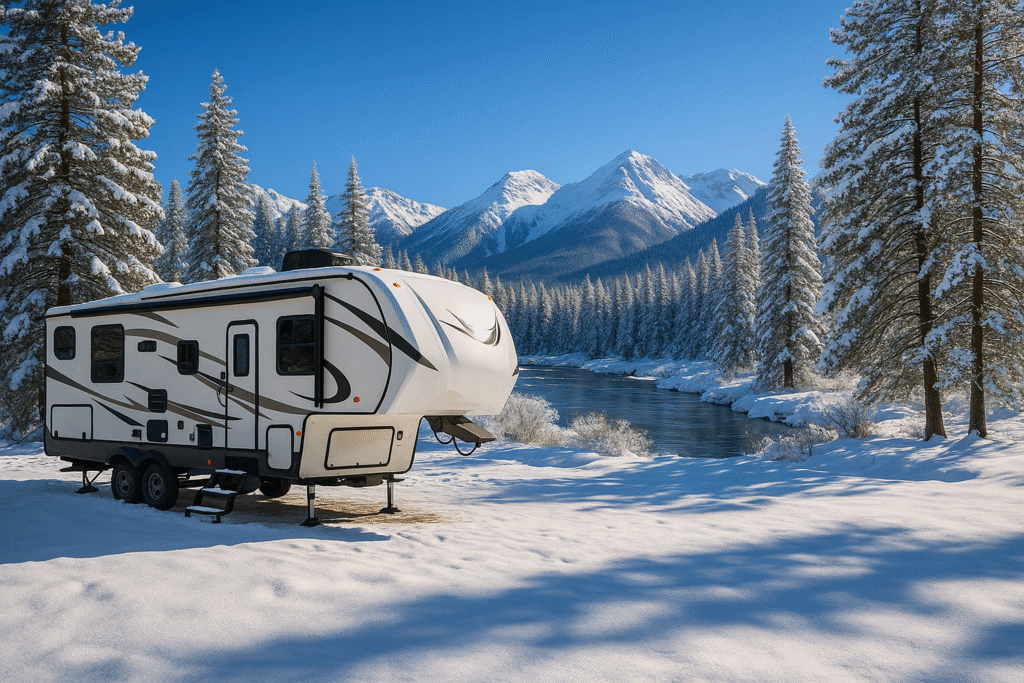
Conclusion: Drive Winter Roads With Confidence
Winter RV driving can feel intimidating, especially when you’re dealing with ice, snow, wind, fog, and unpredictable mountain grades. But the truth is, once you understand how your RV behaves in cold weather — and you approach every mile with patience and awareness — winter traveling becomes far less stressful and a whole lot more manageable.
Everything in this winter RV driving guide comes down to three core principles: slow down, stay smooth, and stay ahead of the conditions. Whether you’re descending a steep grade on packed snow, steering through blowing crosswinds on the plains, or easing through fog that hides the next hundred feet of road, the drivers who stay calm and make steady, deliberate decisions are the ones who stay safe.
With the right gear on board, the right mindset in the driver’s seat, and the right respect for winter conditions, you don’t just survive the cold months — you actually start to enjoy them. Empty campgrounds, quiet roads, crisp mountain scenery, and peaceful winter campsites make it all worth it. Winter doesn’t have to shut down your RV plans. It just asks you to prepare a little more and drive a little smarter.
You’ve now got the knowledge, the strategies, and the tools to travel through winter with confidence. Stay safe, stay aware, and enjoy the road — even when it’s covered in snow.
Related Reading