
If you are asking, “how much solar do I need for my RV?” the real answer depends on how you camp, what you power, and how much battery capacity your RV already has. One RV owner may only need enough solar to keep the batteries charged for lights, vent fans, the water pump, and phone charging. Another may need a much larger RV solar setup to support a residential refrigerator, laptops, Starlink, kitchen appliances, or several days of camping without hookups.
The biggest mistake beginners make is starting with the number of RV solar panels instead of starting with daily power use. A 200-watt solar setup might be plenty for a weekend camper with simple power needs, but it may feel useless for someone trying to run a refrigerator, work from the road, and camp off-grid for several days. On the other hand, an 800-watt setup may sound impressive, but it can still disappoint if the RV battery capacity is too small or the campsite is shaded most of the day.
RV solar panels do not store power. They collect energy when sunlight is available and help replace what has already been used from the batteries. That means the right amount of RV solar power depends on two things working together: how much electricity you use each day and how much energy your batteries can store when the sun is not producing enough power.
This is where many beginners get frustrated. They buy a solar kit expecting it to solve every power problem, then discover that the batteries still run low at night, the inverter shuts off under a heavy load, or cloudy weather changes everything. The issue is not always that the solar panels are bad. In many cases, the RV solar system was never sized around real power use.
Camping style also changes the answer. If the RV is usually plugged into shore power at full-hookup campgrounds, a smaller RV solar setup may be enough to maintain the batteries and provide extra charging between trips. If the goal is RV solar for boondocking, dry camping, or staying at campsites without electrical hookups, solar becomes much more important because the batteries need to be recharged every day.
Appliance choices matter too. Low-power items like LED lights, fans, phones, tablets, and water pumps are much easier to support than microwaves, coffee makers, air conditioners, electric heaters, or hair dryers. Some appliances only run for a short time but pull a large amount of power while they are on. Others, like residential refrigerators, may not seem extreme, but they create a steady load day and night.
Sunlight conditions are another part of the equation. RV solar panels are rated under ideal conditions, but real campsites are rarely perfect. Shade from trees, cloudy weather, short winter days, dirty panels, roof vents, air conditioners, and flat-mounted panels can all reduce how much power the system actually produces. This is why two RVs with the same solar wattage can have very different results.
The goal is not to guess the biggest system you can afford. The goal is to build a balanced RV solar setup that matches your batteries, appliances, camping habits, and realistic sunlight. More panels can help, but only if the rest of the system can store and use that power properly.
This guide explains how to estimate how much solar you need for your RV without getting buried in complicated math. By looking at RV battery capacity, daily power use, high-draw appliances, sunlight, shade, and how often you camp without hookups, you can choose a solar setup that fits the way you actually use your RV.
Start With How You Actually Use Your RV
Before choosing solar panels, start with the way the RV is used in real life. The right amount of solar for your RV depends more on daily habits than on the size of the camper itself. A small travel trailer used for weekend campground trips may need less solar than a camper van used for remote work, even if the trailer is physically larger.
The first question is not how many panels will fit on the roof. The first question is what the RV needs to power when it is not plugged into shore power. Lights, vent fans, the water pump, phone chargers, and basic controls use far less electricity than a microwave, coffee maker, Starlink, residential refrigerator, or air conditioner.
This is why two RV owners can have the same number of solar panels and get completely different results. One person may think a 200-watt RV solar setup works great because they only use basic 12-volt equipment. Another person may feel the same setup is useless because they are trying to run a laptop all day, make coffee with an electric coffee maker, and keep a residential refrigerator running overnight.
Camping style makes a big difference. If you mostly stay at full-hookup campgrounds, solar may only need to maintain the batteries, support small loads, or provide a little backup charging between trips. In that case, a smaller system can still be useful because shore power is doing most of the heavy lifting.
If you camp without hookups, the calculation changes. RV solar for boondocking needs to replace the power used each day because there may be no pedestal to plug into at night. The longer you stay off-grid, the more important battery capacity, solar production, and energy management become.
Your normal routine matters too. Someone who spends most of the day outside, cooks with propane, and uses very little electricity will need much less solar than someone who works online, watches TV at night, uses electric kitchen appliances, and keeps multiple devices charging.
Weather and location also affect how you use the RV. Camping in open desert sunlight is different from camping in a shaded state park. Summer trips with long sunny days are different from fall or winter camping when the sun is lower and daylight hours are shorter.
The best starting point is to make an honest list of what you actually expect to use when unplugged. Include the basics, the comfort items, and the things that might drain batteries faster than expected. This gives you a much better foundation than guessing based on a solar kit size.
Once your camping style is clear, it becomes easier to decide whether you need a small battery-maintenance setup, a moderate RV solar setup for weekend dry camping, or a larger system designed for longer off-grid stays.
Match Solar to Your Daily Power Use
Once you know how you use your RV, the next step is understanding how much power those habits require each day. This matters because RV solar panels are not there to magically run everything at once. Their job is to replace the energy you take out of the batteries.
Daily power use is usually measured in watt-hours. That simply means how many watts a device uses multiplied by how long it runs. For a deeper explanation of watts, kilowatts, and kilowatt-hours, the U.S. Energy Information Administration has a helpful electricity basics guide. A small device running for many hours can use more energy than a larger device that only runs for a few minutes.
For example, LED lights, phone chargers, water pumps, and vent fans usually do not use a huge amount of power. They are often easy for a modest RV solar setup to support, especially if the RV has decent battery capacity and gets good sunlight during the day.
The bigger loads are where solar planning gets more serious. A coffee maker, microwave, air fryer, hair dryer, electric heater, or induction cooktop may not run for long, but they can pull a large amount of power while they are on. These appliances can drain batteries faster than many beginners expect.
Then there are steady-use items. A residential refrigerator, Starlink, CPAP machine, laptop, or security camera may not seem as intense as a microwave, but they can run for hours. Over the course of a full day and night, those smaller continuous loads can add up quickly.
This is why asking “how much solar do I need for my RV?” should always include the question, “what am I actually trying to power?” A camper who only needs lights, fans, and phone charging may be happy with a much smaller setup than someone who works remotely and keeps a refrigerator running around the clock.
It also helps to separate must-have power from nice-to-have power. Keeping the refrigerator cold, charging phones, running lights, and using a water pump may be essential. Running a hair dryer, toaster, or electric heater may be convenient, but those items may require a much larger and more expensive system.
A simple way to think about it is this: solar has to keep up with your normal daily use, not just your best-case use. If you only calculate for sunny afternoons and light appliance use, the system may struggle when the weather changes or your power use increases.
This is where many RV owners overspend or underspend. Some buy too little solar because they only think about panel wattage, while others buy a large kit without realizing their batteries, inverter, or wiring are not sized to support the loads they want to run.
The better approach is to estimate your daily power use first, then choose the RV solar panels, battery bank, inverter, and charging equipment to match that demand. That creates a more balanced system and gives you a better chance of getting the results you expect.
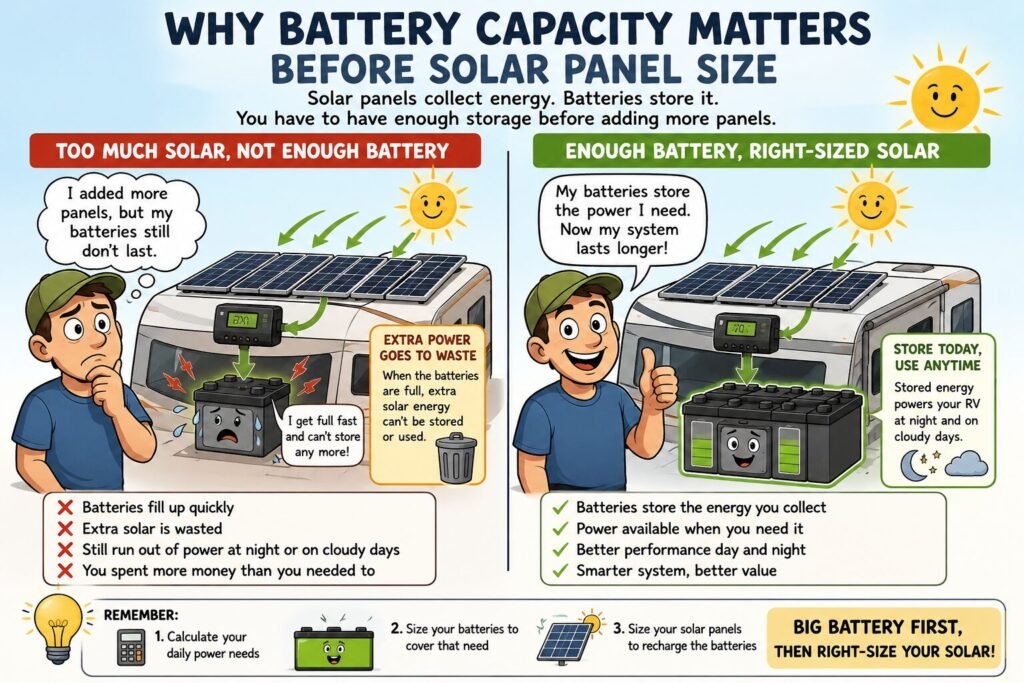
Why Battery Capacity Matters Before Solar Panel Size
Before deciding how many RV solar panels to buy, it helps to understand what the batteries are expected to do. Solar panels collect energy during the day, but the batteries are what keep the RV powered when the sun is down, the weather is cloudy, or the campsite is shaded.
This is why RV battery capacity matters just as much as solar panel wattage. A large solar array may look impressive, but if the battery bank is too small, there is not much room to store the energy being collected. Once the batteries are full, extra solar production may go unused unless the RV is actively using power at the same time.
The opposite problem can happen too. A large battery bank with too little solar may provide plenty of stored energy for a night or two, but it may take too long to recharge. After several days of camping without hookups, the batteries can slowly fall behind if the solar panels are not replacing enough power each day.
Battery capacity is usually measured in amp-hours or watt-hours. Amp-hours can be useful, but watt-hours give a clearer picture because they show the actual amount of energy available. This matters when comparing different battery types, battery voltages, or appliances that use different amounts of power.
Lead-acid, AGM, and lithium batteries also behave differently. Traditional lead-acid batteries should not usually be drained as deeply as lithium batteries, which means the usable capacity may be much lower than the number printed on the battery. Lithium batteries generally provide more usable energy, recharge faster, and hold voltage better under load, but they also cost more upfront.
For example, two RVs may both have a 200 amp-hour battery bank, but the usable power may not be the same if one uses flooded lead-acid batteries and the other uses lithium. This is one reason solar sizing can be confusing when people compare systems without looking at battery type.
The inverter also depends on battery capacity. Large inverters can run bigger appliances, but they pull heavy current from the battery bank. If the batteries are too small, the inverter may shut down, the voltage may drop quickly, or the system may drain faster than expected.
This is especially important for coffee makers, microwaves, air fryers, hair dryers, and other high-draw appliances. The solar panels may help recharge the batteries later, but the batteries have to supply the power at the moment the appliance is running.
A better way to think about solar sizing is to start with storage first. Ask how much battery capacity is needed to get through the evening, overnight hours, cloudy periods, and normal daily use. Then choose enough solar to replace that energy during a realistic charging window.
For light camping, a smaller battery bank and modest solar setup may work fine. For RV solar for boondocking, remote work, residential refrigerators, or longer stays without hookups, battery capacity becomes much more important because the RV depends on stored energy for longer periods.
The best RV solar setup balances battery storage with solar production. The batteries should be large enough to support normal use when the sun is not helping, and the solar panels should be large enough to recharge those batteries under real camping conditions.
Small RV Solar Setups for Basic Camping
A small RV solar setup can work well when the goal is simple battery support rather than running every appliance in the RV. This type of setup is usually best for weekend campers, occasional dry camping, storage charging, or RV owners who mostly stay at campgrounds but want a little extra backup power.
For many people, a small setup means enough RV solar panels to help keep the batteries charged during normal light use. This may include LED lights, phone charging, vent fans, the water pump, propane refrigerator controls, tank monitors, and other basic 12-volt systems.
A small system can make camping more comfortable because it slows down battery drain during the day. Instead of using the batteries all weekend with no charging source, the solar panels help replace some of the energy being used while the sun is out.
This does not mean a small solar setup will support heavy appliances. Microwaves, coffee makers, electric heaters, air fryers, hair dryers, and air conditioners can quickly overwhelm a basic system. Even if an inverter can turn one of those appliances on, the batteries may drain faster than the solar panels can replace the energy.
Small solar setups are often a good match for RVers who cook with propane, use the furnace only when needed, spend most of the day outside, and avoid large electrical loads. In that kind of camping style, the system is not trying to power the whole RV like a house. It is simply helping the batteries last longer.
Portable panels can be especially useful in a small setup. They let you add charging without drilling into the roof, and they can be moved into better sunlight if the RV is parked in shade. The tradeoff is that they need to be unpacked, positioned, connected, and stored after use.
Roof-mounted panels are more convenient because they charge automatically whenever sunlight reaches the roof. For a small RV solar setup, even a modest roof system can help maintain batteries during storage or while traveling between campsites.
Battery size still matters. A small solar panel connected to weak or undersized batteries will not solve the problem if the batteries cannot hold much energy. Before adding panels, it is worth checking the age, condition, and capacity of the battery bank.
A small RV solar setup is usually not about full off-grid independence. It is about reducing battery anxiety, cutting down on generator use, and giving the RV a steady charging source during light camping. For many weekend RVers, that may be all they need.
Medium RV Solar Setups for Boondocking
A medium RV solar setup is usually where solar starts to feel more useful for camping without hookups. This type of system is often a good fit for RVers who want to boondock for a few days, reduce generator use, keep the batteries healthier, and run more than just the most basic 12-volt items.
A medium setup may support LED lights, vent fans, the water pump, phone charging, laptops, a television, furnace blower use, and some limited inverter use. It can also help with CPAP machines, camera batteries, small electronics, and other everyday camping needs that add up over time.
This kind of setup still requires realistic expectations. It may handle short use of a coffee maker or microwave if the inverter and batteries are sized correctly, but those appliances should not be treated the same as lights or fans. High-draw items can remove a lot of stored energy in a short amount of time.
The biggest difference between a small and medium RV solar setup is that the medium system is usually designed around daily camping use. Instead of just slowing down battery drain, the goal is to replace a meaningful amount of the power used during the day.
Battery capacity becomes more important here. A medium solar setup should have enough storage to get through the evening and overnight hours without dropping too low. If the batteries are too small, the system may still feel limited even if the solar panels perform well during the day.
A medium system also benefits from a better battery monitor. Factory battery lights often do not give enough information for boondocking. A shunt-based monitor can show how much power is being used, how much is coming in from solar, and how much battery capacity remains.
This size system is often a good match for RVers who camp in national forests, state parks, dry camping areas, harvest host-style stops, or campgrounds with no electrical hookups. It gives more flexibility without requiring a huge investment or a complicated full-time off-grid setup.
The main limitation is weather and shade. A medium system may perform well in open sunlight but struggle after several cloudy days or under heavy tree cover. For that reason, many RVers still carry a generator or plan occasional shore-power stops as backup.
A medium RV solar setup is a practical middle ground. It can make boondocking much easier, support normal camping comfort, and reduce generator run time, while still keeping the system manageable for most RV owners.
Large RV Solar Setups for Heavy Power Use
A large RV solar setup is usually meant for RV owners who spend more time away from hookups and need the system to support heavier daily power use. This may include full-time RVers, remote workers, frequent boondockers, or anyone with appliances that depend on electricity throughout the day and night.
This type of setup often includes more RV solar panels, a larger battery bank, a stronger inverter, heavier wiring, and better charging equipment. The goal is not just to keep lights and fans running. The goal is to support a higher level of comfort while camping without shore power.
A large system may be needed if the RV has a residential refrigerator. Unlike a propane refrigerator, a residential model relies on electricity all the time. It may not draw a huge amount at every moment, but it runs repeatedly throughout the day and night, which creates a steady demand on the batteries.
Remote work can also push an RV solar setup into the larger category. Laptops, monitors, routers, Starlink, phone charging, cameras, and other electronics may not seem extreme on their own, but several devices running for many hours can add up quickly. For someone working from the RV, reliable power becomes more than a convenience.
Large setups can also make limited use of kitchen appliances more practical. A properly sized inverter and battery bank may support a microwave, coffee maker, toaster, air fryer, or induction cooktop for short periods. These appliances still use a lot of power, but a larger system gives more room to handle those loads without draining the batteries immediately.
Air conditioning is where expectations need to stay realistic. Some large lithium-based RV solar systems can run an air conditioner for limited periods, especially with a soft start installed and strong sun available. But air conditioning uses so much energy that it usually requires a serious battery bank, a large inverter, significant solar input, and careful management.
Electric heat is another challenge. Space heaters and electric water heaters can drain batteries very quickly because they turn electricity directly into heat. Even with a large solar setup, propane heat is usually much more practical for off-grid camping.
A large RV solar setup also needs the rest of the system to be built correctly. Bigger panels and batteries create higher current, which means wire size, fuses, breakers, disconnects, and installation quality matter even more. This is not the place to cut corners or guess.
Charging speed is another important detail. A large battery bank is helpful, but it also takes more energy to refill. Solar panels may handle much of that charging in good weather, but shore power, generator charging, or alternator charging may still be needed after several cloudy days or heavy power use.
The biggest benefit of a large system is flexibility. It can reduce generator run time, support longer off-grid stays, and make the RV feel more comfortable when hookups are not available. It can also make power use feel less stressful because there is more storage and charging capacity available.
The tradeoff is cost and complexity. Larger systems require more planning, more space, better components, and often professional installation. They also need to be monitored and managed so the batteries are not drained faster than the solar panels can replace the energy.
A large RV solar setup is worth considering when the RV is used often without hookups and power needs are high. It is usually not necessary for casual weekend camping, but it can make a major difference for RVers who depend on off-grid power regularly.
What Appliances Use the Most RV Solar Power?
Some RV appliances use a small amount of power over a long period of time, while others use a large amount of power very quickly. Understanding the difference makes it much easier to estimate how much solar you need for your RV.
Low-power items are usually the easiest to support. LED lights, phone chargers, vent fans, tank monitors, water pumps, and propane appliance controls do not normally require a large RV solar setup. They still use energy, but they are usually not the reason batteries drain fast.
Moderate loads can sneak up on you because they run for longer periods. Laptops, televisions, CPAP machines, routers, Starlink, cameras, and residential refrigerators may not seem extreme at first, but they can add up over a full day and night.
A residential refrigerator is a good example. It does not usually pull a huge amount of power every second, but it cycles on and off around the clock. That steady use means the battery bank has to support it overnight, and the RV solar panels need to replace that energy the next day.
High-draw appliances are different. Microwaves, coffee makers, toasters, air fryers, hair dryers, induction cooktops, and electric kettles can pull a lot of power while they are running. Even short use can take a noticeable amount of energy from the batteries.
Air conditioners are one of the biggest challenges for RV solar power. They require a large amount of electricity to start and continue running. Some advanced systems can handle limited air conditioner use, but it usually takes a large lithium battery bank, a strong inverter, significant solar capacity, and careful power management.
Electric heaters are usually even less practical for off-grid solar use. They turn electricity directly into heat and can drain batteries very quickly. For most RVers, propane heat is a much better choice when camping without hookups, although the furnace blower still uses 12-volt power.
Electric water heaters can also drain a system fast. If the RV has a propane water heater option, that is usually more practical when trying to conserve battery power. Running the water heater on electric while boondocking can use up stored energy that may be needed for more important loads.
The inverter also affects how these appliances use power. Any time battery power is changed into 120-volt household power, there is some energy loss. That means running 120-volt appliances from an inverter usually uses more battery power than running efficient 12-volt equipment directly.
This is why appliance choices matter as much as panel size. Two RVers can have the same battery bank and the same number of solar panels, but the one using propane cooking, 12-volt fans, and LED lighting will need far less power than the one using electric cooking, a residential refrigerator, and a hair dryer.
When sizing solar, pay special attention to the appliances used every day and the appliances used for heat. Daily-use items create steady demand, and heat-producing appliances often create heavy demand. Those two categories are usually what separate a basic RV solar setup from a much larger one.
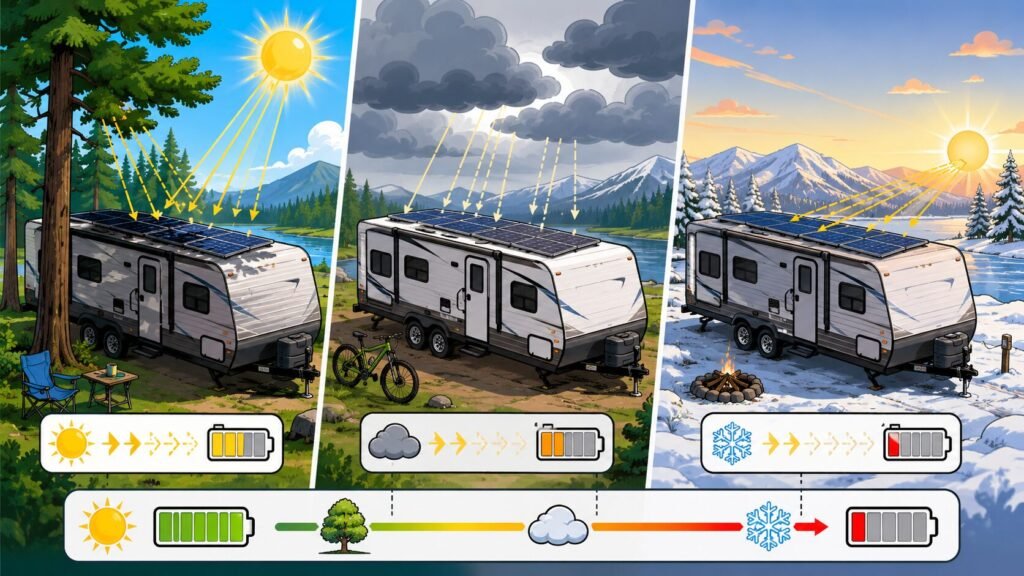
Why Shade, Weather, and Season Change the Answer
Solar panel ratings can make RV solar seem more predictable than it really is. A panel may be rated for a certain number of watts, but that rating is based on ideal test conditions. Real campsites usually have shade, clouds, changing sun angles, dirt, heat, and limited daylight hours.
Shade is one of the biggest reasons an RV solar setup underperforms. A campsite that looks perfect for camping may not be perfect for solar. Trees that keep the RV cool can also block the sunlight needed to recharge the batteries.
Partial shade can be especially frustrating. Even if most of a panel is in the sun, shade from a branch, roof vent, air conditioner, antenna, or nearby RV can reduce output. This is why panel placement on the roof matters and why portable panels can sometimes help.
Weather also changes solar production. Cloudy days do not always stop solar completely, but they can reduce output enough that the batteries slowly fall behind. Several cloudy days in a row can make even a decent RV solar setup feel undersized.
Season matters too. Summer usually gives you longer days and stronger sunlight. Fall, winter, and early spring bring shorter days, lower sun angles, and less total charging time. A system that works well in July may not keep up as easily in November.
Temperature can affect production as well. Solar panels need sunlight, but extreme heat can reduce efficiency. A panel sitting flat on a hot RV roof may not perform exactly like the number printed on the label.
Flat-mounted roof panels are convenient, but they are not always aimed at the sun. They collect power well when the sun is high, but they may produce less in the morning, evening, or during low-angle winter sun. Tilting panels can improve production, but most RV owners do not want to climb on the roof and adjust panels at every campsite.
Portable panels can help because they can be moved into direct sunlight and angled toward the sun. That makes them useful in shaded campgrounds or during lower-sun seasons. The tradeoff is that they require setup, storage, and some attention during the day.
This is why sizing solar too tightly can cause problems. If the system only works under perfect conditions, it may struggle during normal camping conditions. A little extra solar capacity can help make up for less-than-perfect sunlight.
When deciding how much solar you need for your RV, think beyond sunny afternoons in an open field. Consider where you actually camp, how often you park under trees, what seasons you travel in, and whether you are willing to use portable panels or backup charging when solar production drops.
Other Ways to Support Solar for Longer RV Camping
Solar panels are helpful, but they do not have to be the only way to keep an RV powered. For longer camping trips, the best setup often combines solar with other charging options. This gives the batteries more ways to recover when sunlight is limited or power use is higher than expected.
A generator is one of the most common backups for RV solar. Solar works quietly during the day, but a generator can provide charging when the weather is cloudy, the campsite is shaded, or the batteries are too low to wait for the sun. This is especially useful during longer boondocking trips when several poor solar days in a row can slowly drain the battery bank.
A generator can also handle loads that are difficult for solar alone. Air conditioners, electric heaters, microwaves, and other high-draw appliances can place a heavy demand on batteries and inverters. In those situations, running a generator for a short period may be more practical than trying to build a solar system large enough to cover every possible appliance.
Portable solar panels are another useful supplement. Roof-mounted panels are convenient, but they are stuck wherever the RV is parked. If the roof is shaded by trees, nearby campers, or roof equipment, solar production can drop quickly. Portable panels can be moved into direct sunlight, angled toward the sun, and used to add extra charging when the roof panels are not keeping up.
This is one reason some RV owners use both roof-mounted and portable panels. The roof panels provide steady background charging with no daily setup, while portable panels add flexibility at shaded campsites or during lower-sun seasons. The extra setup time can be worth it if it keeps the batteries from falling behind.
External solar panels can also be a good option for RV owners who are not ready to install more panels on the roof. A portable panel kit can often be added without drilling holes or making major changes to the RV. Before using one, it is still important to verify the solar port, polarity, charge controller location, and battery compatibility.
A DC-to-DC charger is another option that many beginners overlook. This type of charger uses the tow vehicle or motorhome alternator to charge the RV batteries while driving. Instead of relying only on sunlight, the batteries can recover some energy during travel days.
This can be very helpful for RVers who move often. If you drive several hours between campsites, a properly installed DC-to-DC charger can put meaningful power back into the battery bank before you arrive. That gives the solar panels less work to do once the RV is parked.
A DC-to-DC charger is especially useful with lithium batteries because many factory alternator charging setups are not ideal for lithium upgrades. The charger helps control the charging process and can protect both the RV batteries and the vehicle’s electrical system when installed correctly.
Shore power is still part of the bigger picture too. Even if the goal is off-grid camping, plugging in occasionally can fully recharge the batteries, balance the system, and give the equipment a break. Some RVers plan a campground night with hookups after several days of boondocking for this reason.
The main point is that longer RV camping does not always require a massive solar system. A balanced setup might include roof solar for everyday charging, portable panels for shade, a generator for backup power, and a DC-to-DC charger for travel days. Together, these options can make the RV much more reliable than solar alone.
When deciding how much solar you need for your RV, think about the full charging plan. Solar may be the main source of power, but generators, portable panels, alternator charging, and shore power can all help extend the time you can camp comfortably without draining the batteries too far.
How to Avoid Overspending on RV Solar
It is easy to overspend on RV solar when the system is planned around fear instead of real power needs. Many beginners worry about running out of battery power, so they start adding more panels, more batteries, and a bigger inverter before they understand what problem they are actually trying to solve.
The most expensive RV solar setup is not always the best one. A large system can still perform poorly if the parts are not matched correctly. Too much inverter, too little battery capacity, undersized wiring, or limited sunlight can make an expensive setup feel disappointing.
A better approach is to size the system around normal camping habits first. Start with the appliances and devices that are used every day, then decide which comfort items are worth supporting from battery power. Not every appliance needs to run from solar.
This is especially true for heat-producing appliances. Coffee makers, air fryers, electric heaters, induction cooktops, and electric water heaters can require a much larger system. In many cases, using propane or limiting those appliances can reduce the size and cost of the solar setup.
It also helps to decide whether the goal is battery support or true off-grid comfort. A weekend camper may only need enough solar to maintain batteries and support basic 12-volt use. A remote worker or full-time boondocker may need a larger system because power is part of daily life.
Before buying a kit, check what the RV already has. Some RVs include factory solar wiring, a basic charge controller, a solar port, or a small roof panel. That equipment may be useful, but it may also have limits. Knowing the wire size, controller rating, and battery type can prevent buying parts that do not fit the system.
Do not ignore battery condition. Adding solar to old or weak batteries may not solve much because the batteries cannot store energy well. In some cases, upgrading the battery bank first may provide a bigger improvement than adding more panels.
Plan for expansion without buying everything at once. A charge controller with extra capacity, clean wiring paths, and room for another panel can make future upgrades easier. This lets you start with a realistic system and grow later if your camping style changes.
Be careful with “complete” solar kits. Some kits are useful, but the label does not guarantee that the panels, controller, wiring, fuses, and inverter are right for your RV. A kit can still be undersized, missing important safety parts, or poorly matched to lithium batteries.
The best way to avoid wasting money is to build a balanced RV solar setup. Match the panels to the battery capacity, match the inverter to the loads you actually need to run, and match the wiring and protection devices to the current the system will carry.
RV solar is worth spending money on when it solves a real problem. It becomes expensive fast when the goal is simply to run everything like shore power without changing habits. A smart system is sized for the way you actually camp, not for every possible appliance running at once.
Final Thoughts on Choosing the Right RV Solar Setup
The best RV solar setup is not always the biggest one. It is the one that matches how you actually camp, what you need to power, how much battery capacity you have, and how often you can recharge from other sources.
For light camping, a smaller setup may be enough to maintain the batteries and support basic 12-volt use. For weekend dry camping or occasional boondocking, a medium system can make the RV more comfortable and reduce generator time. For remote work, residential refrigerators, longer off-grid stays, or heavier appliance use, a larger solar and battery setup may be needed.
The key is to think of solar as part of a complete power plan. RV solar panels collect energy during the day, but the batteries store it, the inverter uses it, and your appliances decide how quickly it disappears. If one part of that system is too small or poorly matched, the whole setup can feel limited.
Sunlight also has the final say. Shade, clouds, short winter days, dirty panels, and campsite direction can all reduce solar production. That is why backup charging options like a generator, portable panels, shore power, or a DC-to-DC charger can make the system much more dependable.
When asking “how much solar do I need for my RV?” start with daily power use instead of panel size. Decide what you really need to run, separate essentials from convenience items, and make sure the battery bank can support the RV when the sun is not helping.
A smart RV solar setup should reduce stress, not create more of it. When the system is sized around real camping habits, it becomes easier to keep the batteries charged, camp longer without hookups, and enjoy off-grid power without guessing every time the sun goes down.
Learn More About RV Solar and Electrical Power
Understanding how much solar you need is easier when the rest of your RV electrical system makes sense. These guides explain the batteries, solar basics, inverter, converter, and common RV power problems in more detail.