
RV solar basics can feel overwhelming at first because solar panels are only one piece of a much larger electrical system. New RV owners often hear terms like charge controller, battery bank, inverter, converter, watts, amps, lithium batteries, and shore power all at the same time. When nobody explains how those parts connect, RV solar power can sound far more complicated than it really is.
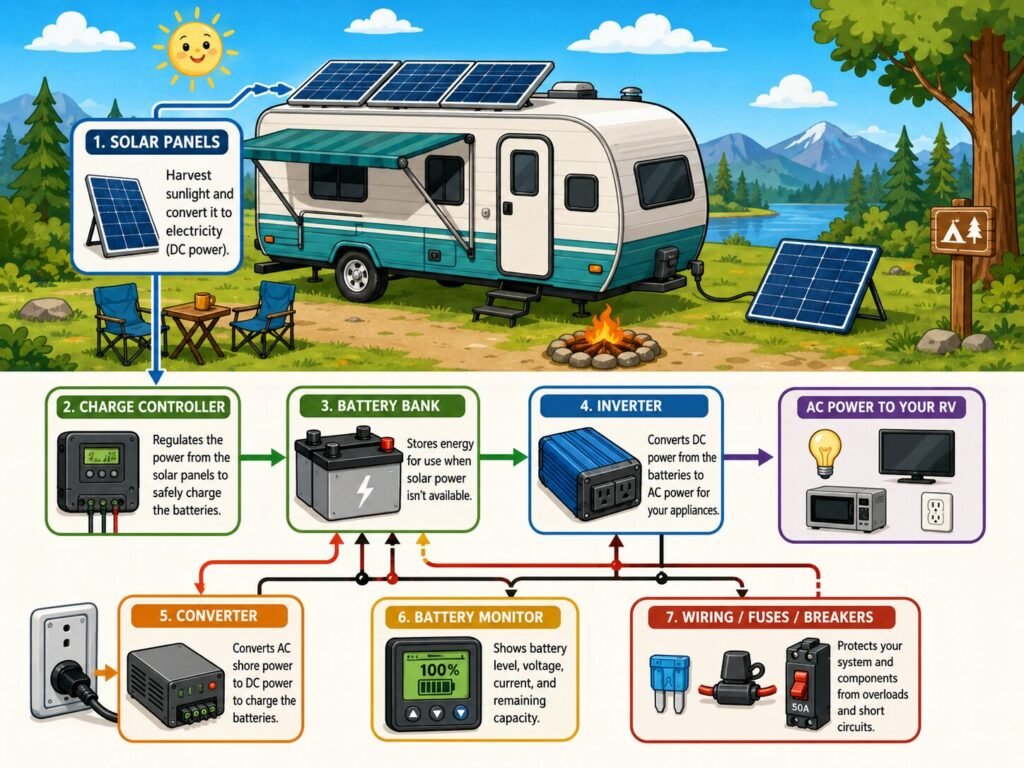
One of the biggest misunderstandings is believing solar panels directly power everything inside the RV. In most systems, that is not how it works. The solar panels collect energy from the sun and send that electricity to a charge controller. The charge controller regulates the power before sending it to the batteries, where the energy is stored until the RV needs it.
From there, the batteries can directly power the RV’s 12-volt systems, including lights, vent fans, the water pump, control boards, and many propane appliance components. When normal household-style 120-volt power is needed, the batteries send power through an inverter, which allows certain outlets and appliances to operate while the RV is not connected to shore power.
That is why adding solar panels does not automatically mean the air conditioner, microwave, coffee maker, hair dryer, and every wall outlet will run all day. Solar panels are only responsible for collecting energy. What the RV can actually power depends on the size of the battery bank, the capacity of the inverter, the amount of sunlight available, and how much electricity is being used at the same time.
A small RV solar setup may be enough to maintain the batteries, run lights and fans, charge phones and laptops, and support basic camping needs. A larger system with more panels, lithium batteries, a larger inverter, and proper wiring can support residential refrigerators, kitchen appliances, and longer periods of off-grid camping. Even then, high-draw appliances can use stored battery power much faster than the solar panels can replace it.
Shade, cloudy weather, short winter days, dirty panels, roof space, and campsite direction can also affect how much power an RV solar system produces. A system that performs well in full summer sun may produce far less energy at a wooded campground or during several cloudy days. This is why generators, shore power, and careful energy use still matter even in solar-equipped RVs.
Another common mistake is focusing only on the number of solar panels. A balanced system matters much more than simply installing the largest solar array possible. Large panels connected to a small battery bank will not provide much stored energy, while a large inverter connected to weak batteries may shut down or drain them quickly. Every part of the system needs to be sized to work together.
This guide explains RV solar basics in plain language, including how solar power flows through the RV, what each major component does, what solar can realistically run, and where beginners often go wrong. Once you understand that solar panels collect the energy, batteries store it, and the inverter makes household power available, the entire system becomes much easier to understand.
What Is an RV Solar System?
An RV solar system is a group of electrical components that collects energy from sunlight, sends that energy through the proper controls, stores it in the batteries, and then makes it available for use inside the RV. The solar panels are the part most people notice first, but they are only one piece of the complete system.
When sunlight reaches the solar panels, the panels produce DC electricity. The amount of power they create depends on several things, including panel size, panel efficiency, the angle of the sun, temperature, shade, cloud cover, dirt on the panels, and how many hours of good sunlight are available during the day.
That electricity does not normally go straight from the panels into the RV appliances. Instead, it first travels to a solar charge controller. The charge controller manages the voltage and current coming from the panels and sends the correct amount of power to the battery bank.
This step is important because batteries need to be charged in a controlled way. Too much voltage can damage them, while too little charging power may leave them partially charged. A properly matched charge controller helps protect the batteries and allows the solar panels to operate more efficiently.
The batteries are the storage part of the system. They hold the energy collected during the day so it can be used later, including after sunset, during cloudy weather, or whenever the RV is using more electricity than the panels are producing at that moment.
This is one of the most important RV solar basics to understand. Solar panels collect energy, but the batteries determine how much power is actually available for later use. A large solar array connected to a very small battery bank may recharge quickly, but it still cannot store much energy for nighttime use.
The stored battery power can be used in two different ways. Many systems inside the RV operate directly on 12-volt DC power. This commonly includes interior lights, vent fans, the water pump, furnace controls, slide controls, tank monitors, and the electronic controls used by many propane appliances.
Household-style appliances and normal wall outlets use 120-volt AC power instead. To run those items from the batteries, the RV needs an inverter. The inverter changes 12-volt DC battery power into 120-volt AC electricity that can operate selected outlets and appliances.
The inverter does not create extra energy. It only changes the form of the power already stored in the batteries. This is why a large inverter does not automatically mean the RV can run everything for a long time. The battery bank still has to supply all of that power.
Some RV solar systems are very small. A basic setup may only include one panel and a small charge controller designed to maintain the battery or support light electrical use. These systems can work well for occasional campers who mainly stay at campgrounds but want a little extra charging between trips.
Larger systems may include several roof-mounted panels, portable panels, lithium batteries, a large pure sine wave inverter, a battery monitor, and heavier wiring. These setups can support longer periods of boondocking and may power televisions, laptops, residential refrigerators, coffee makers, microwaves, and other household appliances for limited periods.
Even large RV solar systems still have limits. Air conditioners, electric heaters, hair dryers, microwaves, and other high-draw appliances can use stored battery power very quickly. Solar may help replace some of that energy during the day, but the panels may not be able to recharge the batteries as fast as the appliances are draining them.
An RV solar system also works alongside the other charging sources already in the RV. When plugged into shore power or running a generator, the converter or inverter/charger can recharge the batteries. In motorhomes and some towable setups, the vehicle alternator may also provide charging while traveling.
This means solar is not usually a completely separate electrical system. It becomes another charging source that works with the batteries, converter, inverter, generator, shore power, and sometimes the vehicle alternator.
The best RV solar system is not necessarily the one with the most panels. A well-designed system balances panel capacity, battery storage, inverter size, wiring, charging equipment, and expected power use. When those parts are properly matched, solar can make off-grid camping much easier and reduce how often the RV needs shore power or a generator.
Once you understand that the panels collect energy, the charge controller manages it, the batteries store it, and the inverter supplies household-style power, the rest of RV solar becomes much easier to follow.
Main Parts of an RV Solar System
An RV solar system works best when every component is properly matched to the others. The panels may get most of the attention, but the batteries, charge controller, inverter, wiring, and monitoring equipment are just as important to how well the system performs.
The solar panels are responsible for collecting energy from sunlight. They may be mounted permanently on the roof, carried as portable panels, or used in a combination of both. Roof-mounted panels are convenient because they can charge while traveling and require no daily setup. Portable panels can be moved into better sunlight when the RV is parked in the shade.
The solar charge controller manages the electricity coming from the panels before it reaches the batteries. Two common types are PWM and MPPT controllers. PWM controllers are usually less expensive and work well in smaller systems, while MPPT controllers are generally more efficient and better suited for larger solar arrays or systems that need to get the most power possible from the panels.
The battery bank stores the energy the solar panels collect. Battery type and capacity have a major effect on how long the RV can operate without hookups. Lead-acid and AGM batteries are still common, but lithium batteries are becoming increasingly popular because they provide more usable capacity, charge faster, weigh less, and usually last much longer.
The inverter allows the RV to use household-style 120-volt power from the battery bank. It converts the DC electricity stored in the batteries into AC electricity used by normal outlets and household appliances. The U.S. Department of Energy provides a helpful explanation of how solar inverters convert DC power into AC power. Smaller inverters may only operate a few outlets or low-power electronics, while larger pure sine wave inverters can support microwaves, coffee makers, residential refrigerators, and several devices at the same time, as long as the batteries can provide enough energy.
The converter is also part of the larger charging system, even though it is not powered by the solar panels. When the RV is connected to shore power or running a generator, the converter charges the batteries from 120-volt AC power. This gives the battery bank another way to recharge when sunlight is limited.
A battery monitor helps show what is happening inside the system. Basic factory gauges often provide only rough battery-level estimates, while a shunt-based monitor can show remaining capacity, current power use, charging rate, and how much energy has moved in or out of the batteries. This makes it much easier to manage power while boondocking.
Wiring, fuses, breakers, disconnect switches, and proper connections are the less visible parts of the system, but they are critical for safety. Solar equipment can move a large amount of electrical current, especially between the batteries and inverter. Undersized wiring, poor connections, or missing protection devices can create voltage loss, overheating, or fire risk.
Some systems also include an inverter/charger, which combines the inverter and battery charger into one unit. These setups can automatically switch between shore power and battery power, making the electrical system feel more seamless during travel or off-grid camping.
Each part of an RV solar system has a specific job. The system performs best when the solar panels, controller, batteries, inverter, wiring, and charging equipment are sized to support the same level of power use.
What Can RV Solar Actually Power?
What an RV solar system can run depends less on the number of panels alone and more on the entire setup. Battery capacity, inverter size, daily sunlight, appliance demand, and how carefully power is managed all determine what is realistic.
Lower-power 12-volt equipment is usually the easiest to support with solar. Interior lights, vent fans, the water pump, tank monitors, USB chargers, furnace controls, and propane appliance control boards use relatively small amounts of electricity compared with household appliances.
Phones, tablets, laptops, televisions, and small electronics can also be practical on many systems. These devices do not usually require huge amounts of energy, especially when they are used for only a few hours at a time.
A residential refrigerator may also be possible, but it requires a larger and more carefully balanced system. Unlike a propane refrigerator, a residential model depends on electricity throughout the day and night. That constant load means the battery bank must have enough capacity to keep it running after sunset and during poor weather.
Small kitchen appliances can be used in some RV solar setups, but they should be treated differently from lights and electronics. Coffee makers, toasters, electric kettles, and air fryers may only run for a short time, yet they can draw a large amount of power while operating.
The inverter must be large enough to handle that demand, and the batteries must be capable of supplying the required current. A system may technically run a coffee maker, but doing so several times a day can still remove a noticeable amount of energy from the battery bank.
Microwaves are another common example. They normally operate for only a few minutes, but their power draw is much higher than many beginners expect. Running one from an inverter is possible in a larger system, though it can place a heavy load on the batteries.
Air conditioners are much more difficult. They require substantial power while running and may need an even larger surge of electricity when the compressor starts. Some advanced RV solar systems can support air conditioning for limited periods, but doing so usually requires a large lithium battery bank, a powerful inverter, significant solar capacity, and careful energy management.
Electric heaters are also poor candidates for most RV solar systems. They turn electricity directly into heat and consume battery energy very quickly, they are not recommended in a RV anyway. Propane heat is usually far more practical for off-grid camping, although the furnace blower still uses 12-volt power.
Hair dryers, electric water heaters, portable induction cooktops, and other high-draw appliances create similar challenges. The issue is not always whether the inverter can turn them on. The bigger question is how quickly they drain the batteries and how long the solar panels will need to replace that energy.
Solar production also changes throughout the day. Panels may produce their strongest output around midday, but far less in the morning, evening, shade, clouds, or winter conditions. An appliance that seems easy to run in bright afternoon sun may have a much greater effect on the batteries at night.
This is why realistic power planning matters. Instead of asking whether solar can run a particular appliance, it is better to ask how many watts the appliance uses, how long it will operate, how much battery capacity is available, and whether the solar panels can replace that energy before the next day.
A modest system can still make a major difference. Keeping the batteries charged for lights, fans, electronics, and basic RV systems may reduce generator use and make short boondocking trips much more comfortable.
Larger systems can support more demanding equipment, but they work best when power use is intentional. Solar provides more freedom, but it does not remove the need to understand where the energy is going. Remember the larger the system, the money it takes to set up.
Roof-Mounted vs Portable RV Solar Panels
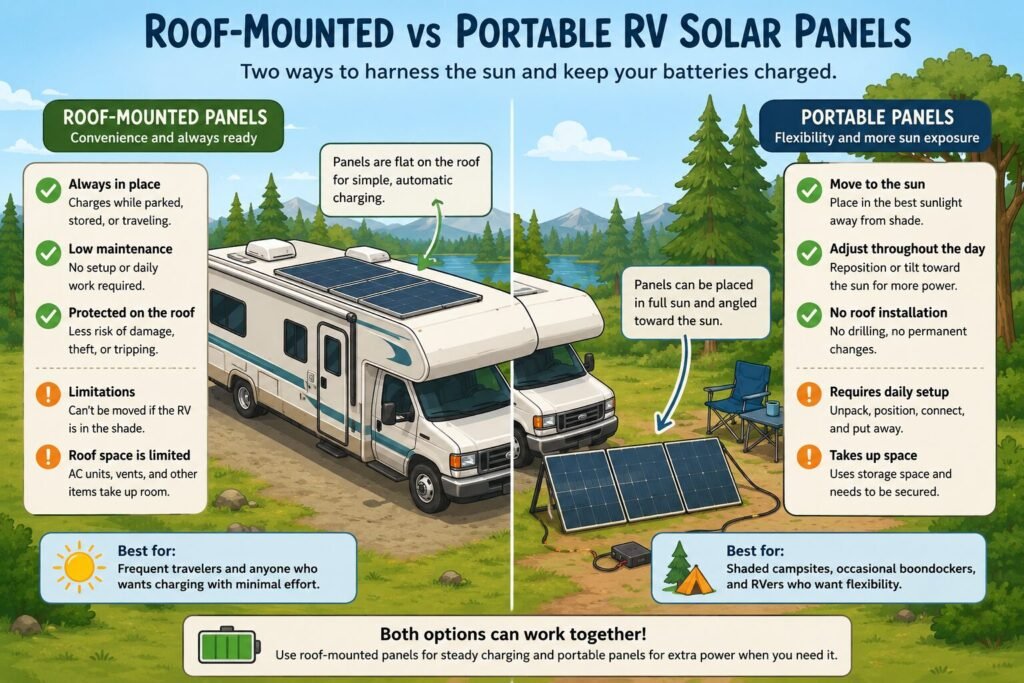
RV solar panels generally come in two forms: permanently mounted panels on the roof and portable panels that are set up at the campsite. Both can charge the same battery bank, but they fit different camping styles and solve different problems.
Roof-mounted panels are the most convenient option because they are always in place and ready to work. Once installed, they can begin producing power whenever sunlight reaches the roof, including while the RV is parked, stored, or traveling down the road.
That convenience makes roof-mounted solar especially useful for RVers who move frequently. There is no need to unpack panels, carry them across the campsite, connect cables, or remember to put them away before leaving.
Roof panels also keep equipment off the ground, where it is less likely to be damaged, stolen, tripped over, or exposed to standing water. A permanent installation can make the system feel almost automatic because charging happens in the background without much daily attention.
The biggest limitation is shade. Roof-mounted panels cannot be moved when the RV is parked beneath trees or when only part of the campsite receives direct sunlight. Even partial shade across one section of a panel can reduce production more than many beginners expect.
Roof space can also limit the system. Air conditioners, vents, antennas, skylights, and other equipment may leave less room for panels than the roof appears to have from the ground. Panels also need enough spacing for safe installation and future roof maintenance.
Portable solar panels offer more flexibility. They can be carried away from a shaded RV and placed in the sun, which can make a major difference at wooded campgrounds. They can also be repositioned during the day to face the sun more directly.
This flexibility often allows a portable panel to produce more useful energy than a similarly sized roof panel under poor campsite conditions. A roof-mounted panel lying flat may receive less direct sunlight, while a portable panel can be tilted toward the sun.
Portable systems are also easier for beginners who do not want to drill into the roof or commit to a permanent installation. Many portable kits include folding panels, a built-in stand, cables, and sometimes a charge controller.
The tradeoff is that portable panels require more work. They must be unpacked, positioned, connected, monitored, and stored after use. They also take up cargo space and may need to be secured if theft, pets, children, wind, or campground traffic are concerns.
Cable length matters with portable panels. A longer cable makes it easier to reach sunlight, but undersized or excessively long wiring can create voltage loss. The panel, controller, cable size, and connection point should all be compatible with the RV’s battery system.
Some RV owners use both types. Roof-mounted panels provide steady background charging, while portable panels can be added when more power is needed or when the RV is parked in shade. This combination can offer convenience without giving up flexibility.
Camping style is usually the best way to choose between them. Roof-mounted panels make sense for frequent travelers who want charging with minimal setup. Portable panels are useful for occasional boondockers, shaded campsites, smaller RVs, and owners who are not ready for a permanent installation.
Neither option is automatically better. The right choice depends on roof space, storage space, campsite conditions, travel habits, budget, and how much setup you are willing to do each day.
What Does “Solar Ready” Mean on an RV?
The words “solar ready” can sound like the RV already has a working solar system, but that is often not the case. In many RVs, solar ready only means the manufacturer installed some of the wiring or connection points needed to add solar later.
A solar-ready RV may include a roof entry port, pre-run wiring, a portable solar plug, a space for a charge controller, or a basic connection near the battery. What is actually included varies widely between manufacturers and even between models from the same brand.
Some RVs labeled solar ready have wiring that runs from the roof to a cabinet but does not continue to the batteries. Others may include a side-mounted port that is only intended for portable panels. A few may include a charge controller, while many do not.
This is why it is important to check exactly what the RV manufacturer installed before buying panels or other equipment. The label alone does not tell you the wire size, connector type, controller rating, polarity, battery compatibility, or maximum amount of solar the system can safely handle.
Wire size matters because solar power has to travel through the wiring with as little voltage loss as possible. If the factory wiring is too small for the size of the planned system, adding larger panels may not produce the expected results and could require the wiring to be upgraded.
Connector type also matters. Some RVs use common solar connectors, while others use proprietary plugs or ports with reversed polarity. A panel that physically connects to the port may still be wired incorrectly for the RV, so polarity should always be verified before plugging anything in.
Battery type is another part of the system that must be checked. A solar-ready RV may have been wired with a basic lead-acid battery in mind, but the owner may later upgrade to lithium. The charge controller and converter must both have charging profiles that are compatible with the batteries being used.
It is also important to find out whether the factory setup includes overcurrent protection, disconnect switches, and proper grounding. These safety components are easy to overlook because they are usually hidden behind panels or inside cabinets.
A solar-ready sticker should be treated as a starting point, not proof that the RV is fully equipped. Before purchasing equipment, locate the factory wiring, identify where it begins and ends, check the owner’s manual, and confirm the system limits with the manufacturer when possible.
Understanding what is already installed can save money and prevent mistakes. In some RVs, the factory preparation makes adding solar quick and simple. In others, the existing wiring may be too limited for anything beyond a small maintenance panel.
The safest approach is to match the new solar equipment to the actual wiring and charging components in the RV rather than relying on the solar-ready label alone.
How Much Solar Does an RV Need?
The amount of solar an RV needs depends on how much electricity is used each day, how much battery capacity is available, where the RV is camped, and how often another charging source is available. There is no single panel size that works for every RV owner.
A small solar setup may be enough for someone who mainly uses lights, fans, the water pump, phone chargers, and a few electronics. That same setup may be far too small for an RV with a residential refrigerator, frequent laptop use, multiple televisions, or regular use of kitchen appliances.
Camping style makes a major difference. An RVer who stays at full-hookup campgrounds and only wants the batteries maintained between trips may need very little solar. Someone who spends several days boondocking without shore power will usually need more panel capacity and a larger battery bank.
Battery capacity should be considered before choosing the number of panels. Solar panels can only replace energy that has already been used, while the batteries determine how much energy can be stored for nighttime, cloudy weather, and periods of heavier demand.
A large solar array connected to a small battery bank may produce more power than the batteries can make useful during the day. On the other hand, a large battery bank with too little solar may take several days of strong sunlight to recharge after heavy use.
Sunlight conditions also affect system size. Solar panels are rated under ideal test conditions, but real-world production is usually lower. Shade, clouds, heat, dirt, panel angle, short winter days, and roof obstructions can all reduce the amount of energy collected.
This means a system that works well in the open desert may struggle in a heavily wooded campground. Portable panels can help in those situations because they can be moved into the sun, but they still depend on having a clear place to set them up.
Daily power use is the most useful starting point. Instead of guessing how many panels are needed, estimate which devices will be used, how many watts they draw, and how long they operate each day. That creates a much clearer picture of how much energy the solar system needs to replace.
For example, lights and phone charging may use very little power, while a residential refrigerator creates a steady load throughout the day and night. A coffee maker may only run for a few minutes, but it draws much more power while operating.
The goal is not to size the system for every appliance running at once. It is to understand normal daily use and build enough charging capacity to replace most or all of that energy under realistic conditions.
Many beginners also overlook the importance of backup charging. Even a well-designed solar system may need help during several cloudy days or when camping under trees. Shore power, a generator, or alternator charging can prevent the batteries from becoming deeply discharged when solar production is limited.
It is usually better to build a balanced system that can be expanded later than to buy the largest number of panels that will fit on the roof. Leaving room for additional panels, a larger controller, or more battery capacity can make future upgrades easier.
For a simple RV used occasionally, a modest system may provide all the support needed. For frequent boondocking, remote work, or heavier appliance use, the system will need more battery storage, more solar input, and stronger charging equipment.
The right amount of RV solar is the amount that matches actual power use, battery capacity, and camping conditions. Measuring those needs first is more reliable than choosing panels based only on a kit label or another RVer’s setup.
Common RV Solar Mistakes Beginners Make
Most RV solar problems do not begin with the panels themselves. They usually come from buying mismatched equipment, expecting too much from a small system, or overlooking how quickly certain appliances can drain the batteries.
One of the most common mistakes is assuming solar panels directly power the RV. Solar panels mainly recharge the battery bank. The batteries still have to supply the energy being used inside the RV, especially at night or whenever power demand is higher than the panels are producing.
Another mistake is buying panels before understanding daily power use. A kit may sound impressive because of its watt rating, but that number does not tell you whether it will support your refrigerator, electronics, furnace blower, or kitchen appliances. Power needs should be estimated before choosing the system.
Battery capacity is often overlooked as well. Adding more solar panels can help recharge the batteries faster, but it does not increase how much energy can be stored. A small battery bank can still run out of power quickly, even when a large solar array is installed.
The opposite problem also happens. Some owners install a large lithium battery bank but do not add enough solar or other charging capacity to refill it. The batteries may last longer between charges, but they can take a very long time to recover after several days of heavy use.
Installing an oversized inverter is another common mistake. A large inverter makes it possible to turn on high-draw appliances, but it also places a much heavier demand on the batteries and wiring. The inverter should be matched to the appliances, battery bank, cable size, and protection devices.
High-draw appliances can be especially misleading. A microwave, coffee maker, hair dryer, or electric heater may run successfully, but that does not mean the system can support it for very long. The real issue is how much energy the appliance removes from the batteries and how long it takes to replace that power.
Shade is another problem beginners often underestimate. A roof covered with panels may look capable of producing plenty of electricity, but trees, antennas, air conditioners, and nearby objects can reduce output. Even partial shade across one panel can noticeably affect production.
Many owners also rely too heavily on the advertised wattage of the panels. Solar panels rarely produce their full rated output throughout the day. Real-world conditions such as heat, clouds, low sun angles, dirt, wiring loss, and flat roof mounting all reduce production.
Incorrect charge-controller settings can damage batteries or prevent them from charging fully. The controller must be programmed for the battery chemistry being used, whether that is flooded lead-acid, AGM, or lithium. The charging settings should follow the battery manufacturer’s specifications.
Upgrading to lithium batteries without checking the rest of the charging system can create problems too. The solar controller may be compatible, but the converter, inverter/charger, or alternator charging equipment may not have the correct lithium profile or protective equipment.
Poor wiring is one of the more serious mistakes. Undersized cables create voltage loss and heat, especially between the batteries and inverter where current can be very high. Loose connections, missing fuses, and improperly sized breakers can also become safety hazards.
Some beginners assume the factory battery gauge provides an accurate picture of remaining power. Many basic gauges only measure voltage, which can be misleading while the batteries are charging or under load. A shunt-based battery monitor provides a much clearer view of energy use and remaining capacity.
Buying a system with no room for expansion can also lead to unnecessary expense later. A charge controller that is already operating at its maximum rating may need to be replaced before another panel can be added. Planning for modest future growth can make upgrades easier and less expensive.
Another mistake is trying to solve every power problem by adding more equipment. Reducing consumption can sometimes make a bigger difference than installing another panel or battery. LED lighting, efficient appliances, sensible thermostat settings, and limiting unnecessary inverter use can stretch available power much further.
The best way to avoid these problems is to treat RV solar as one connected system. The panels, controller, batteries, inverter, converter, wiring, and expected power use all need to support one another. A balanced setup may not be the largest or most expensive, but it will usually be more dependable and easier to manage.
Is RV Solar Worth It?
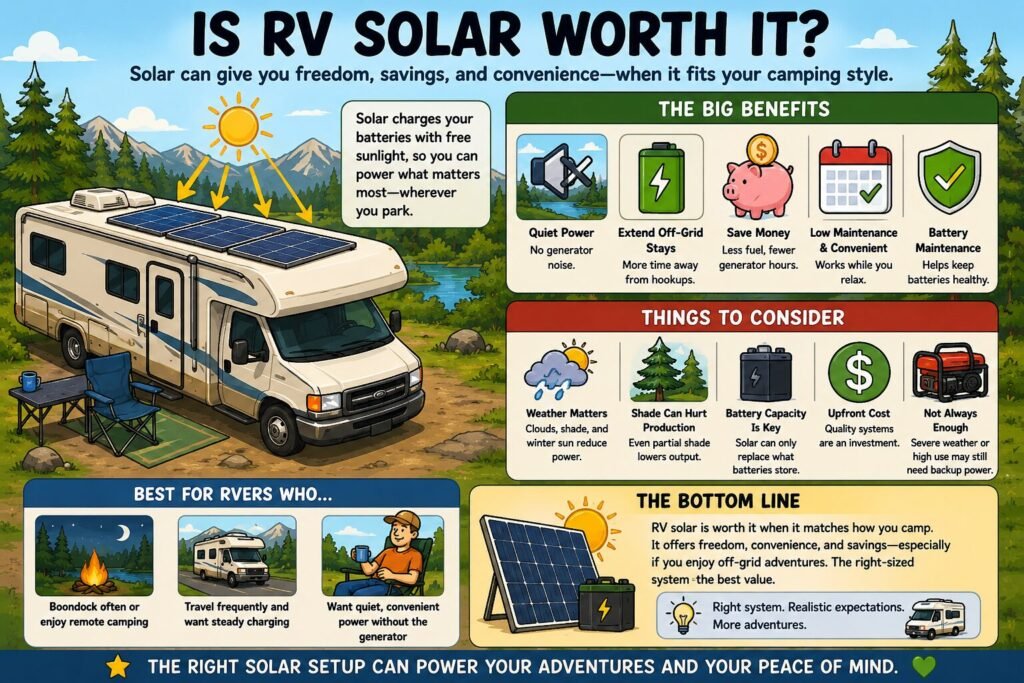
RV solar is worth considering when it matches the way the RV is actually used. It can reduce generator time, keep batteries charged during off-grid stays, and make it easier to camp without relying on electrical hookups.
For RVers who regularly boondock, solar can be one of the most useful upgrades available. It provides quiet charging during the day and can help support lights, fans, electronics, water pumps, refrigerators, and other everyday systems without constantly starting a generator.
Solar is also valuable for travelers who move frequently. Roof-mounted panels can continue charging while the RV is parked or traveling, which helps replace some of the energy used between stops. That steady background charging can make the battery bank easier to manage.
Another advantage is convenience. Once a properly designed system is installed, it requires less daily effort than a generator. There is no fuel to carry, no engine to start, and no noise to manage at the campsite.
Solar can also help maintain batteries while the RV is in storage, provided the panels receive enough sunlight and the system is set up correctly. This can reduce the chance of batteries sitting discharged for long periods.
The value of solar becomes less obvious for RVers who almost always stay at full-hookup campgrounds. When shore power is available every night, a large solar system may not provide enough benefit to justify the cost.
Budget matters too. A small system designed to maintain batteries or support basic loads can be relatively simple. A larger setup capable of running household appliances requires more panels, more battery storage, a larger inverter, heavier wiring, and more expensive charging equipment.
Solar does not completely replace other power sources in every situation. Several cloudy days, heavy shade, winter conditions, or high appliance use may still require shore power, alternator charging, or a generator.
The biggest benefit is freedom. Solar can extend the time an RV can remain away from hookups and reduce how often the batteries need to be charged by other methods. That can open more camping options and make remote campsites more comfortable.
The best way to decide whether RV solar is worth it is to compare the system cost with actual camping habits. Someone who boondocks often may use the system on nearly every trip, while someone who camps with hookups may get more value from a smaller setup.
RV solar is most worthwhile when it solves a real problem. If the goal is quieter charging, longer off-grid stays, fewer generator hours, or better battery maintenance, a properly sized system can be a very practical upgrade.
It becomes less worthwhile when expectations are unrealistic or the system is purchased only because solar sounds appealing. The right setup should be based on how the RV is used, not on installing the largest system possible.
Final Thoughts on RV Solar Basics
RV solar power becomes much easier to understand once the system is viewed as a group of parts working together rather than as panels alone. The panels collect energy, the charge controller manages it, the batteries store it, and the inverter makes that stored energy available to household-style appliances.
The most important part of planning an RV solar system is matching it to the way the RV is actually used. A weekend camper who mainly needs lights, fans, and phone charging does not need the same setup as someone running a residential refrigerator, working remotely, or boondocking for several days at a time.
More equipment is not always the answer. A balanced system with properly sized panels, batteries, wiring, charging equipment, and an inverter will usually perform better than a collection of large components that were not designed to work together.
Realistic expectations matter just as much as system size. Solar production changes with weather, shade, season, panel placement, and daily power use. Even a strong system may occasionally need support from shore power, a generator, or alternator charging.
For many RV owners, the goal is not to run every appliance without limits. The real benefit is keeping the batteries healthier, reducing generator use, extending off-grid stays, and making everyday camping more convenient.
Understanding these RV solar basics gives you a much better starting point for choosing equipment, comparing solar kits, or planning future upgrades. Once you know how the power moves through the system and where its limits come from, RV solar stops feeling like a complicated mystery and becomes another useful tool for camping with more freedom.
Learn More About Your RV Electrical System
Understanding RV solar is easier when you also know how the batteries, converter, inverter, and electrical system work together. These guides explain the other parts of the system in more detail.