
RV electrical systems confuse almost every new RV owner at first, especially when people start talking about an RV converter, inverter, batteries, shore power, solar panels, generators, and 12 volt appliances all at the same time. Many RV owners hear these terms constantly while camping, but very few people ever explain how the systems actually work together inside the RV. That confusion usually shows up the first time batteries suddenly die overnight, outlets stop working while boondocking, or appliances refuse to run the way people expect.
One of the biggest things that confused us early on was assuming the RV electrical system worked just like a normal house. The first few trips were full of little surprises. Some outlets worked while plugged into campground power, but stopped working while traveling. The lights and water pump still worked off the batteries, but the microwave and coffee maker didn’t. Then later we noticed the batteries were charging while plugged into shore power even though the inverter wasn’t turned on at all. Like many beginners, it took a while to realize the RV actually has two completely different electrical systems operating at the same time.
What makes RV electrical systems confusing is that the converter and inverter sound almost identical, yet they actually perform opposite jobs. One changes campground power into battery power while the other changes battery power back into household power. Once you understand that simple idea, a lot of the mystery surrounding RV electricity suddenly starts making sense.
This becomes even more important once RV owners start adding solar panels, larger battery banks, lithium batteries, or boondocking setups. Many beginners buy expensive electrical upgrades before fully understanding how power actually flows through the RV. That can lead to frustration, dead batteries, overloaded inverters, or appliances that still don’t operate the way they expected.
The good news is that RV electrical systems are far less intimidating once you break them down into simple parts. Understanding the difference between an RV converter vs inverter setup can help RV owners troubleshoot electrical problems faster, avoid common beginner mistakes, and feel much more confident whether camping at full hookup campgrounds or off-grid in remote areas.
What Does an RV Converter Do?
An RV converter is one of the most important parts of the RV electrical system, yet many beginners do not even realize it exists until something stops working. The main job of the converter is taking 120 volt AC power from shore power or a generator and converting it into 12 volt DC power that the RV can actually use for many of its everyday systems.
When your RV is plugged into campground power, the converter powers many of the 12 volt appliances and accessories inside the RV while also charging the batteries at the same time. Things like the RV lights, water pump, vent fans, furnace blower motor, slide-outs, control boards, and propane appliance igniters all rely heavily on 12 volt battery power to operate properly.
One thing that surprises many RV owners is that even while plugged into full hookups, much of the RV is still operating off the 12 volt system. The converter simply keeps supplying that power while also recharging the batteries in the background. That is why a bad converter can suddenly cause dim lights, weak slide motors, dead batteries, or propane appliances that stop functioning correctly even though the RV is still plugged into campground electricity.
We actually learned this the hard way during one trip when the RV was plugged in all weekend, yet the batteries slowly kept dying. At first it made no sense because shore power was connected normally and most things inside still seemed to work. Eventually we discovered the converter had stopped charging the batteries entirely. The RV was basically draining the batteries the entire time without us realizing it until the lights became dim and several systems started acting strange.
Converters are usually located near the breaker panel, fuse panel, or battery compartment depending on the RV layout. In many campers, the converter and fuse panel are built together into one power distribution center. Most RV owners rarely notice the converter until electrical problems begin showing up.
Modern RV converters are much smarter than older units. Many newer converters use multi-stage charging systems that help protect battery life by adjusting charging voltage automatically. Older converters often supplied constant voltage continuously, which could slowly damage batteries over time if the RV stayed plugged in for long periods.
Without a functioning converter, the RV battery system quickly becomes unreliable even when connected to shore power. That is why understanding what the converter actually does is such an important part of learning how RV electrical systems work.
Different Types of RV Converters
Not all RV converters work the same way, and this is something many RV owners do not realize until they start having battery problems. Older RVs often came with very basic converter systems, while newer RVs usually use smarter charging technology that does a much better job protecting batteries over time.
One of the most common older styles is called a single-stage converter. These converters continuously send the same charging voltage to the batteries whenever the RV is plugged into shore power. While they technically charge the batteries, they are not very efficient and can slowly overcharge batteries if left plugged in for long periods. This is one reason older RV batteries often dried out or failed sooner than expected.
Modern RVs more commonly use multi-stage smart converters. These systems automatically adjust charging voltage depending on the battery’s condition and charge level. During heavy charging, the converter supplies higher voltage to recharge batteries faster. Once the batteries become mostly full, the converter lowers the voltage to help prevent overheating and battery damage. This smarter charging process helps batteries last much longer and perform more reliably.
Another important change in recent years is lithium battery compatibility. Many older RV converters were only designed for traditional lead-acid batteries and may not properly charge modern lithium batteries. Since lithium batteries require different charging voltages and charging patterns, many RV owners upgrading to lithium eventually discover they also need a lithium-compatible converter to get the full benefit of the battery upgrade.
Some RVs also use converter/charger combination systems that combine the converter and battery charger into one unit. In many modern RVs, this entire system is built directly into the main power distribution center alongside the breaker and fuse panels. This helps simplify the RV electrical system while allowing the converter to manage both 12 volt power distribution and battery charging at the same time.
One thing many beginners do not realize is that a converter does far more than simply “charge batteries.” In many situations, the converter is actually powering much of the RV’s 12 volt system directly while also maintaining the batteries in the background. That is why converter problems can create strange electrical symptoms throughout the entire RV.
As RV electrical systems become more advanced with solar setups, lithium batteries, and larger inverter systems, converters have also become far more sophisticated. Understanding which type of converter your RV uses becomes increasingly important as you begin upgrading or troubleshooting the electrical system later on.
What Does an RV Inverter Do?
Not all RV inverters are the same, and understanding the differences becomes important once RV owners start adding solar systems, lithium batteries, or larger off-grid setups. Inverter size, power quality, and battery capacity all affect what appliances the RV can realistically run while camping without hookups.
One of the biggest differences is modified sine wave vs pure sine wave inverters. Modified sine wave inverters are cheaper and work fine for simple electronics like phone chargers or small TVs, but they can create problems with sensitive electronics, microwaves, residential refrigerators, CPAP machines, and some coffee makers. Pure sine wave inverters create cleaner household-style power and are generally considered the better option for modern RV setups.
Inverter size also matters a lot. Smaller 300 watt inverters are usually only designed for charging phones, laptops, cameras, or small electronics. A 1000 watt inverter can often handle televisions, gaming systems, and some small kitchen appliances. Larger 2000 watt inverters are very common in modern RVs because they can usually run microwaves, coffee makers, air fryers, and several smaller devices at the same time.
Once RV owners move into 3000 watt inverter systems, they can often power large portions of the RV while boondocking. Some larger setups can run residential refrigerators full time while also operating TVs, kitchen appliances, and multiple outlets simultaneously. The larger the inverter becomes, the more larger appliances it can safely run at the same time without overloading the system.
However, inverter size is only part of the equation. Even the largest inverter still depends completely on the battery bank supplying power to it. Large appliances can drain batteries surprisingly fast, especially high-draw appliances like microwaves, coffee makers, hair dryers, and induction cooktops. Many beginners focus heavily on inverter size while underestimating how important battery capacity actually is.
Some RVs also use inverter/charger combination systems. These combine both the inverter and battery charger into one integrated unit. When plugged into shore power, the system charges the batteries normally. Once shore power disappears, the inverter automatically switches over and begins supplying household power from the batteries.
Portable plug-in inverters are another common option. These smaller units are often used during travel days for charging laptops, cameras, or powering small electronics. While convenient, they usually cannot safely power larger RV appliances.
As solar power and boondocking continue becoming more popular, RV inverter systems are becoming far more advanced than they were only a few years ago. Understanding the different inverter types and sizes helps RV owners avoid overloaded systems, dead batteries, and expensive electrical mistakes later on.
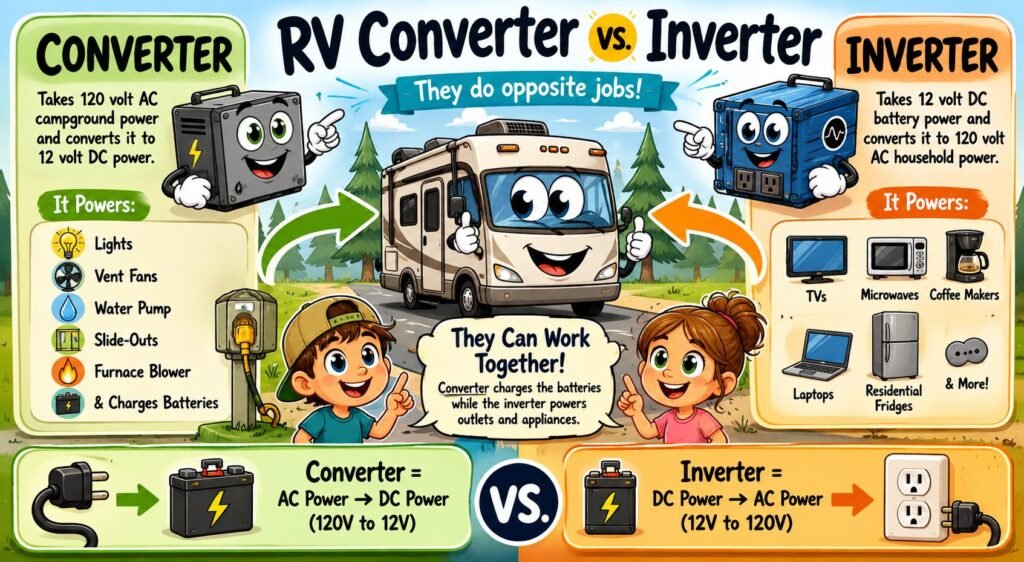
RV Converter vs Inverter: What’s the Difference?
One of the biggest reasons RV electrical systems seem confusing at first is because converters and inverters sound almost identical even though they perform completely opposite jobs. Many RV owners hear both terms constantly while camping, shopping for upgrades, or watching RV videos online, but very few people ever explain how these systems actually work together inside the RV.
A lot of beginners assume RV electricity works just like a normal house, so the first time certain outlets stop working while boondocking or the batteries suddenly die even while plugged into shore power, confusion starts quickly. In reality, the RV is constantly managing both 12 volt battery power and normal 120 volt household power at the same time.
An RV converter takes 120 volt AC campground or generator power and converts it into 12 volt DC power for the RV. This allows the RV to operate things like the lights, vent fans, water pump, furnace blower motor, slide-outs, tank monitors, and many appliance control boards while also charging the batteries in the background.
One thing that surprises many beginners is how much of the RV actually runs on 12 volt power. Even while plugged into full campground hookups, many systems inside the RV still rely heavily on the converter supplying 12 volt power throughout the coach.
An RV inverter works in the exact opposite direction. Instead of creating battery power, the inverter takes 12 volt battery power and converts it into normal 120 volt household power. This allows certain outlets and appliances to continue working even when shore power is unavailable.
That is what makes it possible to run televisions, laptops, microwaves, coffee makers, air fryers, residential refrigerators, and other household appliances while boondocking, driving, or camping off-grid. Without an inverter, most standard household outlets inside the RV would stop working anytime shore power or a generator was disconnected.
A simple way to think about it is that the converter changes campground power into battery power, while the inverter changes battery power back into household power. Once that basic idea clicks, the entire RV electrical system usually starts making much more sense.
What also confuses many RV owners is that converters and inverters can sometimes operate at the same time. While plugged into shore power, the converter may be charging the batteries while the inverter powers certain outlets or appliances inside the RV. In larger solar setups, converters, inverters, batteries, solar charge controllers, and generators may all work together as one integrated RV power system.
As RV electrical systems become more advanced with solar power, lithium batteries, and larger inverter setups, understanding the difference between converters and inverters becomes even more important. Once RV owners understand that both systems simply move electrical power in opposite directions, troubleshooting RV electrical problems becomes far less intimidating.
12V RV Appliances vs Household 120V Appliances
One thing that surprises many new RV owners is that RVs actually operate using two completely different electrical systems at the same time. Some appliances run on 12 volt DC battery power while others require standard 120 volt household AC power. Understanding the difference becomes very important once you start camping without hookups.
Most of the basic RV systems rely on 12 volt power. Things like the interior lights, vent fans, water pump, furnace blower motor, slide-outs, tank monitors, and many appliance control boards all operate from the batteries. Even many propane appliances still need 12 volt power to ignite and control their electronics properly.
Household-style appliances usually require 120 volt AC power instead. Things like microwaves, coffee makers, residential refrigerators, air fryers, televisions, hair dryers, and standard wall outlets typically rely on shore power, a generator, or an inverter system to operate.
This is one reason many beginners become confused when boondocking. The lights and water pump may continue working normally from the batteries, yet the microwave or kitchen outlets suddenly stop working completely. The RV itself still has power, but only the 12 volt system is operating unless an inverter is supplying household AC power.
Many modern RVs now include more 12 volt appliances because they are far more energy efficient for off-grid camping. Some newer refrigerators, televisions, water heaters, and even air conditioners are now designed specifically to operate directly from battery systems. These setups work especially well alongside solar power and lithium battery systems.
Household appliances usually consume far more power than most beginners expect. Running a microwave, coffee maker, hair dryer, or air fryer through an inverter can drain batteries surprisingly fast. This is why larger inverter systems often require larger battery banks and solar setups to support them properly.
Residential refrigerators are another major difference many RV owners notice. Traditional RV refrigerators often run primarily on propane while using only small amounts of 12 volt power for controls and fans. Residential refrigerators operate entirely on 120 volt household power, which means they rely heavily on shore power, generators, or large inverter and battery systems while traveling or camping off-grid.
Understanding which appliances use 12 volt DC power and which rely on 120 volt AC power is one of the biggest steps toward understanding how RV electrical systems actually function during everyday camping.
How RV Power Actually Flows Through the RV
Once RV owners understand the difference between a converter and inverter, the next step is understanding how power actually moves through the RV. At first the electrical system can seem complicated, but it becomes much easier once you break it down into smaller parts.
When the RV is plugged into shore power at a campground, 120 volt AC electricity enters the RV through the power cord and feeds the main breaker panel. From there, household-style appliances like air conditioners, microwaves, outlets, televisions, and residential refrigerators receive normal household power just like a house.
At the same time, the RV converter takes some of that campground power and converts it into 12 volt DC power. This powers the RV lights, water pump, vent fans, furnace blower, slide-outs, tank monitors, and many appliance control boards while also charging the batteries in the background.
When shore power is disconnected, the batteries take over supplying power to the 12 volt system. This is why lights, vent fans, water pumps, and many propane appliances can still operate normally while boondocking or traveling.
If the RV has an inverter installed, the inverter can then take battery power and convert it back into 120 volt household electricity for certain outlets and appliances. Smaller inverter setups may only power a few inverter-prepped outlets, while larger systems can operate much larger portions of the RV.
Generators work very similarly to campground shore power. When the generator is running, it supplies 120 volt AC power back into the RV’s breaker panel. This allows air conditioners, outlets, microwaves, and other household appliances to operate normally even without campground hookups. At the same time, the converter continues charging the batteries just like it would while plugged into shore power.
Solar systems add another layer to the process. Solar panels generate power that flows through a solar charge controller before charging the batteries. The batteries then supply power to the 12 volt system or feed the inverter when household power is needed off-grid.
Fuses and breakers also protect different parts of the system. Breakers protect the 120 volt AC side while fuses protect the 12 volt DC side. If the system becomes overloaded, breakers trip or fuses blow to help prevent wiring damage or electrical fires.
Once RV owners understand how shore power, generators, converters, batteries, inverters, solar panels, breakers, and appliances all work together, RV electrical systems become far less intimidating and much easier to troubleshoot while camping.
How Solar Power Fits Into RV Electrical Systems
Solar power is one of the fastest growing RV upgrades, especially for RV owners who enjoy boondocking or camping without hookups. However, many beginners misunderstand what solar panels actually do inside the RV electrical system.
One of the biggest misconceptions is thinking solar panels directly power household appliances. In most RV setups, solar panels primarily charge the batteries first. The batteries then supply power to the RV’s 12 volt systems or feed the inverter when 120 volt household power is needed.
The solar panels themselves generate electricity whenever sunlight hits them. That power flows through a solar charge controller before reaching the batteries. The charge controller helps regulate voltage and prevents the batteries from overcharging, similar to how an RV converter manages battery charging while plugged into shore power.
Once the batteries are charged, they become the main power source for off-grid camping. The batteries can run the RV’s 12 volt systems directly while also supplying power to the inverter for household appliances like microwaves, televisions, coffee makers, laptops, and residential refrigerators.
Battery capacity becomes extremely important in solar setups. Many beginners focus heavily on adding more solar panels, but the battery bank is often the real limitation. Even large solar systems may struggle to keep up with high-draw appliances like air conditioners, microwaves, hair dryers, or induction cooktops if the battery bank is too small.
This is why many modern boondocking setups combine solar panels, lithium batteries, large pure sine wave inverters, generators, and smart charging systems together. Each part of the system works together to manage and store power more efficiently while camping off-grid.
Generators are still very common even in solar-equipped RVs. During cloudy weather, heavy appliance use, or extended camping periods, generators often help recharge batteries much faster than solar alone can manage. Many larger RV setups use generators as backup power when battery levels become low.
Solar systems can range from small factory-installed trickle charging setups all the way to large roof-mounted systems capable of supporting extended off-grid camping. As solar technology continues improving, more RV owners are building larger battery banks and inverter systems to reduce generator use and camp longer without hookups.
Understanding how solar fits into the RV electrical system makes it much easier to plan future upgrades and avoid unrealistic expectations about what solar power can actually run while camping.
Common RV Converter and Inverter Problems
Many RV electrical problems that seem complicated at first actually come back to either the converter, inverter, batteries, or power flow between them. Once RV owners understand the basics of how these systems work together, troubleshooting becomes much easier.
One of the most common converter problems is batteries that slowly die even while plugged into shore power. This usually happens when the converter stops charging properly or a fuse inside the converter blows. Dim lights, weak slide-outs, slow vent fans, and propane appliances acting strange are also common warning signs of low 12 volt power.
Inverter problems often show up differently. Many RV owners first notice certain outlets suddenly stop working while boondocking or traveling. Other common symptoms include inverter overload alarms, appliances shutting off unexpectedly, or batteries draining much faster than expected while using household appliances.
Overloading the inverter is extremely common for beginners. Small inverter systems may handle televisions and phone chargers fine, but larger appliances like microwaves, coffee makers, air fryers, and hair dryers can quickly overload the system or drain batteries surprisingly fast.
Blown fuses and tripped breakers are another common issue throughout RV electrical systems. Breakers usually protect the 120 volt AC side while fuses protect the 12 volt DC side. A single blown fuse can sometimes disable lights, water pumps, slide-outs, or appliance controls unexpectedly.
Battery condition also affects both converters and inverters heavily. Weak batteries often create strange electrical symptoms that make RV owners think larger electrical components have failed when the real issue is simply low battery voltage or failing batteries.
Fortunately, many RV electrical problems turn out to be fairly simple once the basic power flow inside the RV starts making sense.
Final Thoughts
By this point, RV electrical systems probably make a lot more sense than they did at the beginning of the article. Once you understand how converters, inverters, batteries, shore power, generators, and solar systems all work together, many of the confusing electrical problems RV owners run into become much easier to understand.
The biggest takeaway is realizing that the RV is constantly managing both 12 volt battery power and normal 120 volt household power at the same time. Once that concept clicks, troubleshooting electrical issues and understanding future upgrades becomes far less intimidating.
Whether you eventually add solar, upgrade batteries, install a larger inverter, or simply want to avoid common electrical mistakes while camping, understanding these basic RV power systems gives you a much stronger foundation moving forward.
Learn More About RV Electrical Systems
Now that you understand how RV converters and inverters work, these guides will help you better understand the rest of your RV electrical system and avoid some of the most common power problems RV owners face.